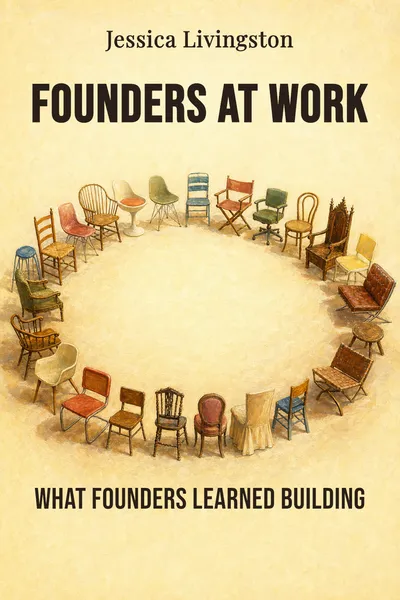
Founders at Work
What founders learned building
Description
Around 2005, Jessica Livingston was working at Y Combinator, the seed fund she had co-founded with Paul Graham and two others, and she kept noticing the same gap. The stories people told about famous startups were clean, retrospective, and mostly wrong. By the time a company was a legend, the founding had been smoothed into a myth: the genius, the garage, the inevitable rise. What she wanted was the version from before anyone knew how it ended — the version where the founders still sounded scared.
So she went and asked them. The result, published in 2007, was Founders at Work, a book of thirty-two interviews with people who had started technology companies: Steve Wozniak on the birth of Apple, Max Levchin on the near-collapses of PayPal, Mitch Kapor on Lotus, Caterina Fake on Flickr, Sabeer Bhatia on Hotmail, and a long list of others, some famous, some barely remembered. Livingston did almost no editorializing. She asked questions and let founders talk, at length, about what the early days had actually felt like.
What emerges is not a manual. It is closer to a chorus — dozens of voices describing the same messy stretch of time from different angles, agreeing on almost nothing about tactics and almost everything about temperament. The founders contradict each other on hiring, funding, and product. They sound uncannily alike on persistence. Which raises the question the book keeps circling without ever quite stating.
The question we’re asking : What do the people who built the companies we now treat as inevitable actually say about how they got built?What we’ll see : how a set of candid founder interviews replaces the origin myth with something rougher, more useful, and harder to copy.
Table of contents
01 Chapter 1 — A book made of thirty-two candid conversations
Livingston's method was almost aggressively simple. She sat down with founders, asked them to walk through the beginning, and stayed out of the way. There is no framework imposed from above, no chapter of takeaways, no attempt to rank the companies. The interviews run long and unpolished, and that is the point — the format is designed to catch the detail that a tidy retelling would sand off. The book reads less like business journalism and more like thirty-two people being honest with a friend who happens to be recording.
The lineup is deliberately uneven. Some subjects were canonical even in 2007: Steve Wozniak, who hand-built the early Apple machines while Steve Jobs handled the world; Mitch Kapor, whose Lotus 1-2-3 helped make the IBM PC worth owning. Others were mid-flight — the PayPal and Flickr people were recent enough that the wounds were fresh. And a few came from companies that had already been folded into something bigger or quietly forgotten, which turns out to matter, because those founders had less reason to perform.

02 Chapter 2 — The messy middle nobody put in the press release
The most valuable thing in the interviews is how bad things got, and how routinely. Max Levchin describes the company that became PayPal changing its business idea several times before it landed on moving money between people — and then nearly drowning under fraud that could have sunk the whole operation. The story most people know skips straight to the acquisition by eBay in 2002. Levchin's version is mostly about the eighteen months when it was entirely unclear the thing would survive at all.
Sabeer Bhatia's account of Hotmail is similarly stripped of glamour. He recalls being turned down by a long line of investors before Draper Fisher Jurvetson backed the free web-based email idea, and he recalls the strain of scaling to millions of users on infrastructure that was never designed for it. Microsoft bought Hotmail in late 1997. What Bhatia dwells on is not the payday but the grind of the year before, when the product's own success was the thing most likely to break it.
03 Chapter 3 — What actually made the difference
If the founders disagree about tactics, they converge hard on one trait: an almost unreasonable persistence. Nearly every interview contains a moment where quitting would have been the sensible choice and the founder simply didn't. Livingston does not dress this up as heroism. It reads more like stubbornness that happened to be pointed at the right target — a refusal to accept that the current disaster was the final word.
Alongside persistence runs a second theme, which is a willingness to be wrong quickly. The founders who lasted tended to hold their original idea loosely. PayPal became a payments company only after several other concepts failed. Flickr, in Caterina Fake's telling, emerged out of a game company that wasn't working, when the team noticed people cared more about the photo-sharing feature than the game itself. The instinct that mattered was noticing the thing that was working and abandoning the thing that wasn't, even when the thing that wasn't was the whole original plan.
04 Chapter 4 — The founder as the recurring character
Step back from the individual companies and the book starts to look like a study of a type. Read thirty-two of these conversations in a row and the products blur, but the person sharpens. There is a recognizable founder personality that recurs across eras and technologies: comfortable with uncertainty to a degree most people would find unbearable, attached to a problem more than to a plan, and possessed of a peculiar ability to keep functioning when the evidence says stop. Livingston never names this type outright, but the collection assembles a fairly precise portrait of it.
This is where Founders at Work quietly argues something bigger than any single interview. It suggests that the decisive variable in a startup is less the idea and more the founder's capacity to metabolize failure without quitting. The book was published as Y Combinator was building an entire investment thesis around exactly that belief — betting on people over pitches — and read that way, the interviews function as evidence for a worldview: that you fund the founder, not the plan, because the plan is going to change anyway.
05 Conclusion
The book Livingston set out to write was a corrective to bad storytelling, and it succeeds at exactly that. By handing the microphone to Wozniak, Levchin, Kapor, Fake, Bhatia and the rest, and then getting out of their way, she recovered the version of these companies that existed before anyone knew they would matter — the version full of rejection, near-death, and improvisation. The origin myth says the outcome was inevitable. The interviews say it very nearly wasn't, over and over.
Related books