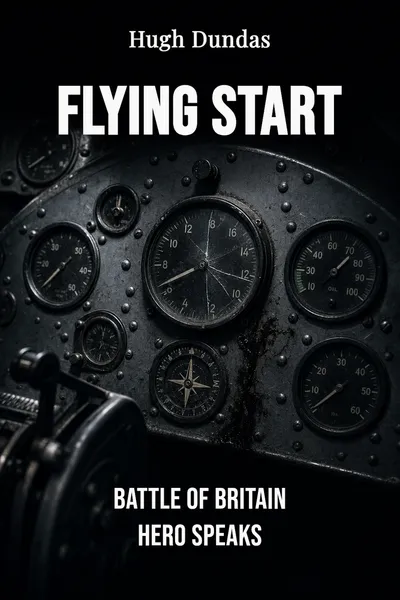
Flying Start
Battle of Britain hero speaks
Description
In the late spring of 1940, a nineteen-year-old named Hugh Dundas — Cocky, to almost everyone who knew him — had logged only a handful of hours in a Spitfire when he was thrown into the air over Dunkirk. He was tall, awkward in the cramped cockpit, and, by his own frank admission, half-terrified. Within weeks he had been shot down, bailed out, and come very close to dying before he had properly learned to fight. He was, in other words, exactly the kind of barely trained young man on whom the defence of Britain was about to rest.
Flying Start is Dundas's own account of that stretch of the war, written decades later by a man who had risen to Group Captain, collected a chestful of decorations, and outlived a great many of the friends who fill its pages. It is not a strategist's history of the Battle of Britain, nor a boastful ace's tally of kills. It is closer to something rarer: a candid record of what the fighting felt like from inside a single cockpit, by someone young enough to be frightened and honest enough, years on, to say so.
The book carries a peculiar double vision. There is the boy living it hour by hour, and there is the older man remembering, aware of who would not come home. That tension — between the exhilaration of flight and the steady erosion of the people around him — is what gives the memoir its weight, and what makes it more than a war story.
The question we’re asking : What did the air war of 1940 to 1945 actually feel like to one of the young men flying it, and what did living through it cost?What we’ll see : A pilot's war told from inside the cockpit — the terror, the friendships, the slow climb to command, and the strange quiet when it finally stopped.
Table of contents
01 Chapter 1 — A nineteen-year-old and a Spitfire he barely knew
Dundas came to flying the way many of his generation did: through the Auxiliary Air Force, a kind of weekend flying club for young men who wanted the thrill of it before anyone imagined a war would need them. He joined 616 Squadron in Yorkshire in 1939, a squadron of amateurs and enthusiasts who suddenly found themselves handed the most advanced fighter in the world and told to learn it fast. The Spitfire was beautiful and unforgiving. Getting one off the ground was one thing; fighting in it, at three hundred miles an hour with someone shooting back, was another entirely.
His first real taste of combat came over Dunkirk in the chaos of late May 1940, as the British army was being lifted off the beaches. He describes the confusion of it with disarming honesty — the difficulty of even finding the enemy, the way the sky could be empty one second and full of aircraft the next, the near-impossibility of telling friend from foe in the scramble. He was, he admits, largely useless in those first encounters, too green to be dangerous to anyone but himself.

02 Chapter 2 — The summer the sky filled with enemies
By the height of the Battle of Britain, in the late summer of 1940, the pattern of Dundas's days had settled into something both monotonous and unbearable: waiting at readiness, the sudden scramble, the climb to meet incoming German formations, the few violent minutes of combat, and then — if you were lucky — the return to an airfield where you counted who had come back. He captures the sheer physical strain of it, the exhaustion of flying several sorties a day, the way tiredness dulled the edge that kept men alive.
He is unsentimental about the fighting itself. There was little of the chivalry that later films would drape over it. Combat was fast, ugly, and largely a matter of who saw whom first. A pilot might loose off his guns at a fleeting shape and never know whether he had hit anything. The romantic image of duels between gentlemen airmen had almost nothing to do with the confused, adrenal reality of a dogfight, where the danger came from the aircraft you never saw.
03 Chapter 3 — From wingman to leading a wing
As the war ground on past 1940, Dundas's rise reflected a hard arithmetic: the pilots who survived became, almost by default, the leaders. Experience was scarce and precious, and a man who had lived through the first battles was worth more than a dozen fresh recruits. He moved from being one aircraft among many to leading a section, then a squadron, and eventually a whole wing — responsibilities that a peacetime air force would have handed only to much older men.
He is thoughtful about what leadership in the air actually meant. It was not about being the best shot. It was about judgement — knowing when to commit and when to hold back, positioning a formation so that it had the advantage of height and sun, and bringing as many of your people home as the fighting allowed. A good leader was measured less by his personal tally than by the survival of the men who flew behind him, and Dundas felt that weight keenly.
04 Chapter 4 — The Italian sky and the end of the shooting
The later part of Dundas's war carried him away from British skies to the Mediterranean and the long, grinding campaign up through Italy. The character of the fighting had changed. The desperate defensive battle of 1940 had given way to an Allied advance in which air power increasingly meant supporting the army on the ground — attacking positions, roads, and columns rather than duelling with enemy fighters overhead. The glamour, such as it had ever been, had largely gone; what remained was dangerous, workmanlike, and relentless.
By now Dundas was a senior figure, a Wing Commander and eventually a Group Captain, still remarkably young for the rank. He writes of the strange position of being an old hand in his early twenties, of watching new pilots arrive with the same rawness he had once carried, and of the effort to pass on what he had learned so that fewer of them would die learning it themselves. The apprentice had become the master, without ever quite feeling old enough for the part.
05 Conclusion
The book closes where its title points — at a flying start, the beginning of a life that the war both accelerated and hollowed out. Dundas went in a frightened nineteen-year-old tumbling out of a burning Spitfire and came out a decorated Group Captain, but he never lets the reader mistake the medals for the meaning. What he remembers most clearly are the faces at the breakfast table and the ones that stopped appearing there.
Related books