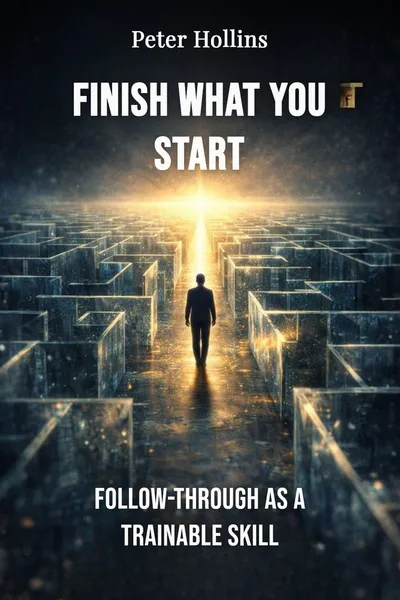
Finish What You Start
Follow-through as a trainable skill
Description
Somewhere in every home there is a drawer, a folder, or a hard drive full of things that were going to be great. The novel that stalled at chapter three. The side business with a logo but no second customer. The language app opened forty times and abandoned on lesson six. We are, most of us, excellent starters. A new project arrives with a clean burst of energy, we buy the gear, we clear the weekend, we tell a few people. And then, somewhere between the beginning and the end, the thing quietly dies. Not dramatically. It just stops.
Peter Hollins, who writes about human behavior and the mechanics of self-improvement, built a whole book around this specific failure — not the failure to begin, which we manage constantly, but the failure to arrive. His argument in Finish What You Start is oddly reassuring: follow-through is not a personality trait handed out at birth to disciplined people and withheld from the rest of us. It is a skill. It has parts. Those parts can be named, practiced, and rebuilt when they break, the same way you'd train a muscle or learn to parallel park.
That reframing matters more than it first appears, because it moves completion out of the realm of character and into the realm of method. If finishing is about willpower, then the people who don't finish are simply weak, and there's nothing to do but feel bad about it. If finishing is a technique, the conversation changes entirely. And that's where Hollins spends his pages — decoding what actually happens in the space between the exciting start and the unglamorous end, and what can be done to survive it.
The question we’re asking : Why are we so good at starting things and so bad at finishing them — and can that be changed on purpose?What we’ll see : How Hollins takes follow-through apart, names its moving parts, and rebuilds it as something you can train rather than something you either have or don't.
Table of contents
01Chapter 1 — The gap between wanting and doing
Hollins starts by refusing the comfortable explanation. When we abandon a project, we tend to say we lost motivation, as if motivation were weather — something that arrives and departs on its own schedule, leaving us to wait for its return. This, he argues, is the core mistake. Treating motivation as the engine of completion guarantees that most things go unfinished, because motivation is at its highest exactly when a project is new and at its lowest during the long middle stretch where the real work lives.
The gap he's interested in is the one between intention and action. We genuinely want the finished thing — the book, the fitness, the business. Wanting is easy and costs nothing. What breaks down is the daily conversion of that want into a small, specific, slightly boring behavior repeated when we don't feel like it. Hollins is blunt that the feeling almost never shows up on cue. The person waiting to feel ready is, functionally, the person who will never move.

02Chapter 2 — The mental architecture of follow-through
Before any system can work, Hollins argues, the mind has to be set up to tolerate discomfort — because completion is largely a matter of doing things that are dull, hard, or both, long after they've stopped being fun. He spends real time on what he calls the psychology underneath the behavior, and much of it comes down to how we relate to our own impulses. The finisher isn't someone who never feels the pull to quit; it's someone who has learned that the pull is not a command.
One of his central ideas is the deliberate cultivation of what might be called productive discomfort. We are wired to treat unpleasant sensations — boredom, frustration, the ache of effort — as signals to stop. Hollins reframes them as neutral, even as evidence that the work is happening. Learning to sit inside that discomfort without immediately reaching for relief is, in his telling, the mental skill that separates people who ship from people who circle forever. It's a form of tolerance you can raise gradually, like a threshold.
03Chapter 3 — The systems that carry you when motivation quits
Having dismantled the myth of motivation, Hollins needs something to put in its place — and his answer is structure. If you can't rely on how you feel, you build an external scaffolding that makes the right action easier than the wrong one, so that finishing depends less on daily heroics and more on decisions already made. The whole practical core of the book is a catalogue of these scaffolds, presented as tools rather than commandments.
Several recur. He's a strong advocate for shrinking tasks until they're almost embarrassingly small, because the enemy of follow-through is the moment of resistance at the threshold, and a tiny task barely triggers it. He champions the removal of friction — clearing the path to the desired behavior and adding obstacles to the tempting one, so that the environment does the willpower work you can't be trusted to do. He talks about implementation intentions, the simple practice of deciding in advance exactly when and where a task will happen, which quietly closes the loophole of deciding in the moment.
04Chapter 4 — When starting over becomes the real habit
Step back from the techniques and a larger stake comes into view, one Hollins gestures at throughout. The cost of not finishing isn't mainly the lost project. A stalled novel or an abandoned course is, in isolation, no tragedy. The real cost is cumulative, and it's paid in a currency he treats as the quiet center of the whole book: self-trust. Every abandoned thing is a small broken promise to yourself, and the promises add up.
This is why the appetite for fresh starts is so dangerous in his account. Beginning again feels virtuous — a new plan, a clean slate, renewed energy. But if the pattern is always to begin and rarely to arrive, then starting over is not a reset. It's the habit itself, and each new beginning teaches you a little more firmly that beginnings are what you do and endings are for other people. The drawer of unfinished things isn't just clutter; it's a record, and some part of you reads it.
05Conclusion
The book returns, in the end, to where it started: the ordinary experience of watching your own enthusiasm drain out of a project you genuinely wanted. Hollins's answer is not to chase the enthusiasm back — it isn't coming — but to build a way of working that no longer needs it. Follow-through, decoded into its parts, turns out to be a stack of trainable skills: tolerating discomfort, distrusting the rationalizations, shrinking the task, clearing the friction, finishing one thing before touching the next. None of it is glamorous, and that's rather the point.
Related books