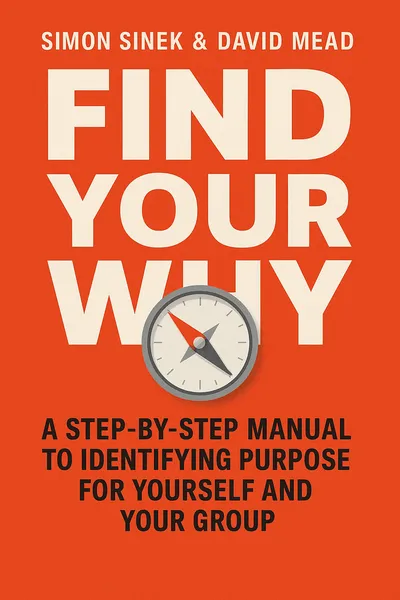
Find your why
A step-by-step manual to identifying purpose for yourself and your group
Description
Understanding your "WHY" is the cornerstone of motivation. This "WHY" is your deep-rooted purpose that fuels your actions and decisions. It's the essence of who you are at your best, shaped by your life experiences, lessons, and influences. When you comprehend your "WHY", it illuminates the "HOW" and "WHAT" of your actions, making it easier to navigate your day-to-day life in alignment with your purpose. This understanding not only inspires you to work but also brings fulfillment at the end of the day. While happiness is derived from "WHAT" you do, fulfillment stems from "WHY" you do it. Therefore, identifying your "WHY" is the first step towards a meaningful life, with the "HOW" and "WHAT" naturally falling into place thereafter.
The "WHY" is essentially your origin story, a culmination of your experiences, lessons, and influences. It represents you at your natural best and is revealed through specific stories and experiences that have shaped you. Knowing your "WHY" instills a passion for your work and a sense of contributing to something larger than yourself. It's the key to feeling inspired and fulfilled every day. As Simon Sinek, David Mead, and Peter Docker put it, "If we want to feel an undying passion for our work, if we want to feel we are contributing to something bigger than ourselves, we all need to know our WHY".
Table of contents
01 The power of why
Understanding the 'why' behind an organization's actions is as crucial as knowing the products or services it offers. This 'why' is often overlooked but is key to differentiating a company and building lasting relationships with customers who share similar values and beliefs. Organizations operate on three levels: what they do, how they do it, and why they do it.
Typically, when meeting a new customer, the focus is on the 'what', such as "We sell paper at the best possible price." This approach, which emphasizes features and benefits, doesn't inspire emotions or build loyalty. In contrast, leading with 'why' you do what you do can create emotional connections and foster loyalty. For example, saying "Our company was established to help spread ideas from one person to another. We make paper for people to share their ideas," appeals to those whose values align with yours, encouraging them to do business with you repeatedly, even if another vendor offers a better price.

02 How to discover your why
Understanding your "WHY" is essential as it brings passion into your endeavors, distinguishes entrepreneurs, directs employees towards their next career move, strengthens team bonds, and provides organizations with energy and direction. To discover your WHY, there are three steps that are universally applicable, whether you are an individual, a team leader, or at the helm of a large organization.
The first step is to collect and share stories that show you at your best, essentially your origin story. You should reflect on your most influential experiences, pinpoint defining moments in your life and career, and revisit the details of experiences that have shaped you. It is often helpful to work with a facilitator or partner who can help you objectively identify the common thread in your most influential and formative stories.
03 Why discovery for individuals
Discovering your personal WHY is a profound journey that delves into the core of what motivates and drives you. It's a quest to uncover the unique purpose that propels your actions and decisions. This exploration is not a solitary endeavor; it benefits greatly from the involvement of a trusted partner. This individual should be someone who can offer a balanced mix of closeness and objectivity, providing a perspective that is often elusive when you try to go it alone.
The role of this partner is akin to a mirror, reflecting back to you the patterns and themes that emerge from your life stories. They are there to listen attentively, to probe with thoughtful questions, and to help you sift through the river of your past, much like one would pan for gold. Your WHY is often deeply entwined with your origin story, which is a tapestry woven from your formative experiences, personal preferences, beliefs, and values. Crafting a WHY statement is an art that captures the essence of who you are when you are at your best. However, reaching that level of self-understanding can be a formidable challenge without the right perspective. This is the value that a partner brings to the process. They are not there to dictate or lead but to facilitate your self-discovery by listening to your stories, spotting recurring themes, and asking questions that dig deeper, all while remaining neutral and supportive.
04 Why discovery for teams and groups
Creating a workable WHY statement for a team, group, or company is a collaborative effort that hinges on the participation of all members to unearth a shared purpose, cause, or belief. The objective is to distill and inspire without complicating matters. This discovery process is best conducted as a workshop rather than one-on-one discussions, necessitating a facilitator to steer the process, extend invitations, and manage all subsequent actions.
The chosen facilitator should be someone the organization trusts, maintains an emotional detachment, possesses a natural curiosity, and is committed to guiding the process without being an active participant. Authentic WHY statements emerge through discovery rather than being artificially constructed.
The initial step involves selecting a facilitator and equipping them with the necessary understanding of the WHY discovery process, including an analysis of examples from other organizations. The facilitator's role is to foster an environment conducive to open dialogue. The workshop itself should be structured into five key segments: establishing the context, engaging in three distinct conversations, and formulating a draft of the WHY statement. Each conversation delves into different facets: the pride felt within the organization, the contributions made to others, and the effects of these contributions. Following these dialogues, participants work together to draft a WHY statement that is approximately 80% complete, allowing for refinement and enhancement over time.
05 Link why with how
Articulating a compelling "WHY" statement is foundational, but the "HOW" and "WHAT" are equally vital for a balanced and practical approach to achieving your purpose. The "HOW" represents your natural strengths, and the "WHAT" encompasses your tangible actions, which together translate your beliefs into practice. While the "WHY" can be aspirational, the "HOW" and "WHAT" must be grounded in practicality and realism.
The "HOW" serves as your recipe for success, describing the actions needed to bring your themes to life. To identify your "HOWs," narrow your themes to about five that resonate with you and encapsulate what your organization stands for. For each theme, state your "HOWs" and add context to illustrate how they will manifest in practice. For instance, if your theme is "Integrity," a "HOW" might be "Always tell the truth," and the context could be "When faced with a difficult situation, I will prioritize honesty."
06 Share your why with others
Discovering your WHY and articulating your HOWs are essential first steps on a purposeful journey. The true value comes when these concepts are brought to life and shared with others. Living your WHY means consistently aligning your actions with your beliefs. If your actions contradict your words too often, you risk losing the trust of others.
Once you've developed your WHY statement and clarified your HOWs, you may know what you want in detail, but sharing it might still feel uncomfortable. Like any other skill, sharing your WHY requires practice and the ability to adapt your WHY statement to suit your audience. For example, if your WHY statement is "I inspire people to do the things which inspire them, so together we can change the world," it could be expressed differently depending on the audience. One way could be "I work with leaders to build inspiring organizations that put people first.
Related books