
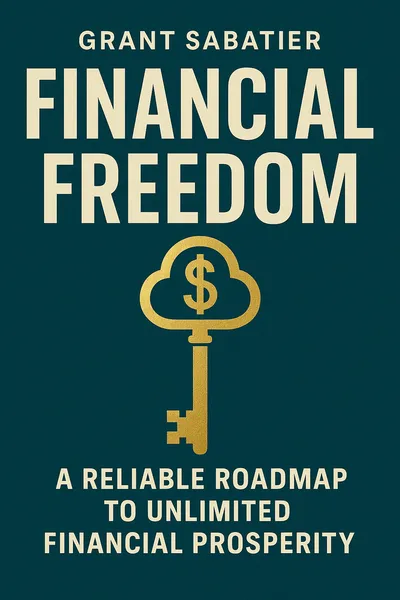
Financial freedom
A reliable roadmap to unlimited financial prosperity
Description
Grant Sabatier's journey from a mere $2.26 to over $1.25 million in five years epitomizes the essence of financial freedom: the liberty to use your time as you please.
Contrary to conventional wisdom that emphasizes frugality and managing scarce resources, Sabatier advocates for a mindset shift towards generating more wealth. He underscores the unlimited potential to earn, juxtaposed with the finite nature of time, urging individuals not to squander it but rather to leverage money as a tool to purchase time.
This perspective challenges traditional narratives around work, saving, and retirement, proposing an alternative approach focused on maximizing both financial resources and personal freedom.
Table of contents
01 Determine your financial freedom number
Financial freedom is a subjective concept, varying from person to person. It is crucial to define what it means to you and determine the amount of money you need to achieve it. This is your "number". The concept of financial freedom is not absolute, and there are no right or wrong answers. Retirement planning is an inexact science, and your definition of financial freedom may change over time due to changes in personal circumstances and tastes.
Ultimately, the amount of money you need for retirement depends on the lifestyle you wish to lead. It's beneficial to consider that there are six generic levels of financial freedom, starting from level 1. The goal is to structure your personal finances to progressively move to higher levels. The younger you start, the less money it will take due to the power of compound interest. The more you can invest earlier, the faster your money will grow, significantly impacting your retirement planning.

02 Assess your current financial situation
Understanding your net worth is a crucial step towards financial freedom. It serves as your financial scorecard, calculated by adding up all your assets and subtracting your liabilities. With modern technology, it's feasible to monitor your net worth on a weekly basis. However, it's important to note that your net worth is not your 'number', which is the amount of money you need to invest to generate sufficient income for future living expenses.
Your net worth includes this 'number' and other assets that may not generate income. Debt, naturally, is a hindrance to your net worth, and it's advisable to pay off the debt with the highest interest rate first. However, it's also important to be smart about debt; sometimes maintaining a mortgage at a lower interest rate and investing that money for a higher return is more beneficial than paying off the mortgage completely. Tax advantages of home ownership should also be considered.
03 Change your mindset about money
Adopting a transformative approach to your financial habits involves embracing a new mindset that prioritizes both saving and earning more for your financial independence. Grant Sabatier encapsulates this perspective aptly by highlighting that every purchase entails not just spending dollars but also trading away your time and future potential value. This viewpoint urges you to assess every expenditure as a trade-off for freedom.
To make more informed decisions about your spending, it's essential to consider the true cost of everything you buy—or refrain from buying—and use that to determine its worth. This entails being mindful of your real hourly rate, factoring in your work hours, daily commute, and time spent preparing for work. When contemplating a purchase, it's crucial to ask yourself probing questions: How much joy or satisfaction will this item bring me? What effort do I need to put in to afford it? How many hours of my life am I exchanging for this?
04 Replace budgets with a focus on savings
Budgets, while often touted as the cornerstone of personal finance, can inadvertently foster a scarcity mindset, according to Grant Sabatier. He argues that the granular focus on small purchases, which are relatively insignificant in the larger financial picture, can lead to unnecessary guilt and stress. Instead, Sabatier suggests focusing on boosting savings rates and maximizing returns on time. He recommends aiming to save at least 20% of income each month by reducing the three largest expenses: housing, transportation, and food.
By doing so, individuals can afford smaller expenses that enhance their lifestyle without guilt. For instance, housing, which accounts for about 33% of the average American's weekly budget, can be reduced through strategies like moving to a cheaper home, renting out spare rooms, or house-sitting.
05 Strategically use your 9 to 5 job
Regardless of your feelings towards your job, it can be a strategic tool to expedite your journey towards financial freedom. Understanding your market value and earning what you're worth is crucial. Consider your full-time job as a stepping stone to financial independence, and strive to extract every possible benefit from it. As Grant Sabatier suggests, optimizing your full-time job is vital to increase your income and achieve your financial goals in the shortest time possible. Although working for someone else may not be the fastest route to wealth, it offers numerous benefits that self-employment does not. Even if your ultimate goal is to be self-employed, it's wise to fully utilize your current job until you can realize this dream without financial worries.
To make the most of your job for financial freedom, employ three short-term strategies: maximizing your benefits, securing regular raises, and continually researching your value. Fully utilize all benefits offered by your employer, including insurance and tax-advantaged savings programs. Negotiate for additional perks like remote work, extra vacation time, transportation support, and reimbursements for after-hours work. Regularly request raises, using data about your peers' salaries and the revenue you generate for the company as justification. Continually research your value and seek ways to increase it, such as acquiring new skills and pursuing ambitious positions within your company.
06 Start a profitable side hustle
Starting a profitable side hustle has never been easier. By working for yourself, you can grow your side hustle to cover all your living expenses and more, accelerating your journey to financial freedom through multiple revenue streams. A side hustle not only provides an additional income but can also be an enjoyable endeavor. Every dollar earned reduces the time it will take to reach your financial goals. There are two main approaches to a side hustle: one that requires your active involvement and one that generates passive income.
The latter is ideal, as it allows you to have a standalone business that you can work on during your free time, aligning with your personal passions and generating income without constant hands-on involvement. This is a positive step towards early retirement. Even semi-passive ventures like blogging, where you write once and get paid repeatedly, are beneficial. A side hustle also offers tax benefits, as many expenses can be deducted if you can prove your intent is to make money. Consider setting up a limited liability company (LLC) to keep your side hustle organized and trackable.
07 Invest as early and as often as possible
To expedite your journey toward financial freedom, leveraging the power of compound interest is paramount. Invest as much as you can, as early and consistently as possible. Your investment portfolio should be built on the foundation of three reliable types of investments: stocks, bonds, and real estate.
Successful investing involves several key steps:
1. Distinguish between long-term and short-term investing. Allocate your funds to certificates of deposit (CDs) or bonds for short-term gains, while considering stocks, bonds, and real estate for long-term investments.
2. Assess your investment capacity and aim to consistently increase your investments over time.
3. Define your target asset allocation based on your financial goals and risk tolerance. For instance, if retirement is more than a decade away, consider allocating 100% of your portfolio to stocks, gradually transitioning to bonds and cash as retirement approaches.
Related books