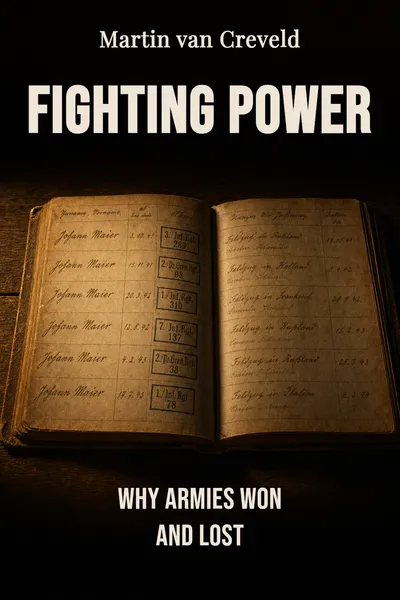
Fighting Power
Why armies won and lost
Description
In 1980, a historian named Martin van Creveld sat down to answer a question most military histories skirt around. Not who had more men, more tanks, more oil — the Allies had all of that, and won. The harder question was narrower and more uncomfortable: unit for unit, man for man, which army actually fought better? He landed on a number that made a lot of people wince. Drawing on earlier work by the American analyst Trevor Dupuy, van Creveld argued that on the Western and Italian fronts of the Second World War, German soldiers consistently inflicted more casualties than they took — that a German division was, roughly, about fifty percent more effective in combat than the Allied divisions facing it. The side that lost the war had, by this measure, been the better fighting force.
That claim is the spine of Fighting Power, the book van Creveld published in 1982 comparing the German and American armies of 1939 to 1945. It's an awkward thing to sit with. The Wehrmacht served a monstrous regime, was starved of fuel and reinforcements, fought outnumbered in the sky and increasingly on the ground, and still, tactically, punched harder than the army that beat it. Van Creveld's point isn't to admire the losers. It's to separate two things we usually blur together: winning a war and fighting well. They are not the same, and the gap between them is where the interesting stuff lives.
So he set the two armies side by side and looked past the headlines — past the beach landings and the strategic bombing and the industrial output — down into how each one was actually built. How it picked officers, formed units, replaced its dead, punished and rewarded, decided who fought next to whom. The word he uses for what comes out of all that is Kampfkraft: fighting power. And the story of where it comes from is stranger, and more human, than the tank counts suggest.
The question we’re asking : If the Germans fought better man for man, what were they doing differently — and why didn't it save them?What we’ll see : Two armies pulled apart to the level of how they raised, wired, and held together the men who did the fighting.
Table of contents
01 Chapter 1 — Two armies, one measuring stick
Van Creveld's first move is to refuse the easy explanations. The Allies won, and it is tempting to reason backwards: they won, so they must have been better at the thing that matters. But strategy, logistics, and sheer material weight explain the outcome of the war without saying much about what happened when a company of infantry met another company of infantry in a Norman hedgerow. Those are different questions living in the same book, and most histories collapse them into one.
To keep them apart, he needed a way to measure combat performance that didn't just count who was left standing at the end. He leaned on the work of Trevor Dupuy, who had crunched hundreds of Second World War engagements and tried to isolate a 'score effectiveness' — how much damage a force did relative to its size, its position, whether it was attacking or defending. Dupuy's finding, which van Creveld adopts and builds on, was that German units outperformed British and American ones by a wide and consistent margin, on the order of fifty percent, across a range of situations, whether winning or losing, attacking or dug in.

02 Chapter 2 — The German way of building a unit
The German army van Creveld describes was organized, above almost everything else, around the fighting group as a living thing. Its doctrine, running back through the nineteenth-century General Staff, treated combat as inherently chaotic — a domain where plans dissolve on contact and no order from the rear can anticipate what a junior officer will face. The response was to push decision-making down. A lieutenant, sometimes a sergeant, was expected to grasp his commander's intent and then improvise toward it without waiting for permission. This is the famous Auftragstaktik, mission-type orders: you're told what to achieve, not how, and you're trusted to figure out the rest.
Trust of that kind has to be manufactured. Van Creveld shows how the Germans engineered it through cohesion. Where possible, men were recruited, trained, and sent to the front in units drawn from the same region, and — crucially — the wounded were returned to their original units rather than reshuffled into whichever formation was short of bodies. A soldier fought alongside men he had trained with, whose faces he knew, under officers who had come up with him. The unit was a home you returned to, not a slot you were plugged into.
03 Chapter 3 — The American way of managing a war
The United States Army built its soldiers on a different philosophy, and van Creveld traces it to a different picture of what an army fundamentally is. Where the Germans saw a fighting organism, the Americans of 1939–45 tended to see a vast production system — a problem of moving men, materiel, and expertise efficiently toward an output. The dominant metaphor was managerial, drawn from the industrial and corporate culture that had made the country rich. The army was, in a sense, run like a giant firm, and it was extraordinarily good at the things firms are good at.
The trouble was that some of the practices that make a firm efficient corrode a fighting unit. The most damaging, in van Creveld's account, was the individual replacement system. American casualties were made good not by rebuilding whole units but by feeding in replacements one at a time — anonymous men shipped forward alone to formations of strangers, often arriving at night, sometimes killed before anyone learned their names. Statistically it kept divisions at strength. Humanly it dissolved the very cohesion that the Germans had gone to such lengths to protect.
04 Chapter 4 — What holds men in the fight
Step back from the two armies and Fighting Power reads as an argument about where combat effectiveness actually comes from — and the answer van Creveld keeps arriving at is unfashionably human. Not weapons, not numbers, not doctrine on paper, but the social bonds inside a unit: whether a soldier fights beside people he knows and won't abandon, whether he trusts the man giving orders, whether the group he belongs to feels worth dying for. Men in combat, the evidence suggests, endure terror less for country or cause than for the few others in the hole with them. Fighting power is, at bottom, the organized production of that willingness.
That reframes what a military institution is for. Everything upstream — recruitment, training, how the wounded are returned, how officers are chosen, how replacements are handled — is really a set of levers that either build or dissolve small-group cohesion. The Germans, van Creveld argues, had for reasons of history and design gotten better at pulling those levers, and it showed everywhere the fifty percent showed. The Americans had built a machine optimized for a different and, in the largest sense, more decisive kind of excellence.
05 Conclusion
Van Creveld set out to explain a number that embarrasses the winners: unit for unit, the beaten German army fought harder than the American one that beat it. His answer was that fighting power isn't in the equipment or the order of battle but in how an institution raises, wires, and holds its men together — and that the Germans, for reasons older than the regime they served, had simply built the better machine for producing men who kept fighting. The Americans built a different machine, superb at everything except the thing he was measuring, and it won the war anyway.
Related books