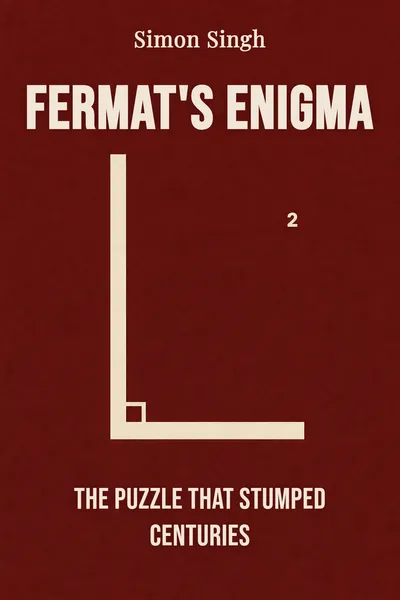
Fermat's Enigma
The puzzle that stumped centuries
Description
Sometime around 1637, a French magistrate named Pierre de Fermat was reading a Latin edition of an ancient Greek text on arithmetic. In the margin, next to a problem about squares, he scribbled a note. Whole numbers can satisfy the equation a squared plus b squared equals c squared — that's just Pythagoras, the three-four-five triangle every schoolchild meets. But raise the power any higher, Fermat claimed, and no whole numbers work at all. No cubes, no fourth powers, nothing. And then the sentence that would torment mathematics for the next three and a half centuries: he had found a truly marvelous proof of this, which the margin was too narrow to contain.
Fermat died in 1665 without ever writing that proof down. What he left was a taunt disguised as a footnote — a claim so simple a teenager could understand it, and so hard that the sharpest minds of every generation after him would break against it. Euler cracked one case. Sophie Germain, forced to correspond under a man's name, cracked a whole class of them. Prizes were offered, fortunes wasted, careers spent chasing a phantom. The theorem sat there, unproven and undisproven, for over 350 years.
Then, in June 1993, a quiet English mathematician at Princeton named Andrew Wiles stood up at a conference in Cambridge and, at the end of a three-day series of lectures, wrote Fermat's statement on the board and said he had proved it. He had been working in secret, alone, for seven years. The room erupted. And then, a few months later, something went badly wrong.
The question we’re asking : How did a scribble in a book margin survive three and a half centuries of the best mathematics could throw at it — and what did it finally take to close it?What we’ll see : We follow the enigma from Fermat's margin through the mathematicians it defeated, into the attic where one man risked everything to answer it, and out the other side to what the whole saga says about how mathematics really gets done.
Table of contents
01Chapter 1 — A margin too small
The problem is deceptively friendly. Take the equation x to the n, plus y to the n, equals z to the n. When n is 2, solutions pour out — 3 squared plus 4 squared equals 5 squared, and infinitely many others. Fermat's Last Theorem says that the moment you push n to 3 or higher, the whole numbers dry up completely. There is no cube that splits neatly into two other cubes, no fourth power that splits into two fourth powers, and so on forever. That's it. That's the entire claim. You can explain it to a curious child in under a minute, which is a large part of why it drove people mad.
Fermat himself was an amateur in the best sense — a lawyer and judge in Toulouse who did mathematics for pleasure and rarely bothered to publish. He had a habit of announcing results in letters and margins and leaving the proofs to others, often as a kind of challenge. Most of his claims were eventually verified, which is what gave the marginal note its terrible authority. If Fermat said he had a proof, mathematicians were inclined to believe him. So the hunt was not just for an answer but for his answer, the marvelous argument the page couldn't hold.

02Chapter 2 — Three centuries of near misses
The first real dent came from Leonhard Euler, the most prolific mathematician who ever lived, who around 1770 proved the case for n equals 3 — no cube is the sum of two cubes. Fermat himself had effectively handled n equals 4. But this was the frustration in miniature: because any higher power is a multiple of some prime, proving the theorem meant proving it for every prime exponent, one at a time, forever. Knocking out 3 and 4 left an infinity of cases standing.
In the early 1800s, Sophie Germain made the first assault on whole families of cases at once. She had taught herself mathematics from her father's library during the French Revolution, and because the academic world was closed to women, she corresponded with the great Carl Friedrich Gauss under the male pseudonym Monsieur Le Blanc. When Gauss eventually learned the truth, he was full of admiration. Her work opened a strategy that carried the theorem forward for a class of primes and stood as one of the most significant advances for a century.
03Chapter 3 — Seven years in an attic
Andrew Wiles first met the problem as a ten-year-old in a Cambridge library, and the idea that something so simple to state had defeated everyone lodged in him and never left. He grew up, became a respected number theorist, and mostly set the childhood dream aside as the kind of thing serious people don't chase. Then, in the 1980s, the ground shifted. Other mathematicians showed that Fermat's Last Theorem would follow from something called the Taniyama–Shimura conjecture — a deep and seemingly unrelated claim linking two vast areas of mathematics, elliptic curves and modular forms. Prove that conjecture, and Fermat fell out as a consequence.
Almost nobody thought Taniyama–Shimura was provable. But it gave Wiles a legitimate mountain to climb, one that happened to have his childhood dream at the summit. So he did something almost unheard of in modern mathematics: he told nearly no one, withdrew from the usual round of collaboration, and worked in near-total secrecy in the attic study of his home. Colleagues assumed he had simply run dry, since he had stopped publishing. In fact he was spending every spare hour, for seven years, building a proof piece by painstaking piece.
04Chapter 4 — The proof that had a hole in it
The triumph did not survive the summer intact. Any proof of that magnitude must be checked line by line by other experts before it counts, and as the referees worked through Wiles's manuscript, one of them found a gap. It was not an obvious blunder — it was a subtle failure in one step of the argument, a place where a crucial quantity could not be controlled the way the proof assumed. For a while it looked minor. It was not. The hole threatened to bring the whole structure down, and everyone, Wiles included, could see it.
What followed is the part of the story that says the most about how mathematics actually works. Wiles did not fix it in a flash of solitary genius. He struggled publicly, painfully, for over a year, the world now watching after all. He eventually brought in a former student, Richard Taylor, and the two of them wrestled with the flaw together. For months it refused to yield, and Wiles came close to conceding defeat. Then, in September 1994, he had the insight — that an approach he had abandoned years earlier could be combined with the method that had failed, and the two together closed the gap exactly. He later described it as the most beautiful moment of his working life.
05Conclusion
The scribble in the margin turned out to be right — no cubes, no fourth powers, nothing above the square. It took 358 years, an English mathematician willing to gamble a decade of his career in secret, a former student, a rescued dead end, and the pooled inheritance of everyone the problem had ever beaten. Andrew Wiles received his honors, and the oldest open question in mathematics finally closed. The story ends where the field almost never lets one end: with a clean, definitive answer.
Related books