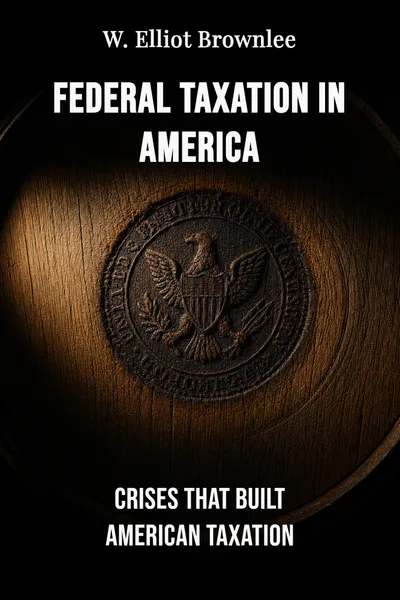
Federal Taxation in America
Crises that built American taxation
Description
In the summer of 1794, farmers in western Pennsylvania took up arms against a tax on distilled spirits — the first internal tax the young federal government had dared to levy. Alexander Hamilton, who had designed the tax to fund the national debt, rode west with a militia of nearly 13,000 men to put down what became known as the Whiskey Rebellion. The rebels scattered before any real battle. But the episode set a pattern that W. Elliot Brownlee traces across two centuries: in America, the power to tax has almost never been granted willingly. It has been extracted under pressure, in moments when the alternative looked worse.
That is the argument running through Brownlee's history of federal taxation, from the Revolution to the present. The country did not build its fiscal machinery through steady, rational reform. It built the machinery in bursts, each one tied to an emergency the government could not fund any other way. War was the great engine. So was the near-collapse of the Union, and later the strain of running a superpower. Each crisis produced not just new taxes but a whole new logic of who pays, how much, and on what — a settlement that outlasted the emergency that created it.
What makes the story more than a ledger of rates is the way these settlements hardened into something durable. Taxes introduced as temporary wartime measures kept running long after the guns fell silent. Systems sold as fair to one generation became the baseline the next generation argued over. To follow American taxation is to watch a reluctant republic repeatedly discover that it could reach deeper into its citizens' pockets than it had ever imagined — and then decline to let go.
The question we’re asking : How did a country founded on tax revolt come to accept one of the most far-reaching fiscal systems in the world?What we’ll see : How successive American crises each forged a new and lasting settlement over who pays, and why those settlements refused to disappear once the emergency passed.
Table of contents
01 Chapter 1 — What the Revolution taxed, and what it feared
The American republic was born out of a fight over taxation, which left it permanently ambivalent about the thing. The colonists' grievance was never that taxes existed — colonial assemblies levied plenty. It was that Parliament taxed them without their consent. "No taxation without representation" was a claim about legitimacy, not a wish to pay nothing. But the slogan carried a suspicion that would shadow the new nation's finances for a long time: that a distant government reaching into local pockets was, almost by nature, a threat to liberty.
That suspicion nearly sank the country before it started. Under the Articles of Confederation, the central government could not tax at all; it could only ask the states for money, and the states mostly declined. Brownlee shows how this fiscal helplessness — a treasury that could not pay the Revolutionary War debt or even its own soldiers — was among the strongest arguments for scrapping the Articles. The Constitution of 1787 handed Congress a real taxing power, and that grant was one of the document's most contested features.

02 Chapter 2 — The Civil War invents a federal reach
The emergency arrived in 1861. The Civil War cost sums that tariffs could not begin to cover, and the Union government, facing a war for its survival, reached for instruments no peacetime Congress would have touched. Within two years it had enacted the first federal income tax in American history, a graduated levy that eventually rose to 10 percent on higher incomes, alongside a sprawling internal revenue system of excises on nearly everything — liquor, tobacco, manufactured goods, legal documents, professional licenses.
Brownlee treats this as a genuine rupture, not a mere spike in spending. To collect these new taxes the government created, in 1862, the office of the Commissioner of Internal Revenue — the ancestor of the modern IRS — and with it a permanent administrative apparatus reaching into the economy in ways Hamilton's excises never had. For the first time, the federal government asked citizens to disclose their incomes and taxed them progressively, on the principle that those with more should pay a larger share. That principle, once introduced, was hard to unlearn.
03 Chapter 3 — The wars that made the income tax normal
The Sixteenth Amendment, ratified in 1913, finally put the income tax beyond constitutional challenge, and Congress promptly enacted a modest one. At first it touched only the wealthy — a small percentage of households paid anything at all. Brownlee frames this early income tax as a deliberately class-based instrument, championed by progressives and Southern and Western Democrats who saw it as a way to shift the burden away from consumption taxes that fell hardest on the poor and toward concentrated wealth and corporate profits.
The First World War transformed it. To fund American entry, Congress raised the top rates dramatically and expanded the reach of the tax, so that by 1918 it was producing revenue on a scale that dwarfed the prewar system. Brownlee calls the settlement that emerged "soak-the-rich" taxation: highly progressive, aimed at war profits and large fortunes, and justified by the shared sacrifice of wartime. The 1920s saw Treasury Secretary Andrew Mellon roll back the top rates, but the structure survived, and the income tax was now a fixture rather than an experiment.
04 Chapter 4 — Regimes, not just rates
The most useful idea Brownlee offers is that American taxation should be read not as a rising or falling line of rates but as a sequence of distinct "tax regimes" — whole settlements about who pays, on what basis, and under what justification. Each regime, he argues, was forged in a national emergency, stabilized afterward, and then governed the country for decades until the next crisis cracked it open. The tariff regime of the nineteenth century, the progressive income-tax regime of the world wars, the mass-tax regime born of 1943: these are not just policies but political orders, each with its own coalition and its own moral story about fairness.
This reframing explains why tax reform is so hard and so rare. Regimes persist because they build constituencies — industries protected by a tariff, taxpayers accustomed to a deduction, a government dependent on a revenue stream it cannot easily replace. Changing rates is ordinary politics. Changing a regime requires a shock large enough to dislodge all of that at once, which is why the genuine turning points cluster around wars and near-catastrophes rather than election cycles.
05 Conclusion
Return to Hamilton on horseback, riding west to enforce a tax on whiskey. The scene captures the whole arc Brownlee traces: a government that wanted revenue, citizens who resisted it, and an emergency that decided the matter. Every major expansion of federal taxation followed that shape — the Civil War, the two world wars, the fiscal crises of the 1980s. None of it came from a calm decision that the country ought to tax itself more. It came from moments when the republic faced something it could not otherwise survive or win.
Related books