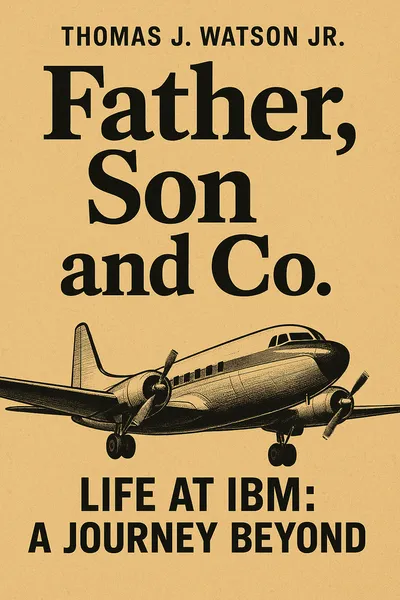
Father son and co.
Life at ibm: a journey beyond
Description
"Terrible Tommy," the oldest son of IBM's founder, was notorious for his mischievous childhood antics in Short Hills, a small town near New York. His father, Thomas Watson Sr., rose from humble beginnings, starting his career selling pianos and sewing machines from a wagon. He later joined a struggling company, Computing-Tabulating-Recording (CTR), which he transformed into the successful IBM. Despite his business acumen,
Thomas Sr. was a disaster in domestic settings, leaving most household chores to his wife. Meanwhile, their son, Thomas Jr., struggled acadically but developed a passion for flying. Despite his lackluster performance in school, Thomas Jr. was expected to join and eventually lead IBM, a prospect that seemed unlikely given his interests and abilities.
Table of contents
01 Terrible tommy's antics
In Short Hills, 20 miles from New York, locals called the IBM founder's eldest son "Terrible Tommy" for his mischief. Notably, he poured skunk essence into the school's air conditioning, causing an evacuation. His father, Thomas Watson Sr.

02 Thomas sr.'s early struggles
Thomas Watson Sr. rose from selling pianos and sewing machines to becoming a pivotal figure in IBM's history. Starting his career at 17, he experienced early failures, including a butcher shop venture, before excelling in sales at NCR under John Henry Patterson.
03 Domestic mishaps and ambitions
While establishing his business, Thomas Sr. left domestic duties to his wife, who managed the household and children. After a fire incident due to his inexperience, household roles were clearly divided.
04 Thomas jr.'s unlikely succession
Thomas Jr. knew his father expected him to take over the family business, but he felt unsuited for the role. His interest lay in the machine room, captivated by the punch card machines used for record-keeping.
05 Ibm's stability during the depression
During the Great Depression, IBM, led by Tom Sr., defied economic downturns by increasing production and stockpiling inventory, anticipating future demand. This strategy paid off when the Social Security Act of 1935 spiked the need for IBM's machines, making the US Government their biggest client.
06 Tom jr.'s university life
While studying at Brown University, Tom Jr. lived a carefree life, unaware of his true wealth from a trust fund set up by his father, Tom Sr., with IBM stock.
Receiving a modest allowance, he focused on flying, which boosted his confidence. Tom Sr., meanwhile, networked with notables like the Rockefellers and President Roosevelt, becoming his close friend and supporter.
07 Tom sr.'s wealth and criticism
In 1936, IBM's Thomas J. Watson Sr., despite criticism for his high salary, reduced his profit share as the company prospered.
His son, Tom Jr., focused on studies at university, distancing himself from distractions. Tom Sr.
08 Ibm's pre-war international relations
In 1937, the International Chamber of Commerce met in Berlin, promoting "World Peace Through World Trade" and hoping to prevent war through commerce. Tom Sr, after meeting Hitler, mistakenly believed he was not war-seeking, a view he later recanted. Meanwhile, Tom Jr visited war-engulfed Peking, causing his father's alarm, but his discreet presence and gift purchases made him favored among local merchants.
09 Tom jr.'s sales training challenges
IBM's sales school in Endicott, New York, was a comprehensive program where Tom Watson Jr., despite trying to blend in, was always recognized as the founder's son. The two-year training, with summers spent as junior salesmen, aimed to familiarize trainees with punch-card machines, crucial to IBM's revenue.
10 Tom jr.'s early sales career
After graduating from sales school, Tom Jr was assigned a lucrative territory in Manhattan, including Wall Street. Despite attributing his success to his father, Tom Sr, Tom Jr excelled in IBM's sales strategy, which involved demonstrating products and offering business surveys for automation with punch cards. IBM rented out machines, ensuring steady cash flow.
11 Tom jr.'s quick military transition
In 1940, Tom Jr. hit his sales target for the year on the first working day with a large order from U.S.
Steel, joining IBM's Hundred Percent Club. Despite his success, he felt unfulfilled and considered leaving IBM. His path changed when he became a military aviator later that year.
12 Tom jr.'s military service insights
Tom Jr. was appointed as an assistant to General Follett Bradley, who led the First Air Force. He quickly recognized the general's exceptional leadership and aviation skills.
13 Ibm's role in world war II
IBM punch cards were crucial for the U.S. military, used for record-keeping and code-breaking.
Beyond punch cards, IBM also produced military equipment like machine guns and gas masks. Under Tom Sr.'s leadership, IBM dedicated two-thirds of its capacity to military production, insisting on only a 1% profit to avoid war profiteering.
14 Tom jr.'s post-war ibm return
In 1946, Tom Jr. resumed his career at IBM, learning the business by shadowing executive vice-president Charley Kirk. This period coincided with IBM's expansion, repurposing wartime production for punch-card machines and boosting sales.
15 Tom sr.'s management techniques
Tom Sr. had a hands-on approach to managing his company, often holding impromptu meetings with employees to either praise or criticize their work, a method he called "parting their hair." He was particularly hard on the finance team, challenging them with unpredictable questions that required extensive reports.
16 Ibm's united nations involvement
Tom Sr. passionately supported the United Nations, leveraging IBM's headquarters for U.N.
events, which enhanced public relations and helped secure global government contracts. Similarly, Tom Jr. engaged with business leaders through the American Society of Sales Executives, gaining valuable industry insights.
17 Ibm's international expansion plans
In 1948, Tom Sr. of IBM planned to split the company, giving domestic operations to his elder son, Tom Jr., and international to his younger son, Dick, through IBM World Trade.
18 Ibm's initial computer skepticism
In the late 1940s, IBM's Tom Sr. underestimated the potential of computers like ENIAC, viewing IBM as a punch card company. In 1947, he directed his team to build a super calculator, leading to the Selective Sequence Electronic Calculator with interchangeable software.
19 Tom sr. And jr.'s friction
Despite being in his mid-seventies by 1950, Tom Sr. continued working full-time at IBM, which had an annual turnover of over $140 million. He encouraged his son, Tom Jr.
, to seek more power within the company. Tom Sr.'s cautious approach to business, shaped by the depression, favored reinvesting profits and avoiding debt, yet he ensured substantial dividends to shareholders through issuing additional shares instead of cash payouts.
20 Ibm's early computer success
IBM's Defense Calculator, later the IBM Model 701, was initially underestimated at $8,000 monthly rental but was still in demand when revised to $12,000-$18,000. Concurrently, IBM's commercial IBM Model 702 rivaled UNIVAC, securing 50 orders within eight months. IBM's batch processing origins evolved through the SAGE defense project, leading to real-time processing capabilities.
21 Ibm's sales-driven growth
In the mid-1950s, IBM capitalized on the growing corporate demand for computers by hosting educational seminars and leveraging its sales force, focusing more on sales strategies than technical innovation. By 1956, IBM led with 87 operational computers and continued to innovate, introducing new models and memory core technology. The company also supported computer science education by donating a computer to MIT and developed the computer disk.
22 Ibm's antitrust settlement
In January 1956, IBM resolved an anti-trust lawsuit by agreeing to license its punch-card technology and sell its machines, besides its rental offerings. Despite this, IBM had already foreseen the decline of the punch-card industry, making the agreement less impactful. A few months later, in May, Tom Watson Jr.
23 Ibm's organizational overhaul
IBM restructured in the mid-20th century, adopting a staff-and-line model to delineate responsibilities. Employees previously began in sales before moving to management, but the new system separated operational staff with specific goals from a corporate staff providing support. Performance metrics varied between these groups, with operational success measured by unit results and staff by their global contribution.
24 Tom sr.'s business philosophy
Tom Sr believed entrepreneurs should act concerned to motivate their team, a value passed to Tom Jr, who shaped IBM's culture around respect, customer satisfaction, and excellence. Tom Jr's leadership program taught IBM's ethics to new hires, involving top management visits. He spent days weekly on employee relations and customer engagement.
25 Ibm's system / 360 launch
By 1961, IBM had achieved an impressive annual revenue of $2.5 billion. Out of the 6,000 computers in the United States at that time, IBM had manufactured over 4,000.
This was the first time that the company's revenue from computers surpassed that from punch-card machines. IBM World Trade was also performing well, with a turnover of $350 million and a growth rate that was double that of IBM's domestic operations. IBM was one of the few American companies that could take advantage of the significant economic recovery happening in Europe.
26 Ibm's growth and antitrust issues
In April 1964, IBM made a grand announcement of the System/360 in 63 American cities and 14 international cities. The company was on the brink of a new era, but Tom Jr. was apprehensive as the equipment hadn't undergone as much testing as he would have preferred.
Initially, a surge of orders came in, making the new system appear promising. However, issues arose, including the necessity to introduce two additional computers to counteract strategies from competitors like Control Data and General Electric at the extreme ends of the System/360 range. The system software was also becoming overwhelmed, and at one point, IBM had over 2,000 people working solely in this area.
27 Ibm's system / 360 challenges
In 1965, IBM faced a crisis with its System/360 project, struggling with software delays and poor machine quality, alongside a shocking $600 million in work-in-progress inventory.
28 Ibm's market dominance
In 1965, IBM was a top U.S. industrial corporation, growing nearly 30% annually due to the System/360's success.
By 1967, it surpassed General Motors in stock market value. However, a 1969 Justice Department anti-trust lawsuit against IBM's total system sales practice led to a major pricing strategy shift, requiring separate pricing for hardware, software, and services. This, along with a recession, reduced IBM's growth to 5% in 1969-1970.
29 Tom jr.'s departure from ibm
By 1970, IBM, led by Thomas Watson Sr. and Jr., was a global behemoth with $7 billion in annual revenue.
As one of America's most successful corporations, it stood tall internationally. Post a heart attack, Tom Jr.'s zest for adventure led him to resign in June 1970, handing IBM's reins to Vin Learson, marking the first non-Watson CEO.
Related books