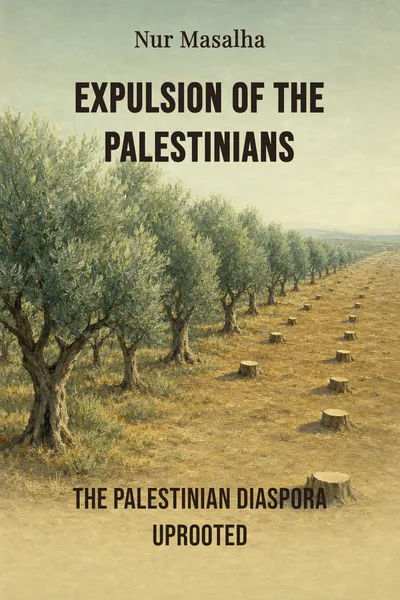
Expulsion of the Palestinians
The Palestinian diaspora uprooted
Description
Nur Masalha, a Palestinian historian who spent years teaching religion and politics at St Mary's University in London, set himself a deliberately narrow task in his 1992 book Expulsion of the Palestinians. He did not write about 1948, the war and the flight of roughly 700,000 people that Palestinians call the Nakba. He stopped before it. His subject was the three decades that came first — the years between the Balfour Declaration of 1917 and the eve of the war — and one idea that circulated through Zionist politics during them. The Hebrew word was transfer. In plain terms, it meant moving the Arab population of Palestine somewhere else.
The book's argument rests almost entirely on internal sources: diary entries, private letters, committee minutes, memoranda that were never meant for the public. Masalha was not interested in what leaders said at congresses or told British commissions. He was interested in what they wrote to each other when they thought no one outside the room was listening. From that material he built a case that the idea of moving Palestine's Arabs was not a fringe fantasy but a recurring, seriously debated proposition among mainstream figures — including some whose names now belong to airports and highways.
That claim was, and remains, contested. Critics argued Masalha mistook speculation for policy, private musing for intent. Defenders answered that intent is precisely what private documents record. The dispute is not really about whether the word transfer was used — it plainly was — but about what its persistent presence in the paper trail is allowed to mean.
The question we’re asking : What did the idea of transferring Palestine's Arab population actually mean inside the Zionist movement before 1948, and how seriously was it entertained?What we’ll see : How a word moved from the margins of a movement into its committee rooms, and what a historian found when he read the private record instead of the public one.
Table of contents
01 Chapter 1 — A concept older than the state
The word Masalha tracks is transfer, and he insists on treating it as a term of art rather than a euphemism decoded after the fact. It appears in the sources in English and Hebrew alike, used matter-of-factly by people who felt no need to disguise it. His starting point is simple: a national movement that aimed to build a Jewish state in a land where Arabs were the large majority faced an arithmetic problem it could not wish away. Roughly nine in ten inhabitants of Palestine in 1917 were Arab. Sovereignty and a Jewish majority could not both be had unless something changed about who lived there.
Masalha argues that transfer was one of the answers considered, and that it surfaced early. He points to figures across the movement's spectrum — from the labor Zionism of the left to the revisionism of Vladimir Jabotinsky on the right — engaging with the notion in one form or another. Some framed it as voluntary, an economic migration that development would encourage. Others were franker about compulsion. What unites the citations, in his reading, is that removal of the Arab population was thinkable, and thought about, by serious people at the movement's center.

02 Chapter 2 — The 1937 turning point
The hinge of the book is 1937. In July of that year the Peel Commission, sent by Britain to explain the Arab revolt that had begun the previous year, recommended partitioning Palestine into a Jewish state and an Arab one. Almost as an aside, the report proposed something more drastic for the mixed populations of the two zones: an exchange of population, with Arabs moved out of the projected Jewish state. The commission cited the Greek-Turkish exchange of the 1920s as a precedent, treating the forced movement of hundreds of thousands as a settled tool of statecraft.
For Masalha, Peel changed the status of transfer. What had been an idea passed around privately now had the backing of a British royal commission, which meant it could be discussed as policy rather than fantasy. He documents the response inside the Zionist leadership with particular attention to David Ben-Gurion, then the movement's dominant figure. Ben-Gurion's diaries and letters from the second half of 1937, in Masalha's account, register enthusiasm — not for the small state Peel offered, but for the principle that a great power now endorsed removing the Arab population from it.
03 Chapter 3 — From transfer committees to war
What followed Peel, in Masalha's telling, was organization. The idea did not stay in diaries; it acquired institutional form. He documents the appearance of bodies within the Jewish Agency dedicated to studying the question — committees that gathered data on Arab villages, land, and possible destinations, and that debated the logistics of where a transferred population might go. Transjordan, Syria, Iraq: the sources weigh the options with the dry practicality of a planning exercise.
This is the part of the book its critics find most and least persuasive at once. The committees existed; the minutes are real. The question is what they signify. Masalha treats them as proof that transfer had graduated from speculation to preparation — that serious people spent serious time working out how it might be done. A more cautious reading holds that studying a possibility is not the same as committing to it, and that the plans never became policy in any binding sense before the war overtook everything.
04 Chapter 4 — What the archive refuses to soften
Step back from the specific claims and the method itself is the deeper subject. Masalha built his case by reading a movement through its own internal papers rather than its public statements — the letters, the diaries, the closed-door minutes. This is a particular kind of history, and it carries a particular argument about how national stories should be told. Founding narratives are usually written from the speeches, the declarations, the documents composed with posterity in mind. Masalha went to the other file: the one where people say what they mean because they assume no one else will read it.
The approach cuts against a comfortable habit. Every nation tends to remember its origins through its best-phrased intentions, and to treat the private record — where the calculations are colder — as either marginal or unfair to cite. Masalha's wager is the reverse. He treats the private register as the more honest one, on the reasonable ground that people reveal their aims more freely when they are not performing. Reading Zionism this way, he found a persistent line of thought that the movement's public face had every reason to keep quiet.
05 Conclusion
Masalha ended his book where the hardest history begins, on the eve of the 1948 war. He had spent three hundred pages establishing not what happened in that war but what had been thought, said, and quietly prepared in the decades before it — the recurring idea of moving Palestine's Arabs, its endorsement by the Peel Commission in 1937, and the committees that took the question up as a matter of planning. He left the flight and expulsion of 1948 to others, having supplied the intellectual prehistory they would have to reckon with.
Related books