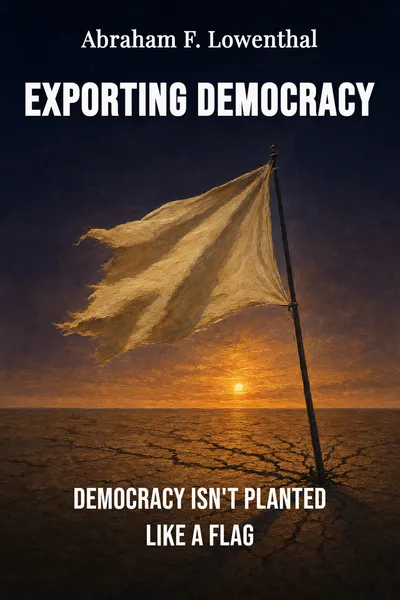
Exporting Democracy
Democracy isn't planted like a flag
Description
For most of the twentieth century, the United States acted on a conviction it rarely paused to examine: that it could plant democracy in other countries the way one plants a flag. Marines landed in the Caribbean, advisers turned up in Latin American capitals, aid was disbursed, elections were supervised, governments were made and unmade — all in the name of spreading self-government. Abraham F. Lowenthal, a scholar who spent decades on inter-American relations, brought historians together to put that record under one cold question. The volume he edited carried the title Exporting Democracy, and its subject was the long American experiment in Latin America, the place where the experiment ran longest and where the results could actually be counted.
The easy move is to settle the question in advance — Washington was either a benevolent tutor or a self-interested meddler. Lowenthal and his contributors refused both shortcuts. They went country by country, intervention by intervention, from the early 1900s through the Cold War, and asked something narrower and more uncomfortable: when the United States set out to promote democracy abroad, did democracy actually take root, and if it did, under what conditions? The answers came back less flattering, and a good deal more interesting, than either the cheerleaders or the critics had braced for.
That accounting hasn't aged into a museum piece. The instinct it picks apart — the belief that a powerful actor, standing outside a society, can engineer its inner political life — keeps coming back wherever ambition meets distance. Lowenthal's hemisphere is one long, patient test of how far that belief survives contact with the record.
The question we’re asking : When a powerful country sets out to export democracy, does it actually arrive — and what makes the difference between a system that takes root and one that collapses the moment the exporter looks away?What we’ll see : From the early Caribbean landings to the Cold War coups, then to the rare moments it worked — and finally to the reason the strongman so often outlasted the constitution the Americans left behind.
Table of contents
01 Chapter 1 — The instinct nobody questioned
The conviction came early and ran deep. From the moment the United States grew strong enough to throw its weight around the hemisphere, it assumed that the political form it had built at home was both the best on offer and, somehow, transferable. Woodrow Wilson is often remembered for promising, in roughly these words, to teach the South American republics to elect good men — a line that captures the spirit even if the exact phrasing is paraphrase. The condescension is obvious. What's easy to miss is that it expressed a genuine belief rather than a cynical cover. Washington kept acting as though democracy were a kind of cargo: deliver it, unpack it, switch it on.
Lowenthal's contributors insist that this belief be taken seriously before it's judged. The point isn't that American leaders were lying when they talked about self-government; many of them meant every word. The point is that the belief lived, often inside the same person, alongside strategic calculation, business interest, and a plain wish for a quiet southern flank. Democracy promotion was rarely the only motive and rarely the dominant one. It was the language a tangle of motives reached for.

02 Chapter 2 — What the record actually shows
The early Caribbean and Central American interventions are where the gap between intention and outcome yawns widest. In the Dominican Republic, in Haiti, in Nicaragua, U.S. forces arrived in the first decades of the century promising order, honest administration and the machinery of elections. They built roads, reorganized finances, trained constabularies, supervised votes. Then they left behind regimes that, more often than not, hardened into dictatorship. The Dominican constabulary the Americans professionalized became the very instrument Rafael Trujillo rode to power and held for three decades. The Nicaraguan guard did the same job for the Somoza family.
The contributors don't read this as an accident or a betrayal of good intentions. They read it as a pattern. The instruments an occupation reaches for — a centralized, well-armed security force, a streamlined administration — turn out to be exactly the instruments an ambitious strongman needs. When an outside power prizes order and a reliable local partner above all else, it ends up building the scaffolding of authoritarian rule while reciting the vocabulary of democracy. The exporter's tools and the exporter's stated goals were quietly working against each other.
03 Chapter 3 — The promotion that worked, and the conditions that made it
The book would be a flat indictment if the story stopped there. It doesn't. Lowenthal is careful to mark the periods when American influence genuinely helped democracy along, because the contrast is where the real lesson lives. The late 1970s and the 1980s, when human-rights concerns climbed nearer the center of U.S. policy, produced episodes of real, constructive support for democratic transitions across South America — pressure on military regimes, backing for civilian oppositions, a new willingness to deny dictators the embrace they wanted.
What separated the helpful interventions from the harmful ones wasn't the sincerity of the rhetoric, which stayed fairly constant throughout. It was the conditions on the ground and the shape the influence took. Where there was an existing tradition of competitive politics to revive, where local democratic forces were strong enough to do the actual building, and where American influence ran through diplomatic pressure and incentive rather than occupation and installed governments, the results held up. In those cases democracy wasn't so much exported as encouraged from outside while being constructed from within.
04 Chapter 4 — Why the strongman, and not the senate, kept surviving
The constabulary outlived the elections. That single recurring fact — the security force the Americans professionalized in Santo Domingo surviving long after the supervised vote was forgotten, then handing Trujillo his throne — carries the deepest claim in Exporting Democracy. What the United States could reliably build was the hardware of a state: a trained guard, a tidy treasury, a constitution on paper. What it could not build was the thing that makes a constitution more than paper — a shared sense that the government belongs to the governed.
The reason isn't a shortage of resources or resolve. Washington spent both lavishly across the hemisphere. The reason is structural, and the Nicaraguan case spells it out as clearly as the Dominican one. Legitimacy is a relationship between a people and its own government, and a third party standing outside that relationship cannot conjure it by decree. The more visibly the outsider does the building, the more it corrodes the very ownership that would let the structure stand. The guard the Americans gave the Somozas was efficient precisely because it answered upward, to a patron, rather than outward, to citizens.
05 Conclusion
Lowenthal opened with a phrase that doubles as a question — exporting democracy — and the book's achievement is to have made the phrase impossible to use innocently again. A century of American effort in Latin America, taken case by case, yields a record in which the act of intervening and the survival of self-government rarely line up. Democracy held where local conditions and local actors could carry it. The most useful American contribution was usually the lightest one: pressure, incentive, the withholding of support from a dictator, rather than a government delivered by force.
Related books