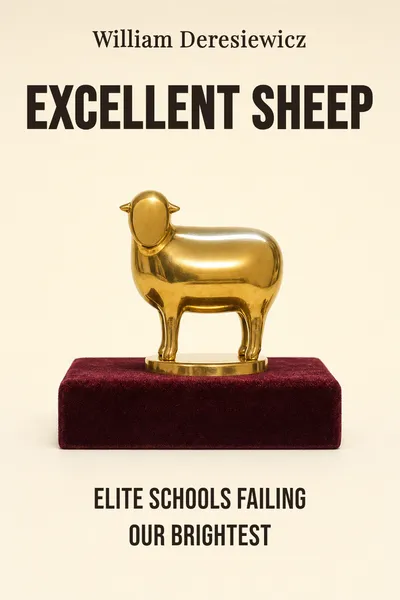
Excellent Sheep
Elite schools failing our brightest
Description
In 2008, after twenty-four years inside the Ivy League — a decade as an undergraduate and graduate student at Columbia, then ten years teaching English at Yale — William Deresiewicz sat on an admissions committee and watched a familiar type of applicant scroll past. Perfect grades. A wall of extracurriculars. Recommendation letters glowing with words like "leadership" and "passion." And, underneath the polish, something he had come to recognize in his own best students: a quiet panic, a sense that the machine they had mastered had never once asked them what they actually wanted. He wrote an essay about it. It went, in the language of the time, viral.
That essay became a book, published in 2014 as Excellent Sheep. The title is not gentle, and it isn't meant to be. Deresiewicz argues that America's most prestigious universities — Harvard, Yale, Princeton and the feeder prep schools that orbit them — have gotten extraordinarily good at producing a certain kind of young person: brilliant, accomplished, driven, and strangely hollow. Kids who can do anything, he writes, except tell you why. They arrive having spent eighteen years clearing hurdles set by other people, and they leave having learned mainly how to clear the next one, at Goldman Sachs or McKinsey or wherever the smart, anxious herd is running that year.
It is a harsh diagnosis, and it lands on the schools far more than on the students. Deresiewicz isn't sneering at the young; he taught them, he liked them, he watched them break down in his office. His quarrel is with an institution that promises to build minds and instead builds résumés — and with a whole class of parents, counselors and admissions officers who keep the treadmill running at full speed.
The question we’re asking : What are elite colleges actually manufacturing, if not the educated, self-possessed adults they advertise?What we’ll see : How a Yale insider came to see the country's finest schools as factories for anxious, aimless overachievers — and what he thinks an education was meant to do instead.
Table of contents
01Chapter 1 — The best-trained students in the world, and the most lost
Deresiewicz begins with a scene he knows from the inside: the office hours. Students would come to him not because a paper was late but because something was wrong, and they couldn't name it. These were not strugglers. They were the winners of the whole game — the ones who had never gotten a B, who ran three clubs and played a varsity sport and volunteered on weekends. And they were, a striking number of them, miserable. He describes a generation fluent in achievement and illiterate in desire, kids who could optimize any task handed to them but froze when asked what they might do with a free afternoon, let alone a life.
The word he keeps returning to is fragility. The system rewards a flawless surface, so the students learn to present one, and the cost is that they never develop the tolerance for failure that actual thinking requires. A single setback reads as catastrophe because they have been taught, relentlessly, that their worth is their record. Deresiewicz cites the surge in campus anxiety and depression not as an unrelated mental-health trend but as a symptom of the training itself: you cannot spend two decades performing for evaluators and emerge with a stable sense of who you are underneath the performance.

02Chapter 2 — How the machine sorts and shapes them
To understand the product, Deresiewicz turns to the factory. The modern admissions process, he argues, doesn't select for curiosity or character; it selects for the ability to game a process, and it does so from an obscenely early age. The well-off child is enrolled, tutored, coached and packaged years before the application is due. By the time the essay is written — often with professional help — the applicant has been engineered into a bundle of "achievements" precisely calibrated to what admissions officers reward. The system claims to find diamonds. Mostly it finds families that could afford the polishing.
He is unsparing about the parents. The pushy, terrified, hovering parent is, in his telling, a rational actor in an irrational arms race. When a spot at a top school feels like the difference between a secure future and a precarious one, the stakes justify any measure: the SAT prep at twelve, the strategically chosen sport, the summer "service" trip designed to look good on paper. Childhood becomes a portfolio under construction. The kids absorb the lesson perfectly — that they are what they can show — and carry it into adulthood.
03Chapter 3 — What college was supposed to be for
Against all this, Deresiewicz sets a nearly forgotten idea of what a university is. Not a career-services office with a library attached, but a place to build a self. The old liberal arts vision — which he defends without embarrassment — held that the point of education was to learn to think, to question inherited assumptions, to figure out who you are and what you believe before the world tells you. That takes solitude, it takes reading that has no obvious payoff, and above all it takes time that isn't being optimized toward the next line on a résumé.
He puts unusual weight on teaching, and on the relationship between a student and a professor who actually pays attention. Real education, he insists, is not the transmission of information — you can get information anywhere. It is the slow, personal work of one mind learning to reason under the guidance of another. This is exactly what the modern research university, with its star faculty rewarded for publishing rather than teaching and its lecture halls full of hundreds, has quietly stopped providing. The mentorship he received, and tried to offer, is being engineered out of the system.
04Chapter 4 — The manufacture of an elite
Step back from the anxious individual student and the book's larger target comes into view: this is a critique of how a democracy makes its leadership class. The students filing out of Harvard and Yale are not just private strivers. They are the future senators, judges, executives and columnists — the people who will run the country's institutions. And Deresiewicz's worry is that the selection machine that produces them is optimized for exactly the wrong traits. It rewards conformity, risk-aversion and the smooth management of appearances, then installs those habits at the top of every consequential organization in American life.
The deeper charge is that the word "meritocracy" has become a comforting lie. The system presents itself as an open competition of talent, which allows its winners to believe they earned their place fairly and owe nothing to anyone. But when the competition is rigged from the nursery in favor of families who can pay to win, the outcome isn't a natural aristocracy of ability — it's an old-fashioned hereditary elite that has learned to describe itself in the flattering vocabulary of merit. The self-congratulation is the most dangerous part, because it forecloses any sense of obligation.
05Conclusion
We come back to the office hours, and to the student who couldn't say what was wrong. Deresiewicz's book is, in the end, an attempt to name it for a whole generation: the sense that you have won every game put in front of you and still have no idea what you want. He traces that feeling back through the admissions machine, the anxious parents and the prestige-hungry schools to a single missing ingredient — an education that was supposed to help you build a self and instead helped you build a file.
Related books