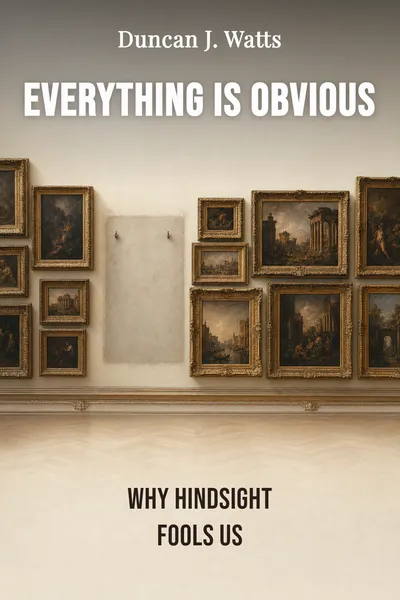
Everything Is Obvious
Why hindsight fools us
Description
On the night of August 21, 1911, a painting walked out of the Louvre under a workman's smock. Vincenzo Peruggia, an Italian handyman who had helped install protective glass on some of the museum's pictures, lifted the Mona Lisa off the wall, slipped it under his coat, and carried it home. For two years it sat in a trunk in his Paris apartment. When the theft was discovered, crowds came to the Louvre not to see the painting but to stare at the empty space where it had hung. Newspapers across the world ran the face on their front pages. By the time the picture was recovered in 1913, it had become something it had never quite been before: the most famous painting on earth.
We don't usually tell the story that way. We say the Mona Lisa is famous because Leonardo was a genius, because the smile is enigmatic, because the composition is perfect. All true, and all things that were equally true in 1910, when it was one admired Renaissance portrait among many. The sociologist and network scientist Duncan Watts uses the painting to make an uncomfortable point: once we know an outcome, we reverse-engineer reasons for it that feel airtight. The reasons sound like causes. They're really just the story we tell after the fact.
Watts spent years at Columbia and later at Microsoft and Yahoo studying how this trick of the mind shapes everything from marketing to military strategy. His argument in Everything Is Obvious is that common sense, the faculty we trust most to explain the social world, is precisely the faculty that misleads us most — because it works backward from results and dresses up accident as inevitability.
The question we’re asking : Why does almost everything in the social world look obvious in hindsight and stay unpredictable in advance?What we’ll see : How a thinker who studied networks and crowds came to distrust the explanations that feel most certain.
Table of contents
01 Chapter 1 — The Mona Lisa was not destined to win
Watts likes the Mona Lisa because it forces a choice. Either the painting is objectively, measurably the greatest portrait ever made — in which case we should be able to point to the qualities that put it above every rival — or its supremacy is partly an accident of history that we've since rationalized. He argues the second is closer to the truth. Plenty of paintings have enigmatic expressions and masterful sfumato. What the Mona Lisa had that they didn't was a theft, a two-year disappearance, and a global press hungry for a mystery.
The deeper problem is that we can't run the experiment again. We have one history, one timeline in which the painting was stolen and recovered and became iconic. We can't rewind to 1911 and check whether it would have risen to the same status without Peruggia. So we do the next best thing, which is also the worst thing: we look at the result and decide it was bound to happen. The fame becomes proof of the quality, and the quality becomes the explanation for the fame. The reasoning is a perfect circle.

02 Chapter 2 — The story common sense tells itself
Common sense feels like a reliable instrument because it almost never fails on the small stuff. We know not to stand too close in an elevator, how to read a room, when a joke will land. Watts is careful to credit this: common sense is extraordinarily good at navigating the everyday situations it evolved for. The trouble starts when we point the same faculty at large-scale questions — why a company succeeded, why a policy worked, why a city behaves the way it does — and assume it works just as well there.
It doesn't, and the reason is structural. To explain individual behavior, common sense reaches for motives and intentions. People did X because they wanted Y. That framing is fine for one person at a time. But social outcomes emerge from millions of people interacting, influencing each other, reacting to what everyone else does. The aggregate has properties no individual intended. Watts calls this the difference between explaining what someone did and explaining what a system produced — and common sense quietly swaps one for the other without noticing.
03 Chapter 3 — Why prediction keeps failing us
If common sense really understood the causes of social outcomes, it should be able to predict them. Watts treats prediction as the honest test of explanation, and by that test, our understanding is far shakier than it feels. Consider the 2007 surge in Iraq. Violence fell afterward, and the surge got the credit. But violence was already shifting for other reasons — the Sunni Awakening had turned against al-Qaeda, and sectarian cleansing in Baghdad had run much of its course. Untangling which cause did the work is nearly impossible, because we only ran history once. We saw the surge, we saw the decline, and common sense stapled them together.
The same difficulty haunts business. We pay CEOs as though their decisions move the fortunes of giant firms, and the heroic-leader story is everywhere in the press. Watts notes that the measurable effect of a chief executive on company performance is real but far smaller than the pay and the mythology imply. Much of what looks like brilliant leadership is the firm riding industry tides, market timing, and accumulated advantage that no individual created. When things go well we credit the captain; when they go badly we fire the captain — and the next quarter often looks much the same.
04 Chapter 4 — What we owe to luck, not logic
Step back from the painting, the surge, the CEO, and a single mechanism connects them: hindsight reshapes how we hand out credit and blame. Once we know who won, we comb the past for the qualities that made them deserve it, and we comb the loser's past for the flaws that doomed them. The winner becomes a genius, the loser a cautionary tale. But Watts's whole argument is that the same qualities were present in cases that went the other way. We're sorting on the outcome and pretending we sorted on the cause.
This has consequences well beyond getting history wrong. It distorts how we reward people. If a fund manager's stellar year was mostly a favorable market, paying for skill we can't actually detect means overpaying for luck. It distorts how we learn. If we study only the successes and reverse-engineer their secrets, we'll keep finding patterns that the failures shared too — survivorship bias dressed as wisdom. And it distorts policy, because a surge that gets undeserved credit becomes a template that fails the next time the contingencies don't line up.
05 Conclusion
Vincenzo Peruggia was caught in 1913 trying to sell the painting to a Florentine dealer, served a short sentence, and faded into obscurity. The picture went back to the Louvre more famous than any work of art had ever been, and we've spent the century since explaining its supremacy in terms of genius alone — quietly editing the theft out of the story, because a smile is a better cause than a burglary.
Related books