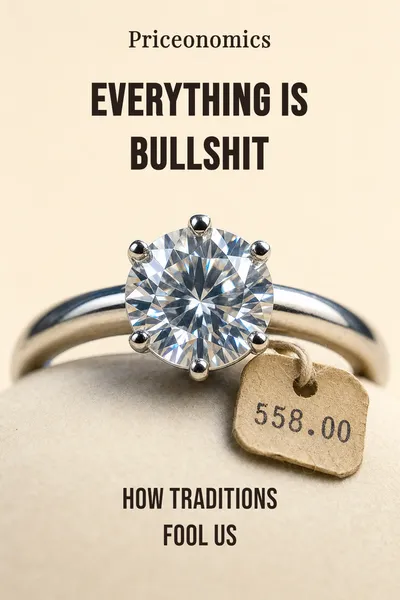
Everything Is Bullshit
How traditions fool us
Description
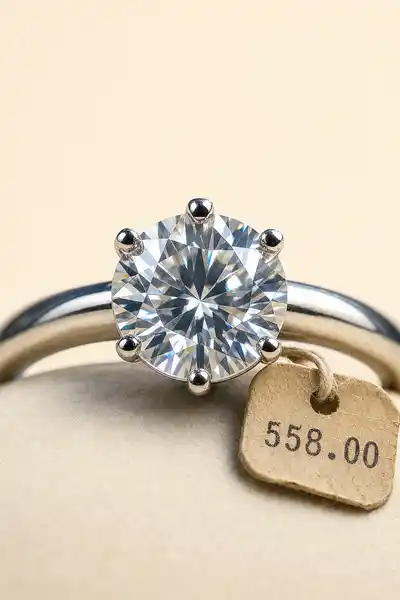
Somewhere around the moment a couple gets engaged, a quiet piece of arithmetic kicks in: the ring should cost about two months' salary. Nobody remembers being told this exactly, and nobody thinks to ask where the figure came from. It just feels correct, the way a lot of things we do feel correct — the diamond, the white dress, the cereal for breakfast, the tie knotted for no reason anyone can name. We treat these as inheritances, worn smooth by generations, older than us and therefore wiser than us.
The book Everything Is Bullshit, written by the team behind the research blog Priceonomics, takes those inheritances apart one by one, and the pattern it finds is uncomfortably consistent. The two-month rule wasn't handed down by grandparents. It was written by an advertising copywriter at N.W. Ayer, working for the diamond cartel De Beers, sometime in the twentieth century. The engagement diamond as a mass ritual barely predates 1938. What looks like a custom turns out, again and again, to be a campaign — the residue of a company that needed to sell something, or a reformer with a cause, or a historical accident that simply never got corrected.
That's the through-line worth following. Not that any single tradition is silly — plenty are pleasant, and knowing the origin doesn't force us to abandon it. The unsettling part is how confidently we mistake manufactured habits for natural law, how we walk around certain that our way of doing things is the obviously right way, when the actual source was a marketing budget or someone's dead agenda. The book is less a takedown than an X-ray.
The question we’re asking : Where do our most confident everyday customs actually come from — and why are we so sure they're inevitable?What we’ll see : How a handful of ordinary rituals were manufactured, sold, and then mistaken for the natural order of things.
Table of contents
01 Chapter 1 — The diamond nobody needed until 1938
Start with the diamond, because it's the book's cleanest case. Diamonds are not especially rare — geologically they're common, and the supply had to be deliberately restricted to keep them scarce. For most of human history nobody proposed marriage with one. The engagement diamond as an expectation, the thing a groom is supposed to buy or feel cheap about not buying, is a modern invention with a traceable start date.
In 1938 the diamond company De Beers, sitting on a market that had collapsed during the Depression, hired the New York advertising agency N.W. Ayer to fix a specific problem: Americans weren't buying diamonds, and when they did, they resold them, which depressed prices further. The agency's task wasn't to describe a demand that existed. It was to build one from close to nothing, and to build it so deep that it would feel ancient.

02 Chapter 2 — How a doctor invented the American breakfast
Breakfast feels like biology. We say it's the most important meal of the day the way we'd state a fact about digestion. But that phrase, and much of what surrounds it, comes from the same territory as the diamond: a cause, a company, and a marketing budget that outlived them both.
The modern American breakfast owes a lot to John Harvey Kellogg, the physician who ran a sanitarium in Battle Creek, Michigan, in the late nineteenth century. Kellogg was a health reformer with strong and specific convictions, and he developed bland cereal foods partly as dietary treatment for his patients. The flaked-grain products that came out of that world weren't launched as breakfast staples for their own sake. They were launched as instruments of a particular idea about how bodies should be run.
03 Chapter 3 — The wedding, the tie, and the money we don't question
The white wedding dress is one of the book's quieter examples, and one of the clearest. It's widely traced to Queen Victoria, who married in white in 1840 — a fashion choice by a single influential woman that hardened, over generations, into an expectation that a bride wears white as a matter of course. Before her, brides simply wore their best dress, whatever its color. One royal wedding rewrote the rule and then made itself invisible.
The necktie is even emptier. A tie does nothing. It covers no button, holds nothing closed, serves no function beyond signaling that a man has dressed for the occasion. Its lineage runs back to cravats worn by Croatian mercenaries in seventeenth-century France, picked up as court fashion, and it has survived centuries purely as a convention that keeps regenerating reasons for itself. We knot it every morning for interviews and funerals and weddings as if it meant something, when its only meaning is that everyone else does it too.
04 Chapter 4 — Traditions are marketing that outlived its inventors
Step back from the individual cases and the book's real subject comes into focus. It isn't diamonds or cereal or ties. It's the machinery by which a deliberate act — a sales campaign, a reformer's crusade, a monarch's dress, an accident of fashion — gets laundered into something that feels like it was always simply true. Everything Is Bullshit is a study of that laundering.
The mechanism has a rough shape. Someone with an interest — commercial, ideological, or just influential — introduces a behavior and gives it a reason. The behavior spreads. Over a generation or two the original reason detaches and floats away, and what's left is the behavior plus a vague sense that it's correct. By the third generation, questioning it feels not just odd but faintly disrespectful, as if you were insulting your grandparents rather than a dead advertising executive. The tradition has acquired the authority of age without ever having earned it honestly.
05 Conclusion
Return to the engagement ring and the two-month rule, and the whole thing looks different now. Not fake, exactly — the ring is real, the marriage is real, the feeling is real. What's fake is the certainty that this is how it has always been and how it obviously should be. The number was written by an ad agency, and it lodged so deep it now passes for tradition. Once you've seen that in the diamond, you start seeing the seams in the dress, the breakfast, the tie, the tip.
Related books