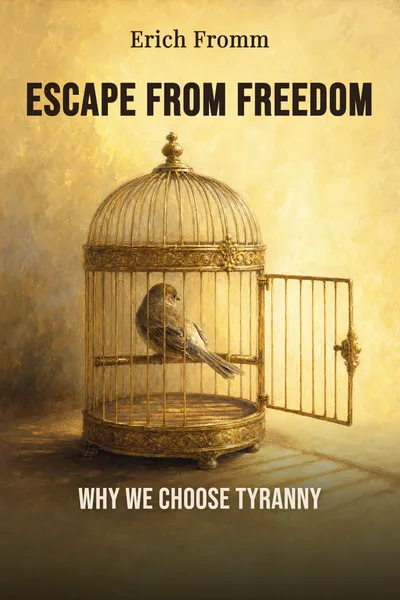
Escape from Freedom
Why we choose tyranny
Description
In 1941, with Europe already two years into a war it could not see the end of, a German émigré named Erich Fromm published a book trying to answer a question that kept embarrassing democrats. Why had millions of ordinary people, in one of the most cultured nations on earth, handed themselves over to a dictator? Not at gunpoint, not by trickery, but with something close to relief. Fromm had trained as a psychoanalyst and read his Marx, and he refused both easy answers — that Germans were uniquely cruel, or that Hitler had simply hypnotized a continent. The truth, he suspected, was stranger and more uncomfortable. People had not been dragged into tyranny. They had run toward it.
The book was called Escape from Freedom, and its central claim still lands like a slap. Freedom, Fromm argued, is not only something we want. It is also something we cannot always bear. The modern individual had spent centuries breaking loose from the bonds that once told everyone exactly who they were and where they belonged — and discovered, on the other side of liberation, a vertigo nobody had warned them about. Standing alone, responsible for everything, anchored to nothing, a person could feel less free than crushed.
Fromm wrote in the middle of the catastrophe, but he was not really writing about Germany. He was writing about a condition he thought modern life produced everywhere, including in the democracies that congratulated themselves for resisting it. The danger he traced was not foreign. It was structural, psychological, and very much at home.
The question we’re asking : Why would people who finally won their freedom turn around and surrender it?What we’ll see : How modern freedom quietly produced its own undoing, and what Fromm thought could hold it together.
Table of contents
01 Chapter 1 — The freedom that arrived without a manual
Fromm starts with a distinction that does most of the book's work. There is freedom from, and there is freedom to, and we tend to talk as if they were the same thing. Freedom from is negative: release from external authority, from the chains of caste, church, guild, and tradition. Freedom to is positive: the capacity to act, to create, to relate to the world and other people out of one's own genuine self. Modernity, Fromm argues, delivered enormous quantities of the first kind and left people badly short on the second.
To see why this matters, he asks us to look back. In the medieval world, a person was not free in any sense we'd recognize. Your place was fixed at birth — peasant, artisan, lord — and the whole order of things, social and cosmic, told you where you stood. That sounds suffocating, and it was. But it also meant you were never alone and never adrift. You belonged to a structure that gave your life meaning before you had to invent any. The chains were real, and so was the shelter.

02 Chapter 2 — The lonely individual modernity built
Here Fromm brings psychoanalysis to bear, which is what makes the book unusual for its moment. Most accounts of fascism in 1941 stayed at the level of economics or propaganda. Fromm wanted to know what was happening inside the person — what need the strongman was actually meeting. His answer is that modern conditions produce a specific psychic state, and totalitarianism offers a specific cure for it.
The state is a mixture of freedom and powerlessness. Capitalism, he argues, made the individual sovereign and tiny at the same time. You are free to do as you like, and you are also a single replaceable worker in a market vastly larger than you, governed by forces you neither control nor understand. You are told you matter supremely, as a consumer, a voter, a self-made person — and you experience yourself, most days, as insignificant. That contradiction grinds away at people, producing anxiety, doubt, and a gnawing sense that the self you're supposed to be expressing is hollow.
03 Chapter 3 — Three ways out of the open door
Fromm names three principal escapes from the burden of freedom, and the first is the most directly political. He calls it authoritarianism, and describes it as the tendency to give up the independence of one's own self and fuse it with someone or something outside oneself, in order to acquire the strength the individual lacks alone. It has two faces that he insists are the same impulse: the wish to submit, and the wish to dominate. Both dissolve the unbearable separateness of the self — one by surrendering to a higher power, the other by absorbing weaker beings into one's own.
Fromm borrows the older clinical word for this pairing: the sado-masochistic character. The masochist longs to belong to a force greater than himself, to obey, to be relieved of the agony of deciding. The sadist longs to make others depend on him absolutely, to swallow their freedom into his. They look like opposites and they crave the same escape from aloneness. In the authoritarian system, Fromm argues, the two click together perfectly — a leader who submits upward to fate or destiny while dominating everyone below, and followers who do exactly the same one rung down.
04 Chapter 4 — When the crowd chooses its own chains
Step back from the mechanisms, and Fromm's larger claim comes into focus: freedom is not a possession you win once and bank forever. It is a relationship the human psyche keeps having to renegotiate, and one it can lose at any point by handing the renegotiation to someone else. This is why the book stayed alive long after 1941. It does not treat tyranny as an accident that befalls societies from outside. It treats the longing for tyranny as a permanent human possibility that grows stronger precisely as freedom grows wider and lonelier.
That reframing has uncomfortable consequences for how we usually think about progress. We tend to assume that more freedom is straightforwardly better, and that authoritarianism is what happens when freedom is taken away. Fromm reverses the causality. Authoritarianism, in his account, is often what people reach for when freedom is given and felt as too much — when the burden of being a self with no anchor becomes heavier than the dignity of being free. The strongman does not need to seize power so much as to be offered it by people desperate to put their freedom down.
05 Conclusion
Fromm wrote Escape from Freedom in exile, watching a continent demonstrate his thesis in real time, and the book never quite reads as a period piece because the condition it describes did not end with the war. The lonely, anxious, formally free individual — sovereign and insignificant at once — is still recognizably us. So is the temptation he diagnosed: to make the discomfort go away by surrendering the self to a leader, a hatred, or simply the seamless agreement of everyone around us.
Related books