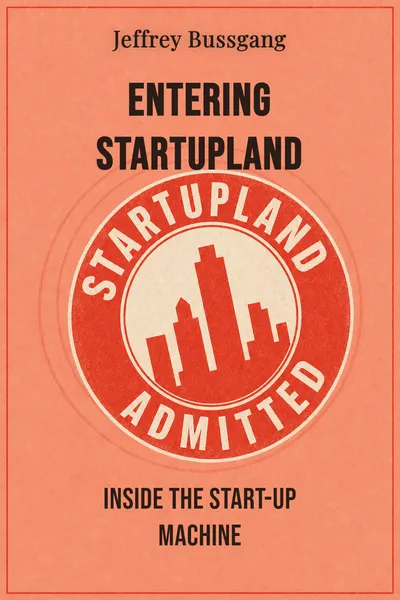
Entering StartUpLand
Inside the start-up machine
Description
Somewhere near you, a company you've never heard of is trying to become something enormous. It has a dozen employees, a lease it can barely afford, a product that half-works, and a founder who talks about the next eighteen months as if they were a war. From the outside, this looks like the most exciting place on earth to spend your working life. Jeffrey Bussgang, a venture capitalist, former entrepreneur, and Harvard Business School lecturer, spent years watching talented people press their noses to that glass — wanting in, having no idea how the door opens.
His book, Entering StartUpLand, starts from an odd gap. There are shelves of books for people who want to found companies. But a start-up needs one, maybe two founders. What it actually needs to survive is the hundred people who do the work — the product managers, the marketers, the salespeople, the operators who turn a pitch deck into a functioning business. Almost nobody had written the guide for them. Bussgang wrote it: part field manual, part travel guide to a country with its own customs, salaries, and unwritten rules.
The premise is that a start-up is less a magical place than a specific kind of organization, one you can learn to read the way you'd learn to read any foreign map. It looks chaotic because it is under-built on purpose — roles are fluid, titles mean less than they seem, and the person who hired you may be gone in a year. Bussgang's wager is that if we understand how the machine actually runs, we can decide, clear-eyed, whether we belong inside it.
The question we’re asking : What does it actually take to join a start-up — not to found one, but to work in one and thrive?What we’ll see : An insider's tour of how these companies hire, organize, and run, and of the judgment it takes to pick the right one.
Table of contents
01Chapter 1 — The dream nobody tells you how to enter
Bussgang opens with a person he has met a hundred times: the accomplished professional, often mid-career, sometimes fresh out of a good school, who has decided that the start-up world is where the interesting future is being built. They read the founder memoirs. They follow the funding announcements. They admire the executives from big companies who now treat scrappy young ventures as the model everyone should copy in a fast-moving innovation economy. And then they freeze, because none of that tells them how to get in.
The problem, he argues, is that the entire genre of start-up literature is aimed at the wrong audience. It celebrates the founder — the visionary, the risk-taker, the face on the magazine cover. But founding is a rare act. A company has at most a couple of founders and then hundreds of people who make it real. Those people are, in a sense, the invisible majority of StartUpLand, and almost nobody had bothered to write them a map. Bussgang's whole project is to correct that imbalance, treating the operator's path as the real subject rather than the footnote.

02Chapter 2 — Finding the door that fits
Once we accept that a start-up needs operators, the obvious question is which operator we might become. Bussgang lays out the major functional territories — product, marketing, growth, sales, business development, operations, finance — not as neat job listings but as distinct ways of thinking about the same problem: how do you build something people want and get it into their hands? Each function attracts a different temperament, and one of the book's steadier arguments is that the wrong-fit hire in the right company is still a bad outcome.
He treats product management as the center of gravity in many start-ups — the role that sits between engineering, design, and the customer, and owns the question of what to build next. It suits people who like ambiguity and can hold competing pressures without flinching. Marketing and growth, by contrast, live closer to the numbers and the funnel, obsessed with how a product finds its audience and how that audience compounds. Sales, which many aspirants quietly look down on, he defends hard: in an early company, the people who can actually close revenue are often the difference between survival and a shutdown.
03Chapter 3 — What the job actually looks like
The heart of the book is its refusal to romanticize the work itself. A start-up job, Bussgang stresses, is defined less by what your title says than by what nobody else is doing. In a company of twenty people, the marketer writes support emails, the product manager runs a sales call, and everyone answers the phone when a customer is furious. The elasticity that makes the environment exciting is the same thing that makes it exhausting, and he wants newcomers to feel that trade-off before they sign.
He is specific about how these companies actually operate day to day. Decisions get made fast and often reversed. Data is thin, so judgment carries more weight than in a big firm where a whole analytics team can be summoned. Resources are scarce, which means priorities are brutal — a start-up succeeds partly by being disciplined about the many good things it refuses to do. Bussgang frames this scarcity not as a flaw but as the operating logic: the constraint is the strategy, and people who need abundance to function tend to struggle.
04Chapter 4 — Reading a start-up from the outside
Step back from the individual roles and Bussgang is really teaching one durable skill: how to read a company you haven't joined yet. His practical job-search advice — research the market, talk to current and former employees, understand the funding stage, meet the founders more than once — adds up to a method for diagnosing an organization from the outside before you commit your years to it. The functions and salaries are the content; the diagnostic eye is the real inheritance the book hands over.
That eye matters because a start-up's health is legible in details outsiders tend to miss. How the company talks about its customers. Whether the revenue is real or promised. How the founders answer the question they don't want to answer. Bussgang, wearing his venture-capitalist hat, is essentially teaching civilians a diluted version of due diligence — the same instinct an investor uses to decide where money goes, applied to where a career goes. It's a quietly powerful transfer of a professional skill into ordinary hands.
05Conclusion
We started at the glass, watching a small company try to become something enormous and wondering how the door opens. Bussgang's answer is deflating in the best way: there is no secret handshake, only a set of things worth knowing. Which function suits us. What the daily work costs. How to price equity against salary against the real odds of failure. How to read a company the way an investor reads a deal, before we trade our years for its promise. The magic, it turns out, is just a machine — one we can learn to inspect.
Related books