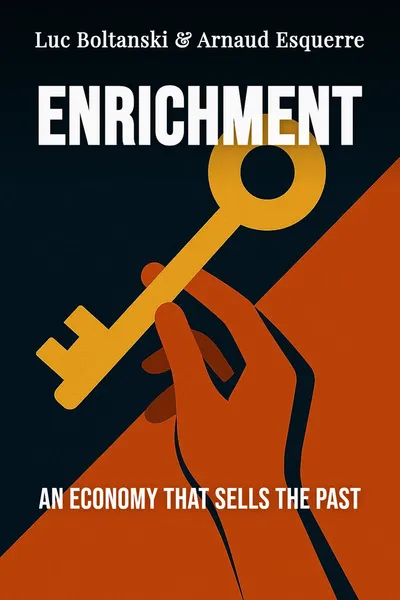
Enrichment
An economy that sells the past
Description
Walk through the center of Arles, or Venice, or a mid-sized town in Burgundy, and count what is actually being produced. Not much, in the old sense. The factories closed decades ago. What thrives instead is a certain kind of commerce: a restored abbey turned foundation, a boutique selling scarves woven the way they were woven in 1890, an antiques dealer, a wine estate that sells the year on the label as much as the liquid in the bottle. The town has not died. It has changed what it lives on. It now lives on the past.
Two French sociologists, Luc Boltanski and Arnaud Esquerre, spent years looking at this drift and gave it a name. In their 2017 book Enrichment, they describe an economy that no longer grows mainly by making new goods cheaper and faster, but by taking things that already exist — old houses, artworks, luxury handbags, vintage watches, regional traditions — and making them worth more. Not by improving them. By enriching them with narrative. A château is not renovated to house workers; it is enriched to become heritage. The word does double duty, and they mean it to.
This matters because it describes something we half-see everywhere in wealthy Western countries and rarely name as a single system. The luxury boom, the heritage industry, the collectibles market, the fetish for authenticity and provenance — Boltanski and Esquerre argue these are not separate trends. They are one economy, with its own logic of value, its own winners, and its own quiet way of sorting people.
The question we’re asking : How does a society that has stopped making new things keep getting richer — and off what, exactly?What we’ll see : How the past became a raw material, how a story turns into a price, and who ends up paying for the arrangement.
Table of contents
01Chapter 1 — A city that stopped making things
Boltanski and Esquerre begin with a puzzle they noticed traveling through provincial France. The industrial economy that had defined these regions for a century was gone. Mines, textile mills, metalworks — shut, relocated, hollowed out. By the standard reading, these places should have simply declined, and many statistics say they have. Yet a lot of them were visibly not poor. Something was circulating. Money was arriving, changing hands, sustaining shops and hotels and a whole class of specialists. The old story of deindustrialization did not fully account for what was actually happening on the ground.
What they found was a different kind of production, or rather a different kind of value. The wealth was not coming from new goods rolling off a line. It was coming from things that already existed being revalued upward. A stone farmhouse that had been nearly worthless as agricultural infrastructure became precious as a second home for a Parisian family. A local savoir-faire that had been ordinary craft became a heritage worth a premium. The region had not started producing more. It had started charging more for its past.

02Chapter 2 — When the object becomes a story
The heart of the book is a claim about how value is now generated, and it is deceptively simple: value increasingly comes from narrative. Boltanski and Esquerre argue that in the enrichment economy, the thing you are paying for is not the object's usefulness and often not even its rarity as such, but the story attached to it — where it came from, who made it, what era it belongs to, what it once meant. Strip the story away and the price collapses. Two nearly identical wooden chairs can differ in worth by a factor of a hundred, and the whole difference lives in the account one of them carries.
They distinguish this from the ordinary commercial object, whose value rests on its function and on how many exist. A new toaster is worth what it is because it toasts and because a million like it can be made. The enriched object works the other way. Its value rests on being singular and on being explained. A handbag from a great Parisian house is not priced for the leather; it is priced for the name, the history of the house, the idea of a certain kind of life. The narrative does not decorate the price. It is the price.
03Chapter 3 — Four ways to price a memory
Boltanski and Esquerre do not leave this at the level of intuition. They try to map how objects actually get priced once they enter the enrichment economy, and they lay out several distinct forms of valuation that coexist and sometimes convert into one another. The point is that an object is not simply worth a fixed amount; it is worth different amounts depending on the frame through which it is being sold, and moving an object from one frame to another is itself a way of making money.
The ordinary form is what they call the standard form: an object valued as one of many, priced by its function and its market of equivalents. Most of what we buy lives here — reproducible, comparable, cheap. But an object can be lifted out of this world. In the collection form, it becomes valued precisely for belonging to a set, for its place in a series a collector wants to complete. Rarity within a category does the work. The object is no longer one of many; it is one of few, and the fewness is the point.
04Chapter 4 — The rich buy time, everyone else pays rent
Step back from the antiques fairs and the auction houses, and Boltanski and Esquerre are describing a shift in where value comes from in rich Western societies — and that shift is not socially neutral. An economy that grows by making new things cheaper tends, however roughly, to spread its gains: more goods, more jobs, lower prices, a broad middle that can consume more each decade. An economy that grows by enriching a fixed stock of old and singular things works differently. It concentrates. Value flows to whoever already owns the château, the collection, the heritage, the brand — and to the specialists who narrate them.
This is the political core of the book, though the authors keep their tone descriptive. The enrichment economy rewards possession over production. It is very good for those who hold the storied objects and the capital to acquire more, and it turns everyone else into an audience or a customer, paying a premium to touch the past through tourism, luxury, or the small enriched pleasures marketed as authenticity. The gains do not diffuse the way industrial gains did. They pool at the top, where the singular things and the means to narrate them already sit.
05Conclusion
Return to that town in Burgundy, the one that stopped making things and started living on its past. Boltanski and Esquerre would not call it a failure. It has found, in its abbey and its vintages and its restored stone, a genuine source of wealth — one that does not need a single new factory. But they would insist we see clearly what it is doing. It is not producing more; it is charging more, by wrapping what it already has in stories that justify the price. The scarf, the château, the numbered watch, the celebrated year: all of them priced not for what they do but for what they are said to mean.
Related books