End the Fed
Central banks and the debt trap
Description
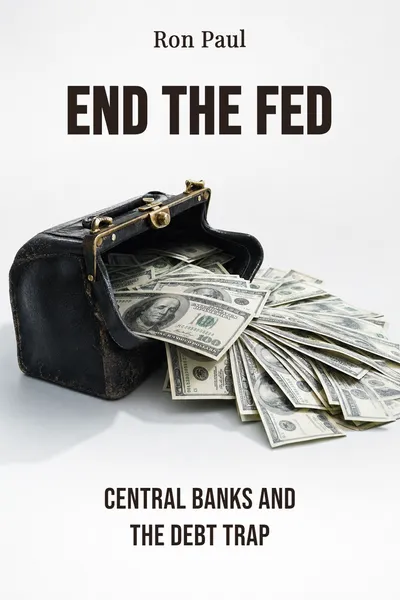
In 2008, as Lehman Brothers collapsed and the credit markets froze, a Republican congressman from Texas found himself in an odd position. Ron Paul, an obstetrician who had delivered some four thousand babies before entering politics, had spent decades warning that exactly this would happen — that a system built on cheap credit and central bank rescue would eventually seize up. Now the cameras came looking for the man who had said it. A year later he published a short book with a title that read like a bumper sticker: End the Fed. It sold well past its expected niche, and for a moment the most technical institution in American life became dinner-table talk.
The Federal Reserve is the sort of thing most of us file under "someone competent is handling it." It sets interest rates, manages the money supply, steps in when banks wobble. Paul's argument is that this comfort is precisely the problem — that an institution able to create dollars out of nothing, answerable to almost no one, is not a stabilizer but a slow-motion engine of debt, inflation, and repeated crisis. He does not treat the Fed as a well-meaning body that occasionally errs. He treats it as a mistake at the root.
What makes the book more than a rant is where Paul comes from. He is not a market strategist talking his book; he spent years reading Austrian economists, then years voting alone in a Congress that found him eccentric. His case is part economics, part constitutional principle, part personal history. To take it seriously, we have to follow how a physician ended up convinced that the country's monetary plumbing was quietly rotting.
The question we’re asking : Why does Ron Paul believe that an institution designed to steady the economy is the very thing that keeps destabilizing it?What we’ll see : How a doctor's reading of Austrian economics turned into a full-throated case against central banking — and what he proposes to put in its place.
Table of contents
01 Chapter 1 — A doctor who read Mises
Ron Paul's path to the money question did not start in economics. It started in 1971, when President Nixon closed the gold window — ending the last thin link between the dollar and gold under the Bretton Woods system. Paul, then a young physician in Texas, had been reading the Austrian economists Ludwig von Mises and Friedrich Hayek almost as a hobby. Mises had argued that money not anchored to something scarce would be forever tempting to governments. When Nixon severed the tie, Paul felt he had watched a prediction come true on the evening news, and he decided the subject was too important to leave to specialists.
The Austrian school is the intellectual spine of the whole book, and Paul is careful to present it as a way of seeing rather than a set of equations. Its claim is modest-sounding and radical in its consequences: prices carry information, and interest rates are the price of money over time. When a central bank pushes rates below where a free market would set them, it is not fine-tuning — it is lying to everyone at once. Businesses read the cheap money as a signal that there is real saving to build on, and they build. The signal is false.

02 Chapter 2 — The machine that prints the boom
The heart of Paul's economic case is the boom-and-bust cycle, and he insists it is not weather. Recessions, in the Austrian telling, are not random storms that a wise central bank rides out. They are the hangover from an artificial party that the central bank itself threw. The sequence is the argument, so it is worth walking through slowly. It begins with the Fed lowering interest rates and expanding the money supply — creating new dollars, in practice, by crediting banks that then lend them out.
Cheap credit sets off a boom. Money flows into long-term, capital-heavy projects — housing developments, construction, speculative ventures — because low rates make them look profitable. Paul's point, drawn straight from Mises and Hayek, is that this activity rests on a false signal. Low rates are supposed to mean people are saving more, freeing up real resources for the future. But the savings aren't there; the Fed manufactured the appearance of them. Resources get committed to projects that the actual economy cannot sustain.
03 Chapter 3 — Whose money loses value first
If the cycle is the mechanical argument, inflation is the moral one, and Paul frames it as a quiet transfer rather than a rise in prices. When the Fed expands the money supply, each existing dollar buys a little less. He calls this what older writers called it: debasement. The dollar of 1913, the year the Fed was created, is worth a small fraction of a dollar today, and Paul treats that erosion not as an accident of history but as the institution's steady output.
The part he wants readers to feel is who pays and who gains. New money does not reach everyone at once. It enters through the banks and the government first, and those who touch it early — large financial institutions, government contractors, borrowers close to the source — spend it before prices have adjusted. By the time the new dollars ripple out to wage-earners and savers, prices have already risen. The people furthest from the printing press get the same devalued money last. Inflation, in this account, is a hidden tax that flows upward, and it is regressive by design.
04 Chapter 4 — The oldest argument in American politics
Step back from the 2008 crash and Paul's fight looks less like a fringe crusade and more like the latest round of a quarrel almost as old as the country. The United States has been arguing about who should control money since its founding. Alexander Hamilton wanted a national bank; Thomas Jefferson and Andrew Jackson fought one. Jackson killed the Second Bank of the United States in the 1830s with rhetoric that Paul could have written — that a private moneyed power, shielded from voters, was a danger to a republic. The Federal Reserve, born in 1913 after decades of banking panics, was the side that eventually won.
What Paul adds to this long dispute is a specific worry about accountability. His deepest objection is not that Fed officials are corrupt or foolish; several, he grants, are serious people. It is that no institution with the power to create money can stay honest for long, because the temptation is structural. A tool that convenient will always be used, and used more, and the discipline needed to resist it is not something a committee reliably supplies. Independence, sold as a shield against political meddling, becomes in his reading a shield against answering to anyone at all.
05 Conclusion
The obstetrician who read Mises on his lunch breaks never got to end the Fed.
Related books