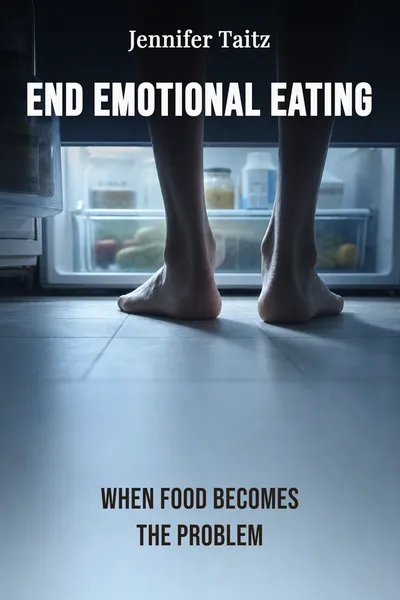
End Emotional Eating
When food becomes the problem
Description
It usually happens around nine in the evening. The day is done, the inbox is quiet, nothing is actually wrong — and yet there we are, standing at the open fridge, eating something we didn't plan to eat and weren't especially hungry for. A few minutes later the plate is empty and the feeling that sent us there hasn't gone anywhere. If anything, a new one has arrived: a low hum of regret, the sense of having lost a small argument with ourselves. This is the loop the psychologist Jennifer Taitz set out to interrupt in her book End Emotional Eating.
Taitz, a clinical psychologist trained in the behavioral therapies that treat anxiety and mood disorders, noticed something that most diet advice ignores. Plenty of people who eat too much, or too erratically, know perfectly well what a balanced meal looks like. They are not confused about nutrition. They are using food to do a job food cannot do — to soften sadness, fill boredom, blunt stress, reward a hard week, quiet anger they'd rather not feel. And because eating delivers a brief, real hit of comfort, the habit trains itself deeper every time.
The trouble is that the relief never lasts, and the method eventually becomes its own source of distress. Food stops being fuel or pleasure and becomes a coping strategy that quietly makes the underlying feeling worse. Taitz's book is not another eating plan. It borrows from a specific branch of psychology to ask a stranger, more useful question: what if the goal isn't to eat less, but to need food to do less?
The question we’re asking : Why does eating to feel better so reliably leaves us feeling worse, and what would it take to stop?What we’ll see : How a clinical psychologist reframes emotional eating not as a food problem but as a difficulty with feelings — and the surprisingly gentle skills she offers instead.
Table of contents
01 Chapter 1 — The reach for the fridge that solves nothing
Emotional eating, in Taitz's account, is not a character flaw or a failure of discipline. It is a learned response, and it makes a kind of sense. When we feel something uncomfortable — a spike of anxiety before a difficult conversation, the flat grey of a lonely Sunday, the irritation of a day that went sideways — the body wants relief, and it wants it now. Eating something rich and sweet delivers exactly that: a genuine, measurable moment of calm. The brain notices. The next time the discomfort shows up, the shortest path to relief is already mapped.
The problem is what happens after the last bite. The feeling that drove us to eat was never about food, so food never resolves it. The loneliness is still loneliness. The stress is still stress. What's changed is that we've now added a second layer on top — the discomfort of having eaten in a way we didn't choose, the private verdict that we've been weak again. Taitz calls attention to this doubling. We reach for food to escape one bad feeling and end up carrying two.

02 Chapter 2 — Why willpower is the wrong tool
The instinctive response to emotional eating is to try harder — more willpower, stricter rules, a cleaner cupboard, a promise to oneself made at midnight. Taitz spends real time explaining why this almost always backfires, and the reasoning is one of the book's most useful contributions. Willpower treats the urge as an enemy to be overpowered. But suppression, in the research she draws on, tends to intensify the very thing it targets. Tell yourself not to think about the cookies and the cookies acquire a strange gravitational pull.
There's a mechanism underneath this. Rigid dieting sets up a mental line between allowed and forbidden food, and the moment that line gets crossed — one biscuit too many — a peculiar logic kicks in. The day is already ruined, so we may as well finish the packet. Psychologists call this the what-the-hell effect, and Taitz shows how the strictest eaters are often the most vulnerable to it. The rule doesn't produce control; it produces a cycle of restriction and collapse that feels exactly like a lack of willpower but is really a predictable result of the rules themselves.
03 Chapter 3 — Sitting with the feeling instead of feeding it
The heart of the book is a set of practices borrowed largely from dialectical behavior therapy, the treatment developed by the psychologist Marsha Linehan for people who feel emotions with unusual intensity. Taitz adapts these tools for the ordinary case: the person who isn't in crisis but who reaches for food whenever a feeling gets uncomfortable. The core idea is deceptively simple. Emotions, left alone, rise and fall. They peak and then they pass. Eating interrupts that natural arc by giving us something to do instead of waiting it out.
Mindfulness is the first skill, and Taitz means something concrete by it, not a mood. It's the practice of noticing what's actually happening — this is anxiety, this is boredom, this is my hand already reaching — before the reaching becomes eating. A great deal of emotional eating runs on autopilot, and simply seeing it in real time creates a pause. In that pause lives a choice that didn't exist a moment before. She offers small exercises: naming the emotion, rating the urge, watching it crest rather than obeying it.
04 Chapter 4 — A different relationship with the plate
Step back from food for a moment and Taitz's project looks larger than eating. What she's really addressing is a habit of mind we all share to some degree: the reflex to treat every uncomfortable feeling as an emergency that demands an immediate exit. Food is one exit. But the same reflex sends other people to their phones, to online shopping, to a second glass of wine, to the compulsive checking of email. The specific escape hatch is almost incidental. The underlying difficulty is the same — a low tolerance for the plain experience of being human without a way out.
This is why the book's title is slightly misleading, and deliberately so. Ending emotional eating isn't achieved by focusing on eating at all. It's achieved by building the capacity to feel — to let sadness be sad, boredom be boring, stress be stressful — without reaching for the nearest anesthetic. The food, in a sense, is the smallest part of the story. It's the visible symptom of a broader question about how we relate to our own inner weather.
05 Conclusion
Return to that moment at the open fridge, nine in the evening, nothing quite wrong. Taitz's work doesn't promise the urge will vanish. It promises something more realistic: that we can learn to meet the urge with curiosity instead of obedience, to name the feeling underneath it, and to let the moment pass without acting on it. The pause between feeling and eating, which once seemed to not exist, turns out to be trainable. Each time we sit inside it, it widens a little.
Related books