Empires of Light
The race to power America
Description
On the evening of September 4, 1882, in a cramped station on Pearl Street in lower Manhattan, an engineer threw a switch and a few hundred lamps flickered on across a square mile of downtown New York. The offices of the financier J.P. Morgan glowed. So did the newsroom of the New York Times, whose reporters noted that the light was soft, steady, and free of the flicker of gas. The man behind the switch was Thomas Edison, already the most famous inventor in America, and the moment was meant to be the birth of an industry he intended to own outright.
He did not own it for long. Within a few years, a rival system, carried by high-voltage alternating current rather than Edison's low-voltage direct current, began stringing wires across far greater distances at a fraction of the cost. Behind it stood George Westinghouse, a Pittsburgh entrepreneur with a taste for hard fights, and a strange, elegant Serbian immigrant named Nikola Tesla, whose motor made the whole thing work. What followed was not a tidy handover from one technology to a better one. It was a decade of lawsuits, sabotage, staged electrocutions of animals, and a marketing campaign built around the electric chair.
Jill Jonnes tells this story in Empires of Light as a collision of three temperaments — the relentless promoter, the combative industrialist, the otherworldly theorist — set against the moment when a city could suddenly decide to abolish the night. The stakes were enormous, and the men involved knew it. Whoever controlled how America was wired would shape the physical texture of modern life.
The question we’re asking : How did three rivals turn the race to electrify America into a war, and who actually won it?What we’ll see : A young industry's founding decade, told through the men who fought over it and the current that outlasted all of them.
Table of contents
01 Chapter 1 — The man who lit Pearl Street
Edison did not invent the light bulb, exactly, and Jonnes is careful about this. Incandescent lamps existed before him; what he built, over months of grinding experiment at his Menlo Park laboratory in New Jersey, was a bulb that lasted, using a carbonized filament that could burn for hundreds of hours. More important, he grasped that a bulb was useless without everything around it. So he designed the entire system — the generators, the underground cables, the meters that would let him charge customers, the whole apparatus of a utility that did not yet exist.
This was the real feat, and it was as much financial as technical. Edison raised money from Morgan and other backers, wired their houses first, and staged the Pearl Street demonstration as proof that a central station could sell light the way a gasworks sold gas. The system ran on direct current at low voltage, which was safe to have in a home and simple to understand. It had one crippling limitation. Direct current could not travel far. Beyond roughly a mile from the station, the voltage sagged and the current died, which meant a city would need a power plant every few blocks.

02 Chapter 2 — The current that changed everything
The workaround was voltage. Electrical power can travel long distances efficiently only at high voltage, then be stepped down for safe use at the far end — and the device that steps voltage up and down, the transformer, works only with alternating current, which reverses direction many times per second. Direct current cannot be transformed this way. Alternating current could be generated cheaply, pushed across miles of thin wire at high voltage, and brought back down to household levels near the customer. It solved the exact problem that trapped Edison.
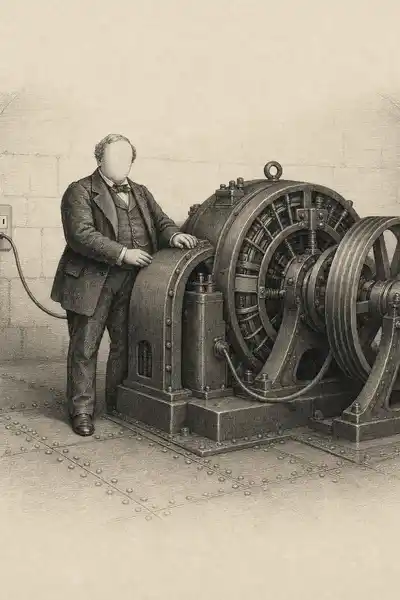
George Westinghouse saw it. He had already made a fortune inventing the air brake for railroads, and he had the engineering instinct and the appetite for risk that a new industry rewards. He bought up the relevant patents and began building alternating-current systems. What he lacked was a good motor. Alternating current could light lamps, but nobody had built a practical motor that ran on it, and without motors the system could not power factories, streetcars, or the machinery of real industry.
03 Chapter 3 — The war that killed with a chair
Edison's counterattack is the darkest passage in Jonnes's book, and the most revealing. Unable to match alternating current on cost or reach, he set out to convince the public that it was lethal. High voltage was genuinely more dangerous than low voltage, and Edison's camp exploited the fact ruthlessly. At West Orange and elsewhere, they staged public electrocutions of stray dogs, cats, and eventually a horse and a cow, using alternating current to make the point that Westinghouse's system killed.
The campaign found its grim centerpiece in the electric chair. When New York sought a more humane alternative to hanging, Edison's associates — chiefly a consultant named Harold Brown — lobbied for electrocution and worked to ensure it was carried out with alternating current, so the public would associate Westinghouse's technology with death. They even pushed to make "to be Westinghoused" a synonym for execution. The first electrocution, of a convicted murderer named William Kemmler in 1890, was botched horribly; the current had to be applied twice, and witnesses were sickened. Westinghouse, who had quietly funded Kemmler's legal appeals, remarked that they could have done better with an axe.
04 Chapter 4 — What was left when the wires went up
Read from a distance, the war of the currents is a useful correction to the way we tell stories about invention. We like the lone genius — the man who has the idea and changes the world. Jonnes's account makes that image nearly impossible to sustain. The light bulb needed a utility around it; the utility needed a current that could travel; the current needed a motor; the motor needed a manufacturer willing to bet a fortune on it. No single person held all of that. The thing we call electrification was assembled from three incompatible temperaments who mostly could not stand one another.
And the credit landed unevenly. Edison, who backed the losing technology and ran the cruelest campaign, remains the household name, his face on the mythology of American ingenuity. Westinghouse, whose system actually won and whose engineering judgment was sounder, is remembered mostly as a brand. Tesla, whose induction motor made the whole edifice possible, died in relative poverty in a New York hotel in 1943, better known now for a cult reputation than for the specific, decisive machine he built. The names history keeps rarely match the work history rests on.
05 Conclusion
The lamps that came on over Pearl Street in 1882 ran on the current Edison would spend the next decade defending and ultimately lose. By 1896, the power lighting Buffalo came from Niagara Falls twenty miles away, carried by the alternating current he had tried to bury under dead animals and a botched execution. Within a generation, the whole country would be wired on Westinghouse's system and Tesla's motor, and the distinctions the three men had fought over so bitterly would be invisible to everyone who flipped a switch.
Related books