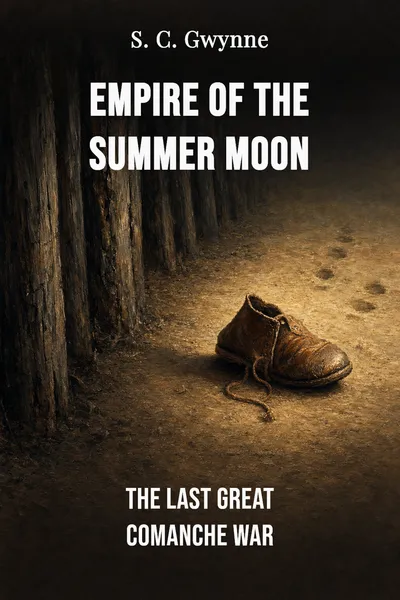
Empire of the Summer Moon
The last great Comanche war
Description
In May 1836, a band of Comanche and allied warriors rode up to a stockade in central Texas called Parker's Fort, where a few extended families of white settlers had built a life on the edge of what maps of the day left mostly blank. By the time the raid was over, several of the men were dead, and a nine-year-old girl named Cynthia Ann Parker had been carried off into a world Anglo-Americans barely understood. She would not be seen again by her own people for twenty-four years. The boy she would later bear to a Comanche chief was named Quanah, and he would become the last and arguably the greatest leader of the most powerful tribe the continent ever produced.
That is the spine of S. C. Gwynne's Empire of the Summer Moon, a book that does something most frontier histories never bother to: it takes the Comanches seriously as a military and political power. For roughly two centuries, these were not a people being slowly pushed aside. They were an empire on horseback that stopped the Spanish, broke the northern advance of Mexico, and held the southern plains against the United States longer than any other tribe held anything. The familiar story of westward settlement, told as steady and inevitable, looks different once we put the Comanches at the center of it rather than at the edges.
Gwynne tells it through two intertwined lives — a captured girl who became Comanche, and her son who fought the closing of an era and then, improbably, outlived it. Around them moves a forty-year war that ended on the high plains of the Texas Panhandle, with the slaughter of the buffalo and a way of life that depended on them. It is a brutal account, unsentimental about both sides, and it asks us to reconsider what we think we know about how the West was actually won.
The question we’re asking : How did a single tribe hold the southern plains for two centuries, and what finally broke them?What we’ll see : How a horse culture became an empire, how a captive family bound two peoples together, and how the last free Comanches were run down.
Table of contents
01 Chapter 1 — The horse changed everything
The Comanches did not begin as the terror of the plains. They started as an obscure, impoverished offshoot of the Shoshone, scraping a living in the mountains of what is now Wyoming, on foot, hunting small game and gathering roots. What transformed them was an animal they did not domesticate themselves: the horse, brought to the Americas by the Spanish and slowly spreading north through trade and theft after the Pueblo Revolt of 1680 scattered Spanish herds across the Southwest.
Most plains tribes acquired horses. The Comanches became something different — they fused with the horse so completely that Gwynne calls them perhaps the finest light cavalry the world had ever seen. A Comanche boy could ride almost before he could walk, could shoot arrows accurately from beneath a galloping horse's neck using the animal's body as a shield, and could cover distances that left pursuing armies exhausted and confused. War, hunting, and travel all ran on horseback, and the buffalo that the horse let them chase across the open grassland gave them everything else: food, shelter, tools, trade goods.

02 Chapter 2 — Parker's Fort and the captive girl
Into this world came the Parkers, a hard-shell Baptist clan that pushed the line of Anglo settlement deep into Comanche range in the 1830s, well beyond where prudence suggested. Their stockade sat exposed on the Navasota River. On the morning of the 1836 raid, the gate stood open and most of the men were out in the fields. The attack was swift and savage in the manner of plains warfare, and it left the survivors scattered and several family members carried off — among them the nine-year-old Cynthia Ann.
Captive-taking was central to Comanche life. Captives were sometimes tortured and killed, sometimes traded, and sometimes — especially children — absorbed fully into the tribe. Cynthia Ann was absorbed. Over the years she forgot her English, took a Comanche name, married a chief named Peta Nocona, and bore children. She became, by every account that reached the outside world, thoroughly Comanche. When white traders and soldiers occasionally glimpsed her and tried to ransom her back, she refused. The frontier could not comprehend it: a white woman who did not want to be rescued.
03 Chapter 3 — Quanah and the empty plains
Quanah grew up as the war for the southern plains entered its final, bloodiest phase. By the 1860s and 1870s the United States had turned the full weight of its army on the Comanches, and the strategy that finally worked was not a single decisive battle but relentless pressure: winter campaigns that destroyed villages and horse herds, and above all the deliberate destruction of the buffalo. Commercial hunters, encouraged by the army, slaughtered the southern herd almost to extinction in a few short years. Without the buffalo, the Comanche way of life simply could not continue.
Quanah belonged to the Quahadi, the most remote and uncompromising band, who held out on the high, waterless tableland of the Llano Estacado that white men could barely cross. He emerged as a war leader of unusual skill and ferocity. In 1874, with the buffalo vanishing, he helped lead a coalition of warriors in an attack on buffalo hunters at an old trading post called Adobe Walls. The hunters, armed with long-range rifles, beat the assault back, and the failure marked a turning point. The army's campaign that followed, the Red River War, ran the last free bands down across the Panhandle through the winter, destroying their shelter and their horses until survival on the plains became impossible.
04 Chapter 4 — What the frontier remembers
The deepest thing Gwynne's book does is correct the geography of the American imagination. The standard story of the West is one of empty space — a frontier of open land where settlement advanced more or less naturally, with Indians appearing as obstacles or victims along the way. The Comanche story refuses that framing. The southern plains were not empty and not waiting. They were governed, contested, and defended by a power that beat back two European empires and held the line against the United States for decades. The settlers did not move into a vacuum. They pushed into someone else's country, and they knew it, which is why the violence on both sides was so extreme.
This matters because the erasure was not accidental. A nation that tells itself the land was open can believe its expansion was a matter of industry and destiny. A nation that admits the land was held by a formidable rival has to reckon with conquest, and with the methods conquest required — starvation through the buffalo, winter raids on villages, the dismantling of a whole way of living. Gwynne does not flinch from Comanche brutality; the torture and slaving were real. But he insists we see that brutality inside a war between peers, not as the savagery of a doomed primitive against the march of progress.
05 Conclusion
The story that began with a girl carried off from an open stockade gate ends with her son buried beside her on the plains where their people once ruled. Cynthia Ann Parker never found her way home, because home had become a place that no longer existed for either of the worlds she belonged to. Quanah, the child she lost, lived long enough to see the buffalo gone, the bands settled, and the Comancheria reduced to a memory — and he made himself the keeper of that memory rather than its casualty. The forty-year war that ran through both their lives did not end in a single surrender so much as in the quiet exhaustion of a land and an animal that had made an empire possible.
Related books