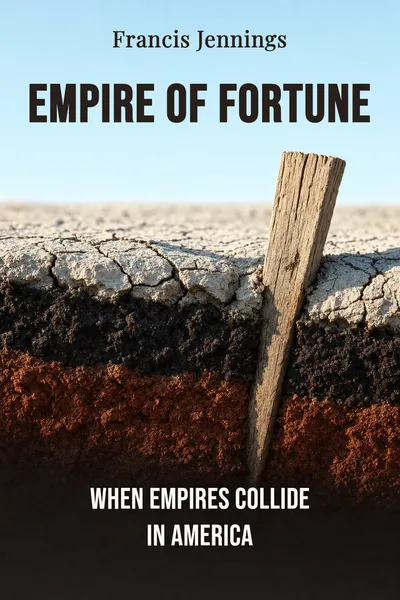
Empire of Fortune
When empires collide in America
Description
Between 1754 and 1763, the armies of two European empires fought a long, brutal war for control of North America, and the version most of us inherited goes roughly like this: brave British colonists, with the help of the mother country, beat back the scheming French and their savage native allies, and in doing so cleared the ground for the United States. The war even comes with a tidy name — the French and Indian War — that tells you in four words who the heroes were and who the villains were. It is a clean story. It is also, according to the historian Francis Jennings, mostly invented.
In Empire of Fortune, published in 1988 as the final volume of a trilogy on colonial America, Jennings took that inherited story apart piece by piece. He had spent a career arguing that the standard histories of the colonial period were written by the winners and their descendants, and that they flattered the British and Americans while erasing almost everyone else. The war for the continent, in his telling, was not a morality play. It was a tangle of greed, blunder, betrayal, and land speculation, in which the supposedly noble actors behaved about as well as anyone fighting over a continent ever does.
What makes the book bracing is not that Jennings dislikes his subjects — it is that he reads the documents they left behind more closely than the legend allows, and the documents say something different from the legend. Where the textbook sees a fight between two empires, he sees at least three. Where it sees loyal colonists, he sees rival operators working their own angles. The result is a history that refuses to be comforting, and that is exactly the point.
The question we’re asking : What actually happened in the war for North America, once we stop telling it as a heroic story?What we’ll see : How Jennings strips the legend off the conflict to reveal the players, the motives, and the politics underneath — and why the legend was built in the first place.
Table of contents
01 Chapter 1 — The war the textbooks misnamed
Start with the name, because Jennings does. "The French and Indian War" is an Anglo-American coinage, and it does quiet work. It frames the conflict as a war the British fought against the French and the Indians — two enemies bundled into a single phrase, with the British standing apart as the implied protagonist. Already the language has chosen sides. The native peoples become an appendage of the French, a menace rather than independent actors, and the British become the side whose perspective we are invited to adopt. Other parts of the world simply call the larger struggle the Seven Years' War and leave it at that.
Jennings's first move is to refuse the framing. The fighting that broke out in the Ohio country in 1754 was not, in his account, a straightforward imperial duel that natives happened to wander into. It was a collision over land — specifically the rich Ohio Valley — in which British colonial speculators, the French crown, and a range of native nations all had stakes that did not line up neatly. A young Virginia officer named George Washington fired some of the first shots, in a confused frontier skirmish that helped tip the whole continent into war. The legend remembers his courage. Jennings is more interested in what he and his backers were actually after.

02 Chapter 2 — Three empires, not two
The deepest correction Jennings makes is to the cast of characters. The standard story has two great powers — Britain and France — with native peoples cast as auxiliaries, picking the French side and paying for it. Jennings insists there was a third power on the field, one with its own diplomacy, its own strategy, and its own capacity to make or break European plans: the Iroquois Confederacy, the league of Six Nations that dominated the politics of the northeast.
The Iroquois were not pawns. For decades they had played the empires against each other, extracting gifts, trade goods, and recognition by keeping their options open and refusing to be captured by either Paris or London. Their diplomacy had a name and a logic, and European officials who ignored it tended to lose. When the British finally won, Jennings argues, it was in no small part because they managed — clumsily, and at a price — to secure enough native cooperation to outmaneuver the French, who had long been the more skillful partners in that delicate game.
03 Chapter 3 — The colonies that played their own game
If the natives were not loyal auxiliaries of France, the British colonists were not loyal auxiliaries of Britain either — and this is the part of Jennings's argument most likely to unsettle a reader raised on the founding mythology. The thirteen colonies did not behave as a united front fighting nobly alongside the redcoats. They squabbled, they hoarded, they refused to pay, and they pursued provincial interests even when those interests cut against the war effort.
Pennsylvania is Jennings's great case study, and he knew its archives intimately. The colony was run by a tangle of competing factions — the proprietary Penn family and its appointees, the Quaker-dominated assembly, the Indian traders, the frontier settlers pressing for more land. These groups fought each other almost as bitterly as anyone fought the French, and their feuds shaped which forts got built, which treaties got honored, and which native allies got betrayed. The frontier violence that the legend blames on French-incited savagery often grew directly out of broken colonial promises and stolen land.
04 Chapter 4 — The myth-making machine
Step back from the battles and a larger question comes into view: if the war was this messy, why do we remember it as a heroic tale? Jennings's answer is that the heroic tale was itself a product of the war — or rather of its aftermath, and of the people who got to write it down. History, in his account, is not a neutral record left lying around. It is composed, and it is composed by those with the means and the motive to compose it.
The winners of the war, and especially the Anglo-American writers who came after, had every reason to tidy the story. A narrative of brave colonists and savage enemies justified the seizure of native land, dignified the speculators as patriots, and gave the emerging United States a clean origin. Inconvenient facts — the broken treaties, the colonial profiteering, the indispensable native diplomacy, the contempt between British and Americans — were not so much suppressed as quietly left out of the frame, until the frame itself looked like the truth. The name of the war, doing its silent work, was only the most compact example.
05 Conclusion
The war ended in 1763 with France pushed out of mainland North America and Britain master of a vast new interior it barely knew how to govern. The legend treats that outcome as a triumph and a beginning. Jennings treats it as the moment the bills came due — for the natives whose lands were now exposed, for the colonists who would soon resent paying for a victory they felt entitled to, and for an empire that had won a continent it would lose within a generation. The fortune everyone had been chasing turned out to be harder to keep than to win.
Related books