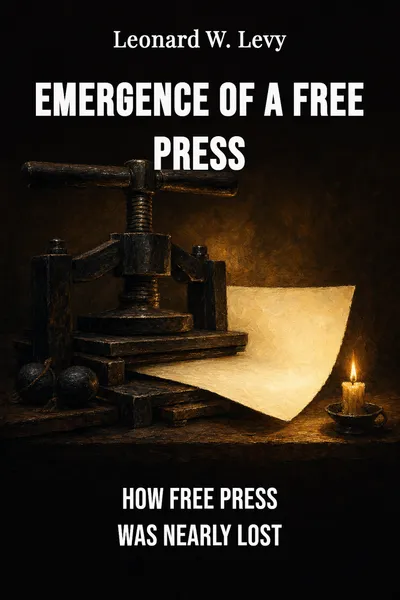
Emergence of a Free Press
How free press was nearly lost
Description
In 1960, a legal historian named Leonard W. Levy published a book called Legacy of Suppression, and it landed with the force of an accusation. The claim was simple and, to many readers, offensive: the generation that wrote the First Amendment did not believe in a free press the way we imagine they did. The men who fought a revolution partly over the right to speak had, in Levy's reading, inherited and largely accepted the English common law of seditious libel — the doctrine that criticizing the government was itself a crime. One Supreme Court justice, Hugo Black, called it one of the most devastating blows delivered against civil liberty in a long time.
The reaction was fierce because the stakes were real. Judges reaching for the original meaning of the First Amendment had long assumed the Founders wanted broad, robust freedom to attack those in power. Levy told them the record didn't support that hope. Nearly three decades later, in 1985, he returned to the subject and rewrote the book almost entirely. The new title was Emergence of a Free Press, and the shift in the word — from suppression to emergence — carried the whole argument. He hadn't recanted. He had refined, complicated, and in one crucial place, changed his mind.
What emerges across the two versions is not a tidy story of liberty triumphant, nor a cynical one of liberty betrayed. It is something harder to hold: a freedom that came into being sideways, through practice more than principle, before anyone had fully worked out what it meant to defend it.
The question we’re asking : Did the framers of the First Amendment actually intend the broad press freedom we now attribute to them, or did we inherit a doctrine that was still half-caught in the logic it claimed to reject?What we’ll see : How Levy took apart a comforting national origin story, what the law of seditious libel really permitted, and why he eventually softened one of his own hardest conclusions.
Table of contents
01Chapter 1 — A libertarian myth, dismantled
The story most of us carry goes like this. The colonists were choking under British censorship. They rose up, in part, to secure the right to speak freely against power. And when they drafted the First Amendment in 1791, they enshrined that right in its fullest form — Congress shall make no law abridging the freedom of the press, full stop. It's a clean narrative, and Levy's central provocation was that it is mostly wishful thinking read backward into the record.
When he went looking for the evidence of a genuine libertarian theory of the press in the founding era, he kept coming up short. What he found instead was that most Americans of the eighteenth century, including many of the framers, still operated inside a much narrower idea inherited from England. Freedom of the press meant freedom from prior restraint — freedom from a government licenser who could stop something from being printed before it appeared. It did not mean freedom from punishment after the fact. Print what you like, but answer for it in court.

02Chapter 2 — The blasphemy of seditious libel
To understand what the founders were living inside, you have to sit with seditious libel — the doctrine at the dark center of Levy's book. In English common law, it was a crime to publish anything that brought the government, its officials, or its institutions into contempt or disrepute. The reasoning had a grim internal logic: government rested on public respect, and to undermine that respect was to threaten public order itself. Criticism was not a right. It was a danger to be policed.
The most striking feature, from a modern vantage, was the treatment of truth. Not only was truth no defense — a true accusation could be treated as more dangerous than a false one, because it was more likely to be believed and therefore more corrosive of authority. The phrase that captured this, passed down through the courts, was that the greater the truth, the greater the libel. A government could jail a printer precisely because what he printed was accurate.
03Chapter 3 — The Zenger case, misread
Every account of colonial press freedom eventually arrives at John Peter Zenger. In 1735, the New York printer was tried for seditious libel after his paper attacked the colonial governor. His lawyer, Andrew Hamilton, argued that the jury should be allowed to consider whether the printed words were true — and that if they were true, they could not be libelous. The jury acquitted. The case became legend, the moment a colonial jury struck a blow for the liberty of the press.
Levy's reading is cooler. Zenger's acquittal, he argued, changed almost nothing about the actual law. Hamilton's argument was a brilliant appeal to a jury, not a settled legal principle courts were bound to follow. Judges continued to instruct juries in the old way; truth remained formally no defense for decades afterward. The verdict was a spectacular act of jury defiance, but a single defiant jury does not rewrite a doctrine. The law of seditious libel stayed on the books, and prosecutions continued.
04Chapter 4 — The compromise Levy came to accept
Step back and the two versions of Levy's book tell a story about how nations narrate their own liberties. We prefer origin myths in which a principle is conceived whole, defended by heroes, and handed down intact. Levy's work is a sustained argument against that kind of comfort. The freedom of the press we cherish did not spring fully formed from the founders' intentions. It assembled itself gradually, out of contradiction — a doctrine of suppression that people kept violating in practice until the violations became the norm.
His revision matters precisely because it refuses both the myth and the easy cynicism that might replace it. The younger Levy risked leaving readers with the impression that early America was simply hostile to free expression, that the liberty was a fraud dressed up after the fact. The older Levy corrected himself without surrendering the core insight. Yes, the theory was thin and the law was repressive. But the practice was raw, defiant, and real, and that practice was the seedbed from which the theory eventually grew. Emergence, not suppression, and not triumph either.
05Conclusion
The move from Legacy of Suppression to Emergence of a Free Press is the rare case of a historian publicly reworking his own most famous argument and coming out stronger for it. Levy never pretended the founders had handed down a finished doctrine, and he never let readers off with the flattering myth. But by 1985 he had found the missing piece: the vigorous, disorderly, everyday practice of a colonial press that spoke far more freely than the law on paper allowed.
Related books