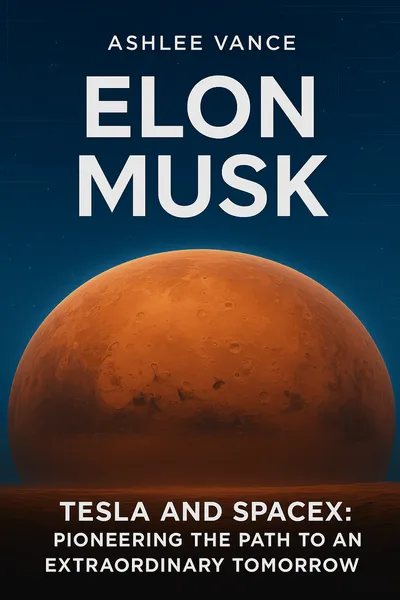
Elon musk
Tesla and spacex: pioneering the path to an extraordinary tomorrow
Description
Elon Musk is an entrepreneur and industrialist pushing boundaries in electric vehicles, solar energy, and space exploration. He co-founded internet companies Zip2 and PayPal before investing his fortune into Tesla, SolarCity, and SpaceX.
Despite near bankruptcies, Musk has led innovative companies that aim to accelerate sustainable transport and energy solutions. Ultimately, his goal is to make life multi-planetary by establishing a human colony on Mars. Musk is known for working extremely hard, moving fast, taking risks, and rallying teams to achieve ambitious visions that many think are impossible.
Table of contents
01 Early days
Elon Reeve Musk was born on June 28, 1971, in Pretoria, South Africa, to Errol, an engineer and entrepreneur, and Maye Musk, a dietician and fashion model. Growing up, Elon visited his father's emerald mine in Zambia and later welcomed his siblings Kimbal and Tosca. Known for his photographic memory and love for reading, Elon did well in school but faced social challenges and experienced his parents' divorce as a teenager. At 17, he moved to Canada using his Canadian-born mother's citizenship to gain entry. He worked various jobs and eventually enrolled at Queen's University, valuing its social environment, and was later joined by his siblings.

02 Start up
In 1994, Elon Musk and his brother Kimbal took a road trip in a BMW 320i, discussing business ideas. Elon's internships had exposed him to electric vehicles and video games, and his performance impressed his supervisors. After earning degrees in economics and physics, Musk enrolled in a PhD program at Stanford but dropped out after two days to enter the internet sector. He and Kimbal founded Global Link Information Network, later Zip2, with a vision to create an online directory for local businesses. They started with $28,000 from their father, working from a small office and enduring financial hardships.
03 X com and paypal
In 1999, Elon Musk sold Zip2 and invested $12 million into creating X.com, an ambitious online bank, despite skepticism due to the nascent state of e-commerce. Musk faced early challenges, including the departure of co-founders Harris Fricker and Christopher Payne, but persevered to secure licenses and a partnership with Barclays, launching X.com with services like bank accounts and mutual fund investments. The company quickly attracted 200,000 customers. Competition from Confinity, co-founded by Max Levchin and Peter Thiel, led to a merger under the X.com name in March 2000, shortly after which X.com raised $100 million from Deutsche Bank and Goldman Sachs.
04 SpaceX
Elon Musk's early 2000s were marked by significant personal and professional challenges and achievements. Married in the early 2000s, his honeymoon was delayed due to a boardroom coup at X.com, which later became PayPal. When he finally took a break in December 2000, Musk contracted malaria during a trip to a South African game reserve, leading to a severe illness that required a lengthy recovery period. After selling PayPal to eBay in 2002 and facing his own mortality, Musk moved to Los Angeles to start a family and pursue his childhood passion for space travel. Los Angeles, with its rich aerospace history, offered Musk the environment he needed to brainstorm and recruit for future space projects. Musk's interest in space exploration deepened through his involvement with the Mars Society, where he contributed to plans for a robotic greenhouse on Mars.
05 Tesla Motors
In the fall of 2003, Stanford graduate J.B. Straubel met with Elon Musk at SpaceX to discuss an electric airplane concept. Although Musk was not interested in the airplane, he was intrigued by Straubel's side project on developing an electric sports car using lithium-ion batteries, leading Musk to invest $10,000 to support the effort. Shortly after, Musk was approached by Tesla Motors founders Martin Eberhard and Marc Tarpenning, who were seeking funding to manufacture an electric sports car. Impressed by their plan, Musk invested $6.5 million, becoming Tesla's largest shareholder and chairman. Musk connected the founders with Straubel, who had been working on an electric powertrain, and Tesla began operations in a San Carlos warehouse, focusing on developing the Roadster.
06 Near-death experience
In 2008, Tesla Motors had significantly overshot its initial budget, spending over $140 million on the development of the Tesla Roadster, against a planned $25 million. This financial strain coincided with the global financial crisis, the worst since the Great Depression. Elon Musk, having invested his $200 million fortune from PayPal into Tesla and his rocket company SpaceX, was facing a rapid depletion of funds. SpaceX had also experienced failures in its second and third orbital launch attempts, adding to the pressure.
Musk's personal life was tumultuous, with his first marriage ending in a public divorce, though he remarried within a year. Professionally, SpaceX's fourth launch was a success, marking the first privately financed liquid-fueled rocket to reach orbit. Despite this, both companies were on the brink of bankruptcy, with speculation about their imminent collapse widespread.
07 To infinity
Since its inception, SpaceX has made significant strides in the aerospace industry, largely due to its innovative approach to manufacturing rockets and parts in-house, setting it apart from competitors like Boeing, Lockheed Martin, and Orbital Sciences. This strategy not only positions the United States as a key player in the global launch market, valued at $200 billion annually, but also allows SpaceX to offer its Falcon 9 flights at a fraction of the cost charged by competitors, with prices dropping from $60 million towards an ambitious goal of $12 million. Central to achieving these cost reductions is SpaceX's pioneering work on rocket reusability, with tests involving rockets returning to floating ocean pads or launch sites for refueling and reuse, potentially reducing costs to one-tenth of those of rivals.
08 Electric cars
Tesla Motors, after nearly facing bankruptcy in 2008, made a remarkable recovery with the launch of the Model S sedan in mid-2012. This all-electric luxury car, with its battery pack as the car's base and a compact electric motor, not only offered a range of over 300 miles on a single charge but also boasted a swift acceleration from 0 to 60 mph in just 4.2 seconds. The Model S's efficiency is a significant leap over traditional gasoline vehicles, operating at about 60 percent efficiency, which is roughly equivalent to 100 miles per gallon.
The company also revolutionized the car buying experience, allowing customers to purchase the Model S directly from Tesla's website or through company-owned stores, without the pressure of sales commissions. Tesla offered a seamless ownership experience with no need for oil changes or tune-ups, and the convenience of home delivery, loaner cars during repairs, and over-the-air software updates. Elon Musk's leadership was pivotal in Tesla's journey. After the initial success of the Tesla Roadster, Musk continued to push the envelope, partnering with designer Franz von Holzhausen and securing a former GM and Toyota factory at a minimal cost. This was followed by a successful IPO in 2010, raising significant capital despite the company's losses.
09 Solarcity and future
Elon Musk, after selling Zip2 and receiving a $15 million payout, invested in his ventures SpaceX and Tesla, steering them away from bankruptcy. Concurrently, in 2006, Musk's cousins Lyndon, Peter, and Russ Rive founded SolarCity, with Musk as chairman and primary shareholder. By 2012, SolarCity had become the largest solar panel installer in the U.S. and went public, reaching a nearly $7 billion valuation by 2014. This was bolstered by a partnership with Tesla Motors to sell home battery storage systems, allowing consumers to store solar energy. SolarCity's growth included plans for manufacturing solar panels and developing solar network control systems.
Musk's businesses are notably interconnected; Tesla's battery packs are used by SolarCity, which also installs solar panels at Tesla's charging stations, enabling free charging. There's also collaboration between Tesla and SpaceX in materials and operational expertise, with the success of one often influencing the stock prices of the others. Musk, compared to industrialist celebrities like Steve Jobs, has become a prominent figure in modern industry.
Related books