
Elements of the Theory of Computation
Computing theory made clear
Description
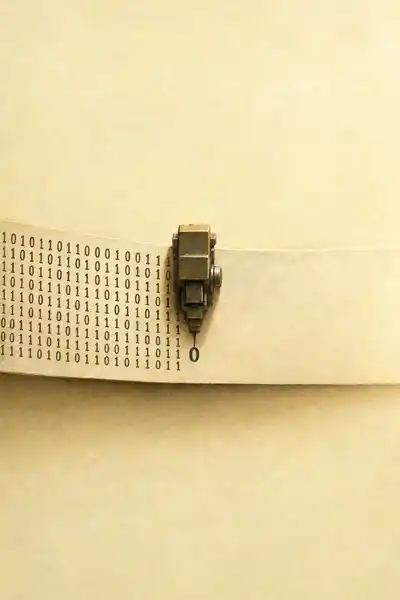
There is a strange move at the heart of computer science, and it happens before a single line of code is written. To reason about what any computer could ever do, you first have to build one out of nothing — a machine made of paper. A tape, a head that reads and writes symbols, a short list of rules. That was Alan Turing's idea in 1936, years before working electronic computers existed, and it remains the object that Harry Lewis and Christos Papadimitriou put at the center of their textbook, Elements of the Theory of Computation.
The book has been a fixture of the field since its first edition in 1981, and the second, published in 1998, softened the tone without softening the content. The authors set out to prove things that sound almost philosophical — that some problems can never be solved by any program, that some solvable problems would take longer than the age of the universe to finish — and to prove them with the plainness of a friend sketching on a napkin. They start with algorithms and complexity in the very first chapter, informally, and keep circling back to them.
What makes the book worth sitting with is that it treats computation as a subject with edges. Most of us meet computers as things that keep getting faster, and assume the frontier is only ever technological. Lewis and Papadimitriou are interested in the other kind of frontier: the one that no amount of hardware moves.
The question we’re asking : If we strip a computer down to its barest logical skeleton, what does that skeleton tell us about the limits of what computing can ever achieve?What we’ll see : How a handful of paper machines lets us draw sharp, permanent lines between what can be recognized, what can be solved, and what stays out of reach forever.
Table of contents
01Chapter 1 — A machine made of paper
Lewis and Papadimitriou do not open with silicon or circuits. They open with symbols on a page. The first genuine machine in their book is the finite automaton, which is about as simple as a machine can be: a small set of states, and rules that say which state to move to when the next symbol arrives. Feed it a string of characters, let it click from state to state, and check where it lands. If it lands in an accepting state, the machine has said yes. That is the whole apparatus. No memory to speak of, no scratch paper — just a finger tracing a diagram.
This modesty is the point. The authors want a device so stripped-down that we can prove things about it with certainty, and then ask what such a device can and cannot do. It turns out finite automata are exactly powerful enough to recognize patterns describable by regular expressions — the same regular expressions a programmer uses to search text. Two very different-looking descriptions, one machine and one notation, turn out to name the identical class of problems. Establishing that kind of equivalence, cleanly, is a large part of what the early chapters are for.

02Chapter 2 — What a machine can and cannot recognize
Climb one more rung and you reach the Turing machine, the device the whole book is quietly built toward. It looks barely more elaborate than what came before: an infinitely long tape divided into cells, a head that reads one symbol, writes one symbol, and shifts left or right, all governed by a finite table of rules. Yet Lewis and Papadimitriou make the case, carefully, that this humble object can carry out any computation that any machine could — that anything we would intuitively call an effective procedure, a Turing machine can perform.
This claim has a name, the Church-Turing thesis, and it is not a theorem but a proposal about what the word 'computable' should mean. The authors treat it with the seriousness it deserves. Every attempt to define computation more powerfully — adding tapes, adding randomness, dressing the machine up in the language of a modern programming environment — turns out to compute exactly the same set of functions. The tape-and-head model keeps winning. That convergence is the evidence that Turing captured something real rather than one arbitrary design among many.
03Chapter 3 — The wall between solvable and unsolvable
The far side is the halting problem, and it is the emotional peak of the book. The question is almost insultingly simple to state: given a program and an input, will the program eventually stop, or will it loop forever? Every working programmer wishes they had a tool that answered this. Lewis and Papadimitriou prove, following Turing, that no such tool can exist. Not that it is hard to build, not that we lack the technology — that it is impossible in principle, for any machine whatsoever.
The proof is a piece of intellectual theater the authors present with real care. Suppose a halting-detector existed. Then we could build a second program that consults the detector about itself and then does the opposite of what the detector predicts — halting when it is told it will loop, looping when it is told it will halt. This contraption cannot consistently exist, so the detector it depended on cannot exist either. It is the same self-referential trap Georg Cantor used to show some infinities outrun others, turned into a statement about programs. A machine, reasoning about machines, corners itself.
04Chapter 4 — When 'possible' still means 'hopeless'
Stepping back, the book's second half makes a subtler and, for daily life, more consequential point. Undecidability is a dramatic wall, but most of the problems we actually care about are decidable — a machine can solve them. The trouble is how long it takes. This is where complexity theory enters, and where Lewis and Papadimitriou shift from asking whether a problem can be solved at all to asking whether it can be solved before we run out of patience, or planet.
The dividing line they draw is between problems solvable in polynomial time — where the work grows manageably as the input gets larger — and problems that seem to demand exponential time, where adding a few items to the input can double the work, then double it again, until even a modest instance would outlast the universe. The first class, called P, is the practical world. The shadow over it is a family of problems, the NP-complete ones, that nobody has managed to place cleanly on either side. Scheduling, routing, packing, countless puzzles that look innocent turn out to belong to this family, all secretly the same problem wearing different clothes.
05Conclusion
The book ends more or less where it began, with a machine simple enough to fit on a napkin, and the reader now able to see how much that napkin decides. From a tape, a head, and a finite table of rules, Lewis and Papadimitriou extract the halting problem, the hierarchy of what different machines can recognize, and the still-open frontier between the tractable and the merely possible. The friendliness of the writing never softens the conclusions; it just makes them reachable without a running start in advanced mathematics.