

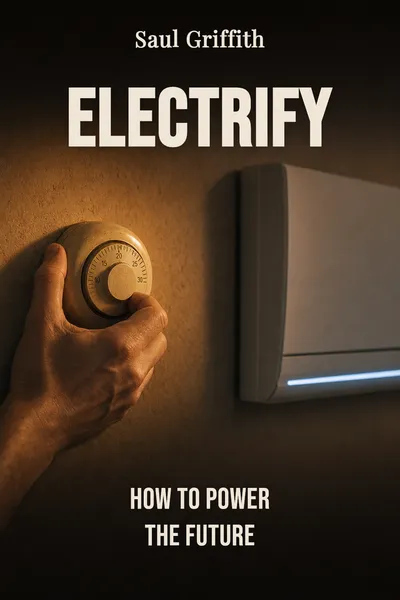
Electrify
How to power the future
Description
Saul Griffith is an engineer, not a preacher, and it shows in the way he starts. Before he tells us what to do about climate, he wants us to look at where the energy actually goes. In his 2021 book Electrify, he lays the American energy system out flat, the way you'd empty a drawer onto a table: how many units come in as coal, oil, and gas, how many get burned in cars, in furnaces, in power plants, and how much of it — more than half — simply vanishes as waste heat before it does a single useful thing. It's an unglamorous opening for a book about saving the planet. That's the point.
From that table, Griffith builds an argument that is almost aggressively concrete. He isn't interested in a distant breakthrough or a carbon tax that might pass someday. He wants to know what machines are in our houses right now, when they'll wear out, and what we should buy to replace them. Furnaces, water heaters, cars, stoves. His claim is that the technology to decarbonize most of daily life already exists, sits on shelves, and mostly needs to be installed the next time something breaks. The hard part isn't invention. It's swapping fast enough, at a price people can afford.
What makes the book unusual is that it treats climate as a plumbing problem — one of pipes, wires, machines, and loans — rather than a moral one. Griffith made a career measuring energy flows for the US government and for private clients, and he writes like someone who has actually counted the wires. The optimism, when it comes, is earned by arithmetic rather than asserted by hope.
The question we’re asking : If the clean-energy machines already exist, why haven't we simply installed them — and what would it actually take?What we’ll see : How Griffith reframes the climate fight as a question of what we plug in, what it costs, and who moves first.
Table of contents
01Chapter 1 — The energy we actually use
Griffith opens with an accounting exercise that most climate conversations skip. Every year, analysts publish a diagram of American energy — a spaghetti tangle of flows from sources like coal, gas, oil, nuclear, and renewables, running toward uses like transport, industry, and buildings. Griffith reads that diagram the way a doctor reads a chart. What jumps out at him is not how much energy the country produces but how much it throws away. Roughly two-thirds of the primary energy that enters the system is lost, mostly as heat, before it moves a car or warms a room.
The waste is not a scandal of carelessness. It's baked into combustion. When we burn gasoline in an engine, most of the fuel's energy leaves as heat through the radiator and the exhaust; only a modest fraction turns the wheels. A gas power plant throws away more than half of what it burns before the electricity even reaches the wire. This is thermodynamics, not laziness, and it means the true scale of the problem is smaller than the raw numbers suggest. We don't need to replace all that primary energy. We need to replace the useful work it eventually does.

02Chapter 2 — Why electrification beats efficiency
For decades, the mainstream climate strategy was efficiency: better insulation, tighter engines, LED bulbs, use less. Griffith doesn't dismiss it, but he thinks it quietly misdiagnoses the situation. Efficiency shaves the edges off a fossil system while leaving the fossil system in place. You can make a gas furnace burn a little cleaner, but it's still a gas furnace, still committed to combustion for its whole life. Efficiency alone, pushed to its limit, gets us a slower version of the crisis, not a way out.
His alternative is to electrify everything, and to power the electricity with renewables. The reason this works better isn't ideology; it's the physics from the previous chapter. Electric machines are radically more efficient than combustion ones, so switching the machine matters more than optimizing the fuel. Replace the gas car with an electric one and the emissions don't just shrink — the whole category of tailpipe loss disappears. Do it across cars, heating, cooking, and hot water, and the demand curve for the entire economy bends downward.
03Chapter 3 — The house, the car, the loan
Having reframed the problem as machines and money, Griffith goes looking for where the money can come from. His answer is unusually mundane for a climate book: mortgages and loans. If the clean machines are an investment that pays back over years, then the sensible way to buy them is the way we already buy the expensive things that pay back over years — with cheap, long-term financing. Nobody buys a house in cash and expects them to. Nobody should have to buy the machines that decarbonize a house in cash either.
This is where his engineer's instinct meets policy. The biggest barrier to an electric car or a heat pump, for most families, isn't the lifetime cost — which can be lower than the fossil version once fuel savings are counted — but the upfront price and the interest rate on the financing. A homeowner with access to a cheap loan can afford the swap; one without it is stuck burning gas for another fifteen years. Griffith argues that the cheapest, fastest climate policy might simply be to make low-interest financing for electrification widely available, backed by government the way home loans already are.
04Chapter 4 — Who has to move first
Step back from the appliances and the loans, and Griffith's real argument comes into view: the climate transition is less a technology problem than a coordination problem. The machines exist. The physics works. The money, over the lifespan of the equipment, pencils out. What's missing is the sequencing — getting millions of individual decisions, made at different kitchen tables in different years, to line up fast enough to matter. That is a problem of institutions, not inventions.
This reframing changes who the actors are. In the older climate story, the burden falls on individuals to consume less and feel guilty, or on a single grand policy — a carbon tax, a treaty — to fix everything from above. Griffith rejects both as too slow. His transition runs through three levels at once: individuals who electrify their homes when things break, industry that has to manufacture and install at a scale it currently can't, and government whose job is not to command but to lower the cost of borrowing and clear the regulatory path so the other two can move quickly.
05Conclusion
Griffith started by emptying the drawer — laying out where every unit of energy goes and how much of it is thrown away. By the end, that accounting exercise has become a plan: replace the machines that burn things with machines that don't, power them with clean electricity, and finance the swap the way we finance houses, one worn-out furnace and one dying car at a time. The waste heat that leaked out of the opening diagram is the same waste the whole strategy is built to eliminate.