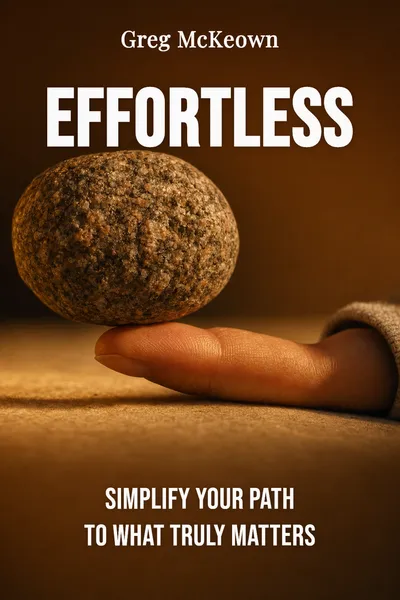
Effortless
Simplify your path to what truly matters
Description
The concept of "effortless" living, as proposed by Greg McKeown, is akin to wearing polarized sunglasses while fly-fishing. Without these glasses, the glare on the water obscures the fish swimming beneath the surface. However, once you put them on, the glare is filtered out, revealing the fish underneath. This analogy illustrates how we often struggle with tasks, blinded by the glare of effort and difficulty. But when we adopt an effortless approach, we can see the easier path that was always there, just hidden from view.
Of course, not everything in life can be made effortless. However, by making the right things less impossible, then easier, and ultimately effortless, we can achieve more. This approach involves making essential tasks easier and distractions harder, thereby stacking the deck in our favor. It's about discovering a new way of living that allows us to achieve more with ease, without burning out.
Table of contents
01 Step #1 – enter the state of ease:
Decluttering your mind and heart by eliminating distractions enhances focus, productivity, and well-being. Simplifying processes makes work easier and reduces stress. Being mindful and fully present improves time management, decision-making, and engagement, making tasks feel effortless.
FLIP: Pursue the simplest route.
Humans have a natural tendency to seek the path of least resistance, a characteristic that can be harnessed to make daunting tasks seem more manageable. By reimagining a challenging project not as a steep climb but as an opportunity for ease, we can make tasks more approachable and boost motivation. For example, William Wilberforce, a 19th-century British abolitionist, achieved success not by directly confronting slavery on moral grounds, but by cleverly altering maritime law to disrupt the slave trade. In a similar vein, Southwest Airlines managed to save $2 million by rethinking the concept of a ticket, moving away from industry norms. The initial step towards simplifying tasks involves questioning our assumptions and searching for simpler, yet valuable, solutions.
Reid Hoffman, the co-founder of LinkedIn, emphasized that a key business strategy is to tackle the simplest, easiest, and most valuable problem. When faced with a strategy that feels as arduous as pushing a boulder uphill, it's crucial to pause and consider, "What's the simplest way to achieve this result?" By setting aside the belief that an easier path is somehow less valuable, we can dissolve obstacles. This mindset can lead to innovative solutions that not only alter behaviors but also shift perceptions, making tasks feel less burdensome and more enticing. This approach encourages a reevaluation of challenges, promoting efficiency and creativity in problem-solving.
DELIGHT: Make tasks pleasurable
British activist Jane Tewson's brush with death in a Sudanese refugee camp back in 1981 was a pivotal moment that led her to rethink fundraising strategies for charities in the region. Recognizing the difficulty in soliciting donations, Tewson innovated by merging the act of giving with the pleasure of entertainment, specifically comedy on television. This ingenious blend gave birth to Comic Relief, a charity that has impressively amassed over $1 billion for various causes since its inception in 1988, thanks to events like Red Nose Days and other fundraising galas.
This concept of combining necessary tasks with enjoyable elements can be applied to everyday activities to enhance their appeal. For example, to stick to a daily fitness regimen such as running on a treadmill, one could simultaneously listen to a favorite podcast. This pairing can turn a potentially monotonous exercise into a much-anticipated part of one's day. Additionally, establishing rituals around routine activities can add a layer of enjoyment and meaning. Historical figures like Agatha Christie, who indulged in apples during her bath to inspire her mystery writing, or Beethoven, who counted out exactly sixty coffee beans for his morning brew, demonstrate that even the most unusual rituals can make ordinary tasks delightful. Adopting such practices can lead to a more playful and effortless approach to life, making even the mundane tasks a source of joy.

02 Step #2 – execute easeful action
Achieving an effortless state, streamline by eliminating unnecessary steps, not oversimplifying. Focus on essentials for efficiency and incremental progress. Simplification ensures manageability, sustainability, and consistent quality, yielding long-term benefits.
DETERMINE: Define the "Completed" state.
Effortless action is about achieving more with less exertion, advancing through measured pacing rather than forced efforts. When embarking on any essential project, it's imperative to first take a moment to clearly define what "done" means for that particular endeavor. Without a clear end goal, projects can become difficult to complete, as the lack of a defined endpoint can lead to mission drift and a collection of indistinct ideas. To circumvent this issue, it's beneficial to articulate and document what the completed state of the project will look like right at the start. This allows for a focused application of resources to reach the desired outcome. Furthermore, establishing a "Done-for-the-Day" list can aid in identifying what tasks will contribute to meaningful progress on your projects. This list should comprise tasks that, once finished by day's end, will leave you feeling accomplished and productive. By defining what a successful day entails, you can more effectively work towards making it a reality. This approach not only streamlines productivity but also aligns with the principle of making progress through a more relaxed and intentional mindset, rather than through relentless and often counterproductive effort.
INITIATE: Identify the clear first step.
Building momentum is a crucial part of achieving success. It involves creating a domino effect of small successes that propel you forward, much like Netflix co-founder Reed Hastings did when he started Netflix as a DVD delivery service. His first step was to mail a single CD to himself to see if it would get damaged in transit. When it arrived undamaged, he realized that sending DVDs by first-class mail could work, and this first step set the momentum for the growth of Netflix. If there isn't an obvious first step, another strategy is to commit to a 10-minute microburst of focused activity on the task. This simple start can increase motivation and energy levels. For instance, Marie Kondo's Konmari Method requires you to tidy your entire house all at once, but author Fumio Sasaki suggests starting by discarding something immediately. This approach makes the first step less intimidating and more likely to get you into action. Similarly, Silicon Valley companies advocate for building a minimum viable product to get customer feedback. This is akin to having a microburst as your initial step. By making the first step easy, momentum can power you onwards. Progress in tiny increments can add up to significant progress over time.
03 Step #3 – attain easeful outcomes:
Achieving exponential outcomes requires changing negative behaviors and thinking patterns to interrupt old habits and foster effectiveness. By focusing on strategic actions and creating new patterns, you can maximize potential and significantly impact results, ensuring sustained improvement.
EDUCATE: Continually enhance skills.
Leveraging the knowledge and skills of others is a wise tactic for achieving outstanding outcomes. This method entails grasping the overall concept and mastering the foundational principles rather than just memorizing facts and techniques. Elon Musk, the entrepreneur behind Tesla and SpaceX, is a notable example of this strategy. Despite common misconceptions, Musk lacked a background in mechanical engineering, physics, or rocket science when he started his ventures. He instead embraced a learning style that included extensive reading and employing seasoned professionals to educate him in the field. Musk's learning philosophy is akin to a semantic tree, emphasizing the importance of comprehending the core principles, akin to the trunk and main branches, before focusing on the finer details, or the leaves. This approach has allowed Musk to pioneer transformations across various sectors, such as space, energy, and transportation.
AMPLIFY: Utilize strengths.
Harnessing the strengths of others towards your goals can generate significant results. This can be achieved by teaching others, thereby creating a figurative army working towards your objectives. Teaching not only accelerates your own learning but also increases engagement as you focus more intently, listen to understand, and think about the underlying logic to put ideas into your own words. A powerful method to turn your audience into teachers is to become a good storyteller. Stories are easy to remember and share, making them an effective tool for teaching. Aesop, an ancient Greek storyteller, is a prime example of this, with his stories being retold for over 2,500 years. Similarly, A.G. Lafley, former CEO of Procter & Gamble, advocated for the "Sesame Street Simple" approach, emphasizing that messages should be straightforward enough for everyone to understand, repeat, and teach to others. By making essential things easy to teach and share, you can ensure that the results will follow.
Related books