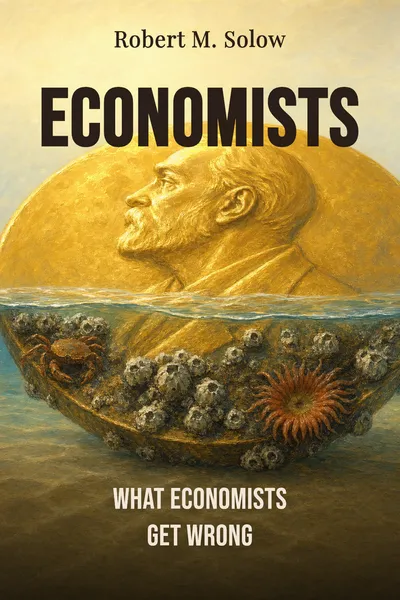
Economists
What economists get wrong
Description
Robert Solow won the Nobel Prize in economics in 1987, spent most of his career at MIT, and remained, until his death in 2023 at ninety-nine, one of the sharpest and driest voices the profession produced. He is the man who, when asked why productivity showed up everywhere except in the productivity statistics, coined the line about the computer age being visible everywhere but in the numbers. That instinct — to notice the gap between what economists claim and what they can actually show — runs through his writing about his own field. He never left economics. He just kept an eye on it.
In his essays and reviews about the discipline, gathered and returned to across decades, Solow does something economists rarely do in public: he talks about economics itself. Not the equations, but the habit of mind. What it is good at, where it fools itself, what happens when its practitioners step off campus and start advising presidents or writing op-eds. He is neither a booster nor a debunker. He is an insider who has watched the field promise more than it can deliver, and who thinks the honest response is to say so.
The result is a portrait of a discipline caught between real analytical power and a recurring temptation to overreach. Economics can illuminate a labor market or a growth path with a clarity no other social science matches. It can also mistake the tidiness of its models for the messiness of the world, and mistake technical training for wisdom about how people should live. Solow spent a lifetime holding both truths at once.
The question we’re asking : What does economics actually get right, and where does it reliably fool itself?What we’ll see : A Nobel laureate turns his attention to his own profession — its models, its blind spots, and what happens when it speaks in public.
Table of contents
01Chapter 1 — The model is not the world
Solow's first move, again and again, is to defend the economic model and then immediately qualify the defense. A model is a deliberate simplification: you strip away most of reality to isolate the mechanism you want to understand. Done well, it clarifies. You cannot think seriously about interest rates or trade or unemployment without some abstraction, because the full world is too noisy to reason about directly. On this, Solow is unembarrassed. He built models. He thought they were the right tool.
The trouble starts when economists forget that the simplification was deliberate. A model that assumes rational actors with stable preferences and full information can be useful precisely because it is false in a controlled way — it tells you what would happen if those conditions held. But the profession has a habit of sliding from "this is a useful fiction" to "this is how people are," and the slide is usually invisible to the person making it. The assumptions harden into beliefs about human nature.

02Chapter 2 — Growth, and the piece nobody could explain
Solow's own great contribution was to the theory of economic growth, and it is worth staying with because it shows him practicing what he preached. In the 1950s he built a model of how economies grow over the long run, feeding in capital and labor and watching what came out. The model was clean and it won him the Nobel. But its most famous result was a confession of ignorance rather than a claim of mastery.
When he measured how much of the growth in output could be explained by adding more capital and more workers, the numbers did not add up. A large share of growth — most of it, in the American data — came from something the model did not name. Solow labeled it technical change, or the residual: the improvement in how inputs get combined, the new methods, the better ideas. It became known, half-jokingly, as a measure of our ignorance. The biggest driver of prosperity was the part the theory could not account for.
03Chapter 3 — When economists talk to the public
The moment an economist steps outside the seminar room, Solow argues, the job changes and most economists do not notice. Inside the discipline, disagreement is normal, provisional, hedged with conditions. In public — advising a government, testifying to a committee, writing for a newspaper — the audience wants a verdict, and the temptation is to supply one with more confidence than the evidence supports. The hedges fall away. The maybe becomes a must.
Solow knew this terrain personally; he served on Kennedy's Council of Economic Advisers and spent decades as a public voice. He was sympathetic to the pull toward certainty — a policymaker cannot act on a shrug — but wary of what it does to the profession's honesty. An economist who tells the public that a policy will produce a precise result, when the honest answer is a range with real uncertainty, has traded credibility for influence, and eventually loses both.
04Chapter 4 — The uses and limits of a discipline
Read across the whole span, Solow's reflections point to a single question about what kind of thing economics is. Not whether it is a real science — he thought it plainly was, in the sense that it makes claims you can test against evidence and sometimes has to abandon them. The harder question is what sort of science: one that will eventually resemble physics, with universal laws and settled foundations, or one that is permanently partial, tied to institutions and history and the particular society it studies.
Solow came down firmly on the second view, and it colors everything. If economics is inescapably about human arrangements that differ across time and place, then the dream of a single master theory is not just unrealized but misconceived. The American labor market of the 1960s and a developing economy today are not two instances of one law; they are different subjects that happen to share a vocabulary. A discipline that forgets this exports models to places they do not fit and calls the failure a puzzle.
05Conclusion
The residual that Solow found in his growth model — the large, unnamed thing driving prosperity — turns out to be a fair emblem for his whole view of the field. Economics can measure a great deal precisely, and then there is the part it cannot reach, the part it has to admit it does not yet understand. His achievement was not to close that gap but to keep insisting it be marked honestly, on the map, in plain sight, rather than smoothed over for the sake of a tidier theory.
Related books