Economics Explained
How markets really work
Description
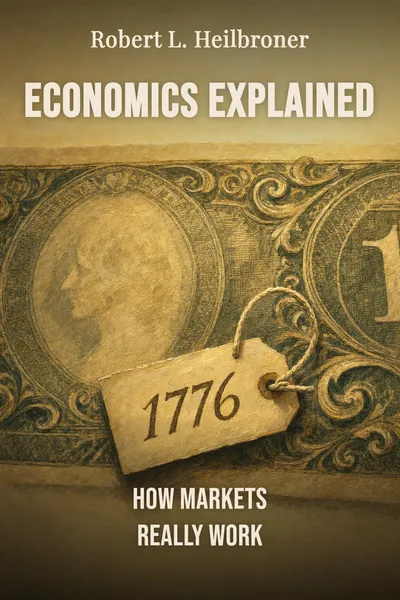
Robert Heilbroner spent a career doing something economists rarely bother with: explaining, in plain words, what the thing they study actually is. In 1982 he and William Milberg turned that habit into a short book called Economics Explained, aimed not at students cramming for exams but at ordinary readers who wanted to know why a recession happens, where money comes from, and what the word "market" really means once you stop treating it as furniture. Heilbroner had already written The Worldly Philosophers, a bestseller about the great economic thinkers. Here he tried the harder trick — not the biographies of the ideas, but the ideas themselves, laid out cleanly.
His starting move is disarming. Before defining supply or demand, he asks a prior question most textbooks skip entirely: why does a society need an economic system at all? The answer, for him, is almost boring in its clarity. Every human group has to solve two problems — produce enough to survive, and distribute the work and the rewards in a way that holds together. That is the whole game. Markets, prices, wages, taxes are just one historically recent way of answering it.
From that angle the familiar vocabulary of the business pages stops being technical jargon and starts being a set of names we gave to forces that were already running. Heilbroner's ambition was to hand the reader those names, and the reasoning behind them, so the daily churn of numbers becomes legible rather than intimidating.
The question we’re asking : When we talk about "the economy" and "the market," what exactly are we naming — and how much of it did we build ourselves?What we’ll see : How Heilbroner strips economics back to the two problems every society must solve, and rebuilds its whole vocabulary from there.
Table of contents
01Chapter 1 — The economy is a human invention, not a law of nature
Heilbroner opens by refusing to treat the economy as a natural object, like weather. It is a system of provisioning, and every society that has ever existed had one, though most looked nothing like ours. His favorite illustration is that for most of human history there was no economy in our sense at all. Production and distribution were handled by two mechanisms that predate markets by tens of thousands of years: tradition and command.
Tradition means the son does the father's work, land passes as it always has, and the harvest is shared the way custom dictates. Nobody calculates, nobody bids. A medieval village or a hunter-gatherer band runs on inherited rules, and it can run that way for centuries. Command means someone at the top — a pharaoh, a planning ministry — decides who produces what and who receives it. The pyramids were built by command; so was the Soviet steel quota. Both systems work, in the narrow sense that people get fed and things get made.

02Chapter 2 — The market was an idea that had to be fought for
If the market is an invention, it had inventors, and Heilbroner is careful to date it. Something recognizable as a market economy does not appear in Europe until roughly the sixteenth to eighteenth centuries. Before that, markets existed — fairs, ports, traders — but they were islands inside a world still governed by tradition and command. What changed was that land, labor, and money themselves became things you could buy and sell. When a peasant becomes a wage worker and land becomes real estate, the market stops being one activity among many and becomes the organizing principle of the whole society.
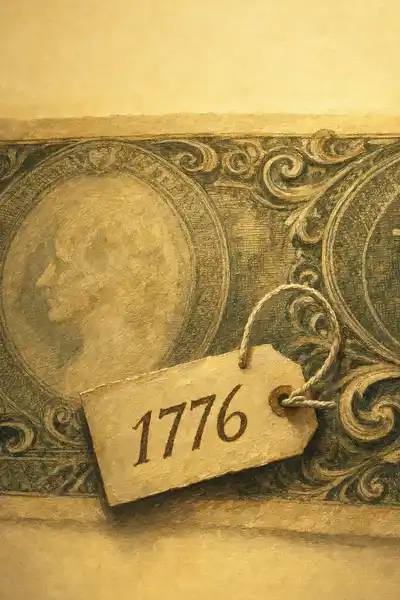
The reason this matters, in Heilbroner's telling, is that it required a genuinely new idea to make it respectable. For most of history, the pursuit of gain was regarded with suspicion, hedged by religion and custom. It took Adam Smith, in 1776, to argue that self-interest, left to compete in a market, would be disciplined into serving everyone. Smith's phrase for this was the invisible hand: the baker serves us not from benevolence but from his own advantage, and competition keeps him honest and his prices in check.
03Chapter 3 — What GDP, inflation and the rest actually name
Having established what a market is, Heilbroner turns to the vocabulary that tries to measure it — the macroeconomic terms that fill the news and confuse everyone. His method is consistent: define the word by the thing it counts, not by the equation. Gross Domestic Product, for instance, is simply the total money value of everything a country produces in a year. It sounds grand, but it is a headcount of output, and Heilbroner is quick to note what it leaves out — unpaid work, environmental damage, and the difference between building a hospital and rebuilding after a flood, which count the same in the total.
Inflation gets similarly plain treatment. It is not prices behaving badly; it is a general, sustained rise in the price level, which is the same thing as a fall in what a unit of money will buy. Money, he reminds us, has no value of its own — a banknote is a claim on goods, and inflation quietly shrinks that claim. He is careful with causes, treating the question as genuinely contested rather than settled, whether the pressure comes from too much demand chasing too few goods or from rising costs pushing prices up.
04Chapter 4 — The government inside the machine
The deepest thing Economics Explained argues, once the definitions are in place, is that the market and the government are not rivals in separate corners. They are woven into the same fabric. Heilbroner has little patience for the fantasy of a pure free market untouched by the state, because it never existed. Markets need enforceable contracts, honest money, courts, and property rules — all of which only a government can supply. The state is not an intruder in the machine; it is part of the machinery that lets the machine run.
This becomes concrete when he returns to Keynes. If total spending can fall short and stay short, then something outside the market has to step in when it does. Government spending, taxation, and the central bank's control of money become the levers by which a modern society tries to smooth the business cycle — to soften the slumps and cool the booms. Heilbroner presents this not as ideology but as the logic of the system itself: a market economy that swings needs a stabilizer, and the only institution large enough to be one is the state.
05Conclusion
The through-line of Economics Explained is the one Heilbroner set at the very start: the economy is a way a society solves the problems of production and distribution, and a market is one historically specific way of doing that. Everything else — GDP, inflation, the business cycle, the central bank — hangs off that frame. The vocabulary that looks forbidding on the business page turns out to be a set of names for forces that are, at bottom, human and legible.
Related books