Economic Liberalism and Under-development
Free markets, lasting poverty
Description
Frederick Clairmonte wrote his study of economic liberalism at a moment when the world was busy congratulating itself. The colonial empires were unwinding, new nations were raising flags, and the reigning wisdom held that if these young economies simply opened themselves to trade, played by the rules of the market, and let comparative advantage do its work, prosperity would follow. It was a hopeful story, and it had the elegance of good arithmetic. Clairmonte's book is a long, patient argument that the arithmetic was wrong — not by accident, but by design.
His question was blunt. If free markets were the engine of wealth, why had two centuries of expanding world trade left so much of the globe poorer, more dependent, and more locked into producing raw materials for someone else's factories? The doctrine promised convergence: the poor catching up to the rich. What Clairmonte saw instead was divergence that had hardened into structure. The countries selling cocoa, copper and cotton stayed sellers of cocoa, copper and cotton, while the countries that bought them kept the mills, the ships, the credit and the profit.
To make his case he goes back to the source — not to the poverty itself but to the ideas that framed it, the classical economists who built the case for laissez-faire and the trade relationships that grew up alongside their theories. He treats liberalism not as timeless truth but as a document with a date, an address, and a set of beneficiaries. Read that way, the promise of free markets starts to look less like a law of nature and more like an interested account of who should keep doing what.
The question we’re asking : If open markets create wealth, why has expanding world trade so often deepened the poverty of the countries that entered it?What we’ll see : How a persuasive economic doctrine, born in a particular time and place, came to organize a lasting division between the workshops of the world and its plantations.
Table of contents
01 Chapter 1 — The doctrine before the poverty
Clairmonte begins by refusing to treat underdevelopment as a starting condition, a kind of economic weather that some regions were simply born into. Poverty, in his account, is not the absence of development but a particular relationship to it — a position within a system that produces wealth in some places precisely because it drains it from others. The word matters. "Under-development" is not "pre-development." It names something done, not something merely missing.
The doctrine that organized this relationship was economic liberalism: the conviction that markets left to themselves allocate resources better than any state, and that free trade between nations makes everyone richer. Clairmonte grants the theory its intellectual seriousness. It was not a swindle dressed up as science. It was a genuine body of thought, argued by serious men, and it captured something real about the productive energy of markets. That is exactly what makes it dangerous, in his reading — a half-truth is far more durable than a lie.

02 Chapter 2 — The workshop and the plantation
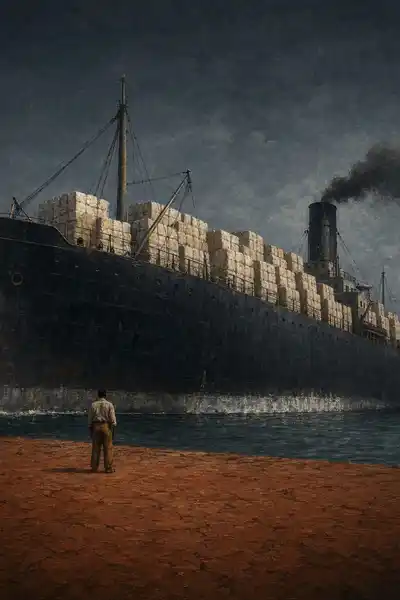
The heart of Clairmonte's argument is a picture of the world sorted into two kinds of economy. On one side stand the workshops — the industrial centers that manufacture, finance, ship and set prices. On the other stand the plantations and the mines: economies organized around a single crop or a single metal, selling it raw into markets they do not control. This is what free trade, over time, actually produced. Not a level field of equal traders, but a durable division of labor in which some do the labor and others keep the leverage.
The trap, he shows, is that specialization looks rational at every individual step. A country with good soil and cheap land grows sugar because sugar is what it can grow most cheaply; the textbook applauds. But a monocrop economy is hostage to a single price set far away, vulnerable to gluts, and stripped of any reason to build the industry that might one day let it escape. The very efficiency the theory praises is what closes the exit. Comparative advantage, followed faithfully, becomes a sentence rather than a strategy.
03 Chapter 3 — When the classics wrote the rules
To understand how this arrangement acquired its moral authority, Clairmonte returns to the classical economists themselves. Adam Smith, David Ricardo, and the tradition that followed them gave the emerging commercial order something it badly needed: a theory that made self-interest look like collective benefit and made the pursuit of profit look like a public good. Free trade was no longer just profitable for the strong; it was, according to the argument, good for everyone, everywhere, in the long run.
Ricardo's doctrine of comparative advantage is the pivot. It showed, with real elegance, that even a country good at nothing in particular could gain from trade by specializing where its disadvantage was smallest. Clairmonte does not dispute the logic on its own terms. He disputes what the logic quietly assumes: that the pattern of specialization is fixed and fair, that today's producer of raw wool is not thereby prevented from ever becoming a maker of cloth. The theory freezes a snapshot of relative strengths and calls it destiny.
04 Chapter 4 — A theory that travels light
Step back from the trade routes and the plantations, and Clairmonte's larger claim comes into focus: economic liberalism is remarkable less for its accuracy than for its portability. It travels light. It can be lifted out of the specific circumstances that made it plausible and applied anywhere, to any economy, as if history did not exist. That weightlessness is its genius and its deception. A doctrine that carries no memory of who it once served can present itself, in every new setting, as pure disinterested science.
This is why he insists on treating it as ideology rather than theorem. Not ideology in the sense of falsehood, but in the older sense: a set of ideas that organizes how a society sees itself and, crucially, obscures the interests it advances. Liberalism's power is that it makes an arrangement of unequal advantage feel like the outcome of free choices freely made. If a country stays poor while trading openly, the doctrine has a ready answer — it simply did not open enough, did not reform enough, did not trust the market enough. The failure is always the patient's, never the prescription's.
05 Conclusion
Clairmonte ends more or less where he began, with the mismatch between what economic liberalism promises and what expanding trade has actually produced. The workshops kept their machines and their leverage; the suppliers of raw goods kept supplying, decade after decade, on terms they did not set. The doctrine that assured them convergence delivered a division of labor that hardened into a hierarchy — and did so while insisting, all the while, that the outcome was the fair fruit of free exchange.
Related books