Economic Anthropology
Economies before the market
Description
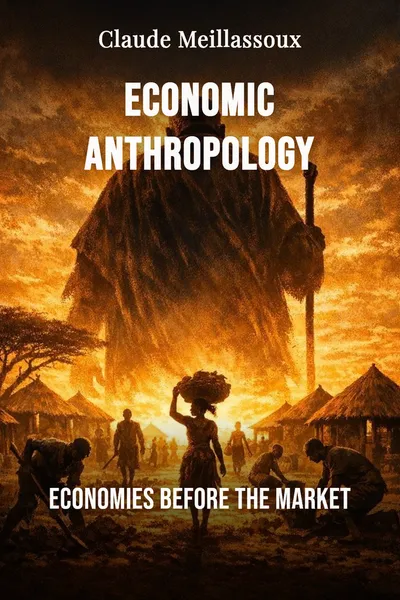
For most of human history, people fed themselves, raised children, buried their dead and paid their debts without anything we would recognize as a market. No prices, no wages, no money changing hands for labor. And yet goods moved, surpluses were produced and stored, obligations were honored. These were economies — full ones, with their own logic — they simply did not run on buying and selling. The uncomfortable fact at the center of Claude Meillassoux's work is that the arrangement we treat as the economy, the market, is a recent and local exception rather than the rule.
Meillassoux was a French anthropologist who spent years among agricultural societies in West Africa, watching how people organized production, distribution and kinship without the machinery economists assume is universal. What he found did not fit the textbook. Scarcity, self-interest, the rational calculation of costs against benefits — the concepts that economics treats as human nature turned out to describe one kind of society rather well and most others not at all. He set out to ask what economics looks like when we stop treating the market as the natural destination of every human group.
The project is less a critique than a widening. If we only ever study the economy through the categories built to explain our own, we see our own reflection everywhere and learn nothing about the astonishing variety of ways humans have organized material life. Economic anthropology takes that variety seriously, and in doing so it quietly unsettles the idea that economic laws are laws at all.
The question we’re asking : What were economies actually like before the market organized them, and what do they reveal about the categories we use to think about economics?What we’ll see : How non-market societies produced, shared and reproduced themselves — and what that long detour sends back to the discipline that forgot them.
Table of contents
01Chapter 1 — The market is not the economy
We tend to collapse two things into one word. The economy, in everyday speech, means markets — prices, supply and demand, the dance of self-interested buyers and sellers. Meillassoux's starting point is that this is a confusion of history with nature. The economy, in the broad sense, is simply the way a society organizes the production and circulation of what it needs to survive. The market is one historically specific way of doing that, and not the oldest or the most common.
Think of the sheer length of the human record. For tens of thousands of years, hunter-gatherer bands met their needs without accumulating, trading for profit, or treating land and labor as things to be bought. Agricultural communities that came later produced food, stored grain, redistributed surpluses and supported their elders — all through channels that had nothing to do with a price mechanism. These societies were not failed markets, waiting for coins to be invented. They were working systems with their own rules, and those rules were often explicitly designed to prevent the kind of accumulation a market rewards.

02Chapter 2 — Where the economist's tools stop working
The problem with carrying economic theory into a non-market society is that its instruments measure things that may not exist there. Take value. In a market, value appears as price, and price emerges from exchange. But in a society where land is not sold, where a daughter's marriage is settled in cattle and obligation rather than cash, where the harvest is redistributed by an elder according to rank — where is the price? There is movement of goods, there is clearly something being weighed and owed, but it refuses to resolve into a number. The economist's ruler does not fit the object.
This produced one of the long-running arguments in the field, between the formalists and the substantivists. The formalists held that economic theory applies everywhere: people always allocate scarce means among competing ends, so the logic of choice is universal and only the setting changes. The substantivists, following the historian Karl Polanyi, countered that the economy is embedded in social relations, that it takes radically different institutional shapes, and that market categories simply distort what they are laid over. Meillassoux worked firmly on the substantivist side, but he pushed further than description.
03Chapter 3 — Kinship as the first economic system
If the central economic problem of these societies was reproduction, then kinship was not a quaint custom sitting alongside the economy. Kinship was the economy. This is Meillassoux's sharpest contribution, drawn from his fieldwork in West Africa: in self-sustaining agricultural communities, the organization of family, marriage and generation was the mechanism that organized production, distribution and the renewal of the labor force. Who married whom, who owed labor to whom, who inherited what — these were the structures that kept the whole system running.
The decisive relationship was between elders and juniors. The elders controlled what Meillassoux called the means of reproduction, above all access to women and therefore to marriage and children. A young man could not simply take a wife; marriage required goods and permissions that only the elders commanded. So juniors worked the land under the direction of the old, not because they were paid, but because labor now bought the right to marry and reproduce later. Power rested on controlling the conditions under which the next generation could come into being, and that control was exercised through the idiom of family.
04Chapter 4 — What the long history corrects
Set economic anthropology beside economics and the mirror does its work. Economics presents its findings as laws — of supply and demand, of marginal utility, of the self-interested agent — in the register physics uses for gravity. But a law that holds in one kind of society and dissolves in most others is not a law of nature. It is the description of an institution. What Meillassoux and his colleagues established is that the market society in which those laws were discovered is a particular case, and that generalizing from it to all of human experience is a category error dressed up as science.
This does not make economics wrong about markets. It makes it provincial about everything else. When economists explain non-market behavior — gift-giving, kinship obligation, the refusal to accumulate — as irrational, or as a primitive stage on the road to proper markets, they are not analyzing those behaviors. They are failing to see them, because the only lens they carry assumes the market is the endpoint. Anthropology supplies the correction: these were coherent systems pursuing ends the market does not recognize, chiefly the reproduction of the group itself across generations.
05Conclusion
The societies Meillassoux studied had no stock exchanges, no wages, no prices, and they nonetheless managed the full weight of economic life — feeding their members, organizing labor, moving surpluses, ensuring there would be another generation to do it all again. What held them together was not the market but the structure of kinship, with its debts between young and old and its control over the conditions of reproduction. The economy was there all along; it was simply woven into relations that an observer looking for a marketplace would never think to count.
Related books