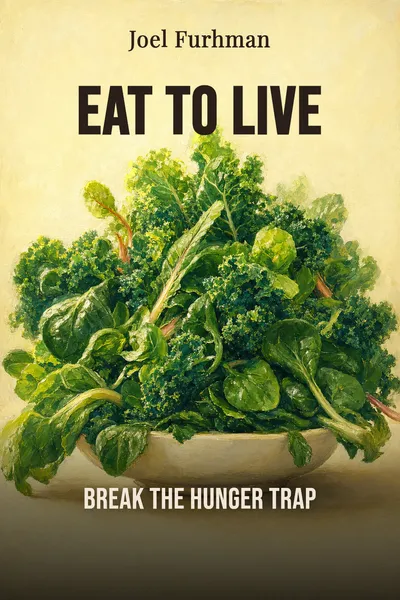
Eat to Live
Break the hunger trap
Description
Joel Fuhrman is a family physician who spent years watching patients cycle through the same experience: they lost weight, they felt miserable, they gained it back, and they blamed themselves. In 2003 he published Eat to Live, a book built around one deceptively plain instruction — eat foods with the most nutrients per calorie, and eat a lot of them. The book sold well, then kept selling, and in 2011 Fuhrman put out a revised edition with a chapter he hadn't been able to write the first time, because the idea in it had only crystallized later. That chapter is about hunger. Specifically, about the possibility that most of us have never felt real hunger in our adult lives, and have spent decades responding to something else entirely.
The claim sounds like a rhetorical flourish until you sit with what he means by it. The gnawing, shaky, irritable, must-eat-now sensation that shows up a few hours after a typical meal — the one we all call hunger — Fuhrman argues is not hunger at all. He calls it toxic hunger, and reads it as something closer to a withdrawal symptom: the body reacting to the tail end of digesting processed, low-nutrient food, not to an actual need for calories. If he's right, the whole architecture of dieting is built on a misread signal. We keep eating to make an uncomfortable feeling stop, and the feeling was never telling us what we thought.
Eat to Live is usually filed under weight-loss books, and it does contain a six-week plan with a lot of vegetables in it. But the more interesting thing it does is reframe why the plan is so hard at first and so easy later. It treats craving as a physiological event with a beginning and an end, not a character flaw. And it points at a mechanism — food behaving like an addictive substance — that lets the reader stop moralizing about their own appetite and start reading it differently.
The question we’re asking : What if the hunger that drives us to overeat isn't hunger at all, but a symptom we've been feeding instead of curing?What we’ll see : How Fuhrman rebuilt weight loss around nutrient density, why the first weeks feel like withdrawal, and what it means to call food addictive.
Table of contents
01 Chapter 1 — The equation nobody wants to hear
Fuhrman's whole method compresses into a formula he writes as H = N / C: health equals nutrients divided by calories. The idea is that the body needs a certain load of micronutrients — vitamins, minerals, phytochemicals, fiber, the compounds packed into plants — and that most modern eating delivers plenty of calories while starving us of that load. The fix isn't to eat less in the sense of shrinking portions and enduring it. It's to shift toward foods where the ratio runs high: leafy greens, other vegetables, beans, fruit, some nuts and seeds. Eat those, and the calories take care of themselves.
This is where Eat to Live parts ways with the diets it's usually shelved beside. Calorie counting treats food as a budget to be rationed. Low-carb treats one macronutrient as the villain. Fuhrman's move is to make nutrient density the organizing principle and let quantity be generous. A large salad, a pot of vegetable soup, a bowl of beans and greens — you can eat a genuinely large volume of this food and still take in fewer calories than a small fast-food meal, because the density runs the other way. Fullness comes from volume and fiber, not from calories.

02 Chapter 2 — The withdrawal we mistake for appetite
The new material in the 2011 edition centers on a sensation everyone knows and almost nobody questions. A few hours after eating, a familiar discomfort arrives: a hollow feeling in the stomach, sometimes a headache, fatigue, shakiness, difficulty concentrating, irritability. We read all of it as one word — hungry — and we eat, and it goes away. Fuhrman's claim is that we've misidentified the whole experience. Those symptoms, he argues, aren't the body signaling a real need for fuel. They're the body finishing the work of processing low-quality food, and reacting to that process the way it reacts to withdrawal.
He calls it toxic hunger, and contrasts it with what he calls true hunger — a cleaner, calmer sensation felt in the throat and mouth, without the headache and jitters, that shows up only when the body genuinely needs more. Most people eating a standard diet, he suspects, rarely if ever feel the true version. They're kept in a near-constant loop of the toxic one, eating every few hours to suppress symptoms that eating actually caused. The meal that relieves the discomfort is also the meal that guarantees it will return.
03 Chapter 3 — Density over restriction
Once toxic hunger is on the table, the six-week program reads differently. It's not a test of endurance; it's a detox with a predictable arc. The early days are genuinely uncomfortable — Fuhrman is honest that people feel worse before they feel better, with fatigue, headaches, and cravings that can be intense. This is the withdrawal phase, and he frames it as evidence the mechanism is real. The symptoms that flare when someone cuts processed food, caffeine, and sugar are the toxic-hunger signals surfacing without their usual suppressant. Push through, and something shifts.
What shifts is the baseline. As the body adapts to a diet dense in micronutrients, Fuhrman reports that the between-meal discomfort fades. People stop feeling the shaky, headachy urgency. They start feeling true hunger instead — later, milder, easier to sit with. Cravings that once felt overpowering lose their grip, not because the person got stronger but because the physiological driver went quiet. The overeating that seemed like a personality trait turns out to have been tethered to the food itself.
04 Chapter 4 — When the fix is a diagnosis
Step back from the meal plan and the more provocative move in Eat to Live is what it does to the word addiction. Fuhrman is arguing, in plain terms, that food — certain food, eaten habitually — can behave like a drug: it produces discomfort on withdrawal, that discomfort drives repeated use, and the use is misread by the person doing it as ordinary need. This is a diagnosis, not a scolding. And it reframes a person who can't stop overeating not as someone with weak resolve but as someone in a chemical loop they were never told they were in.
That framing has teeth because of how much of medicine and culture treats weight as a matter of character. The overweight patient is assumed to lack discipline; the diet that fails is assumed to have failed because the person cheated. Fuhrman's toxic-hunger model relocates the cause into physiology, where it can be addressed by changing the input rather than by demanding more virtue. Since 2011 the broader science of food reward, ultra-processed foods, and the mechanisms that make certain foods hard to stop eating has moved in a direction that rhymes with his intuition, even where the details are still argued over.
05 Conclusion
Fuhrman started from a clinician's frustration: patients who did everything the diet books told them and still failed, still hungry, still blaming themselves. Eat to Live's answer was to stop trusting the hunger. The formula — nutrients over calories — is the visible half of the book, but the toxic-hunger chapter is the part that changes how the plate feels rather than what's on it. If the urgent discomfort between meals is a symptom of poor eating rather than a call for more food, then the hardest thing about eating well isn't sustaining it. It's the first six weeks, when the old signal goes quiet.
Related books