

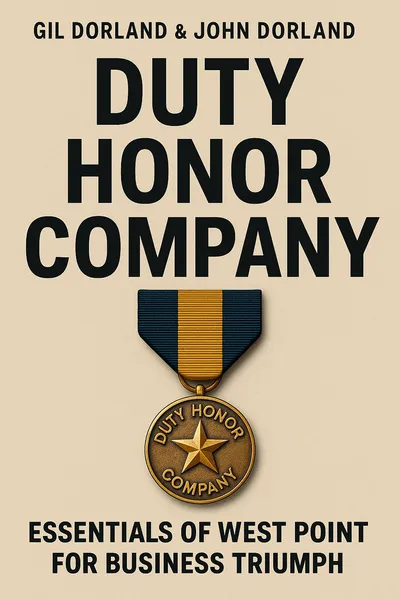
Duty honor company
Essentials of west point for business triumph
Description
The underlying pillars of duty, honor and country from West Point can be adapted to business as duty, honor and company. Leadership and ethics should be top priorities for business managers. Getting out front to lead, inspire and motivate coworkers is essential. With strong leadership and high ethical standards focused on the company's success, the enterprise can flourish.
However, business is fundamentally different than war - it should aim to create value, not destroy. Competition can drive innovation but cooperation is also vital. The goal is win-win relationships, not zero-sum victories. Ultimately business succeeds by serving society, not defeating
Table of contents
01Section 1 - applying military leadership
Business leadership is deeply rooted in military leadership practices, with the primary difference being the terminology used. The core principles of leadership in both fields emphasize the importance of uniform principles, clear mission statements, the development of leaders over managers, high ethical standards, discipline, a well-defined organizational structure, appropriate attire, character development, recognition of achievements, morale building, valuing real-world experience, ongoing training, balancing creativity with longevity, and inspiring positive action.
One of the foundational aspects of military leadership that translates directly into business is the emphasis on operating under a unified set of principles. This approach ensures that all members of an organization are aligned and working towards common goals. Similarly, having a clear and concise mission statement is crucial in both military and business contexts, as it provides a clear direction and purpose for the organization. Developing leaders rather than managers is another principle borrowed from military practices. Leadership training programs like those at West Point focus on self-improvement, proficiency, responsibility, decision-making, setting an example, and team development. These principles are equally applicable in the business world, where leadership is about guiding teams to achieve objectives rather than merely managing tasks. Ethics play a significant role in both military and business leadership. The military teaches its personnel to consider the implications of their actions, ensuring they do not deceive, unfairly gain advantage, or would be dissatisfied if on the receiving end of their actions. These ethical considerations are just as important in business, where ethical lapses can lead to the downfall of a company.

02Section 2 - adapting battle planning
Effective business planning can greatly benefit from the application of military principles, which have been proven to be successful in various high-stakes situations. One of the key ideas to apply is the concept that decisions should be made by individuals, not groups, as this promotes accountability and leads to higher quality decisions. Military history shows that decisive victories often come from a singular strategic direction, and this can be translated into the business context by having a clear decision-making process.
In this process, it is important to clearly define the problem, list all related assumptions, analyze relevant facts, and weigh the pros and cons of each potential solution. Drawing definitive conclusions and providing explicit recommendations are also crucial steps. Staff should be encouraged to present solutions rather than just identifying problems, which means they need to conduct sufficient analysis to suggest viable solutions or recommendations before engaging with superiors.
Planning must be comprehensive and address the who, what, when, where, why, and how, as well as determine the capabilities, resources, strengths, and weaknesses of all relevant parties, including competitors. Without systematically gathering and evaluating intelligence, businesses risk being unprepared for the challenges they face. Asking "What if?" is a valuable exercise in contingency planning, allowing businesses to prepare for various scenarios and respond rapidly and adaptively to changes in the market or competitive actions.
Understanding the target consumers is critical for business success. Sales revenue depends on meeting customer needs, so products should be designed and marketed with the consumer in mind. This involves conducting analysis that includes setting clear objectives, describing the market, profiling target consumers, evaluating potential approaches with their pros and cons, drawing conclusions, and recommending actions with clear rationales. Such analysis will inform the necessary positioning and messaging for the product or service.
03Section 3 - using war strategies in business
The strategies and tactics used in battle have long been recognized for their applicability to managing a business. The fundamentals for success on the battlefield have remained constant over time, suggesting that proven tactics will continue to work in various contexts. While it is true that consumer tastes and technology evolve, human nature remains largely unchanged. Businesses, like armies, seek competitive advantages by improving product features and employing decentralized operations to stay agile and responsive.
Military strategies emphasize the importance of unexpected, bold, and aggressive actions, often described as audacious. The key traits of successful military attacks—surprise, concentration, speed, flexibility, and audacity—are equally relevant in the business world. Small companies, in particular, need audacity to compete with larger rivals. Identifying and quickly servicing niche markets before competitors can respond requires speed and coordination to maintain momentum. Concentrating resources in one area, rather than spreading them thinly, is more effective and mirrors the military principle of massing forces for a decisive effort. Many business initiatives fail due to insufficient audacity in leveraging advantages for maximum yield.
After achieving a victory, whether on the battlefield or in the marketplace, it is crucial to adopt a temporary defensive posture to consolidate gains before pursuing long-term benefits. Analyzing and anticipating competitors’ responses is essential. The adage that the best defense is a good offense reflects the mindset of maintaining readiness for a vigilant counterattack. Defenders should plan for worst-case scenarios, contain initial penetrations, secure necessary resources, identify additional support options, ensure ease of movement and simple plans, and communicate the counterattack strategy to everyone involved.