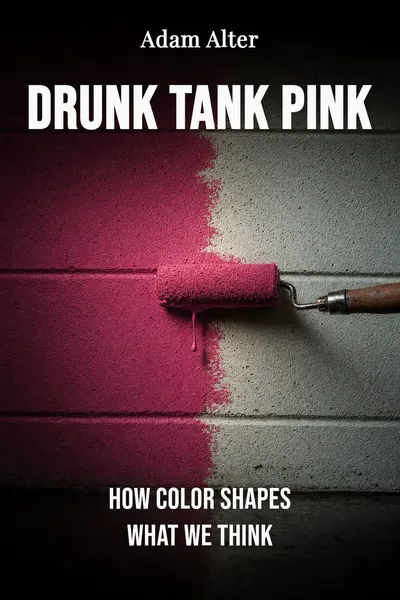
Drunk Tank Pink
How color shapes what we think
Description
In the late 1970s, a Navy correctional officer in Seattle named Gene Baker painted the walls of a holding cell a specific shade of bubblegum pink. He'd read that the color might calm agitated inmates, and he wanted to test it. The commanding officers whose names ended up on the study, Baker and Miller, gave the shade its lasting label: Baker-Miller pink, or, more memorably, drunk tank pink. Reports came back that men held in the pink cell grew less hostile within minutes, sometimes before they'd been there fifteen. The finding traveled fast. Prisons repainted. A visiting-team locker room at the University of Iowa football stadium got a coat of it, on the theory that it would sap the opponents' aggression before kickoff.
The trouble is that the effect never held up cleanly. Follow-up studies produced weaker results, or none, and some found the calm wore off or reversed. But the pink cell is the perfect doorway into a stranger and better-documented truth, and it's the one the psychologist Adam Alter uses to open his book. The color of a wall may or may not soften a drunk man's temper. What is not in doubt is that the world around us — its colors, its names, its weather, the strangers in the room — is quietly editing our thoughts while we're convinced we're doing the thinking ourselves.
Alter's argument is that the mind is far more porous than we like to believe. We experience our choices as the output of a private, sovereign self. In practice, a surprising share of what we decide is written by cues we never registered — a font, a temperature, a first name, the size of the crowd. The pink cell is famous because it feels absurd. The uncomfortable part is how ordinary the rest of the evidence is.
The question we’re asking : How much of what we judge, choose, and feel is actually authored by the world around us rather than by us?What we’ll see : How color, language, faces, weather, and the presence of others reach into decisions we're sure we made alone.
Table of contents
01 Chapter 1 — A cell painted the color of Pepto-Bismol
Alter opens with the pink cell because it is the loud, improbable version of a quiet, well-supported idea. Alexander Schauss, a researcher who championed the shade in the late 1970s, claimed that even people who tried to resist its effect couldn't — that the color drained muscular strength on contact. The prison at Naval Correctional in Seattle became the proving ground, and for a while the story spread as settled fact. Sports teams painted opposing locker rooms. Buses meant to calm rowdy passengers got the treatment. A single wall color, it seemed, could rewrite a mood.
The honest complication is that the science was shaky. Schauss's strength-draining demonstrations didn't replicate well, and controlled studies of the calming effect were mixed at best. Alter doesn't hide this; he uses it. The point isn't that drunk tank pink is a proven sedative. The point is that we found the claim plausible enough to repaint prisons over it, because at some level we already suspect that our surroundings work on us in ways we can't feel. The pink cell is a hunch the culture acted on before the data arrived.

02 Chapter 2 — The words that steer the eye that steers the choice
If color slips past our attention, language does it even more thoroughly, because we assume words are neutral carriers of meaning rather than active shapers of it. Alter draws heavily on the research tradition around framing and priming to make the case that the exact words in a question, or even the fluency with which a name reads, tilts judgment in directions we'd never endorse if we could see them happening.
Consider names. Alter reports on studies suggesting that people, companies, and even stocks with names that are easy to pronounce are treated more favorably than those with awkward, hard-to-read ones. Shares with fluent ticker symbols were found to perform marginally better in the days after a company went public — not because the businesses were sounder, but because investors process an easy name as an easy, trustworthy thing. The ease of reading gets misattributed as the safety of the bet. It's a small distortion, repeated across millions of decisions, that adds up to real money moving on the basis of phonetics.
03 Chapter 3 — Faces, weather, and the crowd we didn't notice
From here the book widens outward, from the colors and words closest to us to the people and conditions surrounding us. Faces come first, because we read them faster than almost anything, and Alter marshals evidence that we read far too much into them. In one striking line of research, people shown photographs of rival political candidates for a fraction of a second — too brief to reason about anything — could predict the winners of real elections at rates well above chance, simply by picking the face that looked more competent. Voters believe they weigh policy. A good part of the vote, it seems, is decided by a jawline.
Weather works on us with the same invisibility. Alter cites findings that stockbrokers trade more optimistically on sunny mornings, that college admissions officers may weight applicants' academic strengths more heavily on cloudy days and their social strengths on sunny ones, and that people report higher life satisfaction when the sun happens to be out during the survey. The weather is not about us. It has nothing to do with the applicant's transcript or the market's fundamentals. Yet it seeps into the verdict, and the verdict is then defended as a considered judgment about the thing itself.
04 Chapter 4 — The self we think we own
Step back from the individual studies and Drunk Tank Pink is making one large, unsettling claim about selfhood. We carry around an intuition that there is a stable person at the center of us — an author who takes in the facts, weighs them, and issues decisions from a private control room. Alter's accumulated evidence suggests that control room is far more open to the street than we imagine. The color of the wall, the ease of a name, the sun on the window, the number of people watching: these aren't decorations around the self. They are, in part, inputs to it.
The implication that lands hardest is not that we're occasionally fooled. It's that the feeling of authorship is nearly automatic and nearly always available, regardless of what actually drove the choice. The mind is, in Alter's telling, a relentless narrator. It hands us a coherent story — I chose this because it was right — and files away the wall, the weather, the crowd as background noise that surely didn't matter. The confidence is the problem. We are most sure we're thinking freely precisely when we can't see the strings.
05 Conclusion
The pink cell, in the end, was never really about pink. The color may or may not calm a drunk man; the studies never quite agreed. What the story delivered was a frame — the idea that a wall could reach into a mind — and once that frame is in place, the rest of the evidence stops looking exotic. The red exam booklet, the fluent ticker, the competent jawline, the sunny morning, the silent crowd: each one is a small pink cell, editing a judgment we're certain we made alone.
Related books