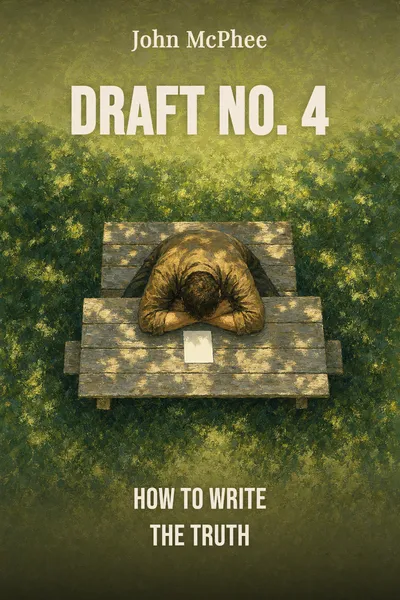
Draft No. 4
How to write the truth
Description
For decades, students at Princeton took a class simply known by its course number, and the man teaching it had a peculiar way of talking about writing. He didn't lead with voice or inspiration. He drew diagrams. He'd sketch the shape of a piece on a legal pad — a spiral, a fork in a road, the letters ABC/D — as if a magazine article were a bridge that had to hold weight. John McPhee had been publishing in The New Yorker since 1965, and by the time he gathered his teaching into a book in 2017, he'd spent half a century turning geology, oranges, canoes and shad into some of the most admired nonfiction in the language.
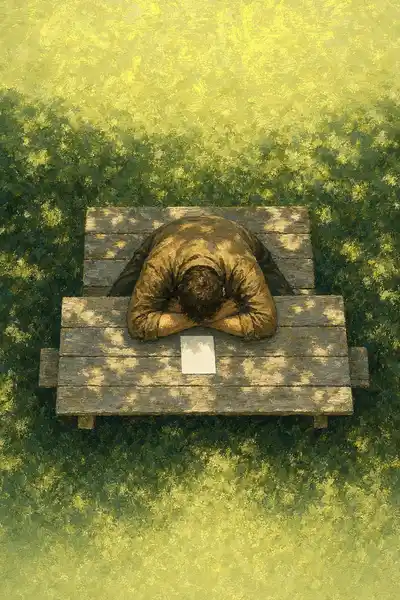
That book, Draft No. 4, is not the writing manual anyone expected. There is no pep talk, no promise that the words will flow. Instead there's a man describing, with almost surgical calm, how he once lay on a picnic table for two weeks unable to start, and how the panic of the blank page is not a flaw in the process but the process itself. The title comes from his own count: the first draft is misery, the second and third are labor, and the fourth is where the writing finally becomes writing.
What makes the book strange and useful is that it treats nonfiction as a problem of engineering more than of feeling. The facts are fixed; you cannot invent them. So the whole art migrates elsewhere — into the order of things, the cut, the transition, the single verb that carries a paragraph. The freedom is real, but it lives inside a fence, and McPhee spends the book showing us exactly where that fence runs.
The question we’re asking : How do you make true writing come alive when you're forbidden from inventing anything?What we’ll see : How one of nonfiction's great craftsmen built a whole method out of structure, revision, and the hard rule that the facts come first.
Table of contents
01Chapter 1 — The problem is always structure
Before McPhee writes a sentence he can keep, he decides on a shape. This is the least glamorous and, in his telling, the most important decision a nonfiction writer makes. He describes returning from reporting with a chaos of notes — interviews, observations, quotations, facts that refuse to sit in the order they arrived — and the first real task being to find the form that will hold them. Not to summarize the material, but to build an architecture the reader can walk through without getting lost.
His examples are almost engineering blueprints. For a profile of an art collector, he arranged the piece around the man's paintings, letting each canvas open a new stretch of the story. For a piece on the Atchafalaya, he used the geography of the river itself. Famously, one essay was structured in the shape of the letters ABC over D, with three strands running in parallel above a single continuous fourth. He drew these structures out before writing, sometimes on index cards he could physically reorder on a table.

02Chapter 2 — Where the first draft comes from
McPhee is unusually candid about how bad the beginning feels. He describes the days spent avoiding the first sentence, the lying on the picnic table, the sense of having no ability at all — and he treats this not as a personal weakness but as a universal condition of the work. The blank page, he writes, is where every writer discovers whether they have anything. His remedy is not confidence. It's permission to write badly.
The first draft, in his method, is meant to be terrible. Its only job is to exist, to get something down that the later drafts can operate on. He recommends writing it fast and low, telling yourself that no one will ever see it, addressing it in your head to someone forgiving — your mother, he suggests, or a close friend — so the internal editor stops strangling every sentence. You cannot revise a blank page. You can revise a bad one.
03Chapter 3 — Cutting is a form of respect
Some of McPhee's sharpest advice is about what to remove. He worked for years at The New Yorker under editors who cut for space, and he came to see the enforced deletion not as damage but as improvement. A piece that has to lose ten percent almost always gets better, because the material that survives the cut is the material that earned its place. Excess, he argues, is easy; compression is hard and it is where quality lives.
He tells the story of writing to length under strict constraints, and of the discipline that produced. When every line has to justify its existence, sentimentality falls away and precision takes over. He distinguishes between two kinds of cutting: pulling out a self-contained block, which is clean and painless, and trimming within a sentence, which is delicate surgery. Both matter, and both require the writer to be honest about what the reader actually needs versus what the writer is fond of.
04Chapter 4 — The line between shaping and lying
For all his talk of structure and selection, McPhee draws one line he will not cross, and Draft No. 4 keeps returning to it: in nonfiction, you do not make things up. Not a quotation, not a detail, not a composite character, not a rearranged fact presented as if it happened otherwise. The whole architecture of his craft — the shaping, the cutting, the choosing — operates strictly inside the boundary of the true. This is what makes the book, underneath its practical advice, a quiet argument about what the genre owes its readers.
The tension he explores is that structure and selection are themselves forms of power. Deciding what comes first, what gets emphasized, what falls away — these choices bend the reader's experience, and a dishonest writer could use them to mislead while touching no single false fact. McPhee's answer is that the writer's obligation is not just to avoid invented facts but to avoid arrangements that create false impressions. You can leave things out, but you cannot leave things out in order to deceive. The shaping serves clarity, not distortion.
05Conclusion
By the time Draft No. 4 gathers all this together, the picture of writing it offers is almost the opposite of the romantic one. There is no muse, no flow, no gift descending on the fortunate. There is a man on a picnic table, a stack of index cards, a dictionary open to a word he doesn't quite have yet, and a fourth draft where the sentences finally start to work. The method is patient, procedural, and available to anyone willing to endure the bad first draft to reach the good later ones.
Related books