

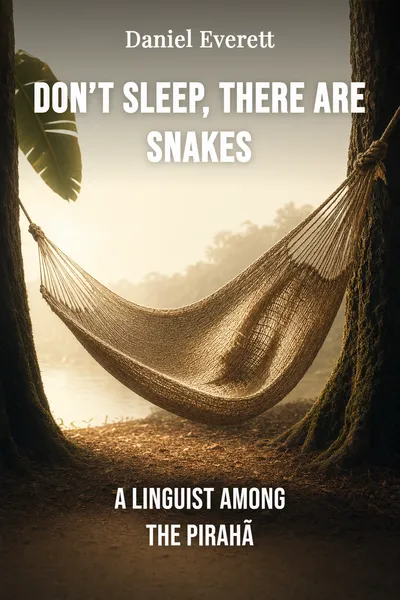
Don’t Sleep, There Are Snakes
A linguist among the Pirahã
Description
In 1977, a young American named Daniel Everett took a boat up the Maici River, a tributary deep in the Brazilian Amazon, with his wife and small children and a single goal: to translate the Bible into the language of the Pirahã. He had trained for it. He knew phonetics, he knew field methods, he carried the conviction of a man sent by God to a people who had no word for him. The Pirahã, a few hundred hunter-gatherers scattered along the riverbank, greeted him with curiosity and total indifference to his mission. Years of work lay ahead. So did one of the strangest intellectual journeys in modern linguistics.
Everett stayed, on and off, for some thirty years. He learned a tongue so difficult that fluent outsiders could be counted on one hand. He survived malaria, a near-fatal poisoning, and a flood that nearly took his family. And slowly he noticed things that did not fit. The Pirahã seemed to have no numbers, no fixed words for colors, no creation stories, no memory of ancestors more than a generation or two back. They laughed easily and slept little. They did not, in the end, want what he had come to give them — and the longer he watched, the less sure he became of who was converting whom.
The title comes from a phrase the Pirahã use at nightfall, a casual goodnight that doubles as a warning about the riverbank. It also names a book that started a fight. For Everett came home arguing that this small tribe spoke a language whose grammar broke a rule that the most influential theory in the field had declared unbreakable.
The question we’re asking : What did one linguist find on the Maici that turned his mission, and then his discipline, upside down?What we’ll see : A life among the Pirahã, a language built around the here and now, and the quiet challenge it threw at the idea of a universal human grammar.
Table of contents
01Chapter 1 — A missionary on the Maici River
Everett did not arrive as an adventurer. He came through the Summer Institute of Linguistics, an evangelical organization that trains people to learn unwritten languages and translate scripture into them. The deal was straightforward and demanding: live with the people, master the speech nobody had written down, and render the Gospel of Mark into it. The Pirahã had defeated previous attempts. Their language had no obvious relatives, a tiny inventory of sounds, and a tonal, sung quality that let speakers hum or whistle whole sentences. It was, by reputation, close to unlearnable.
The method was brutal in its simplicity. Everett would point at things, repeat what he heard, and build a dictionary one misunderstanding at a time. He describes the early years as a fog of half-grasped words and exhausting trial and error, punctuated by the ordinary terror of raising young children far from any hospital. At one point his wife and daughter nearly died of malaria; getting them downriver to help took days. The forest did not care about his project.

02Chapter 2 — A language that lives in the present
The deeper Everett went, the more the absences piled up. The Pirahã, he reports, have no numbers at all — not even "one" and "two" — only loose terms for a small amount and a larger amount. They cannot be taught to count, not for lack of intelligence but because counting answers no question they care to ask. They have no fixed color words, describing shades by comparison to things in the world. They have no myths of how the world began, no genealogies reaching back, no fiction. Their art is sparse and fleeting.
Everett came to think these were not separate quirks but expressions of a single principle, which he called the immediacy of experience. The Pirahã talk about what is happening now, what is directly witnessed, or what was witnessed by someone alive who told them. A claim that cannot be tied to lived experience tends not to be made. This is not a taboo they recite; it is a habit so deep it shapes what counts as worth saying. A people anchored that firmly in the present has little use for numbers, abstract recurring labels, or stories of an unseen beginning.
03Chapter 3 — The grammar that wasn't supposed to exist
The claim that turned Everett into a controversial figure concerns something technical: recursion. In the dominant theory of language, associated above all with Noam Chomsky, the human mind comes equipped with a universal grammar, and one of its prized features is the ability to embed a phrase inside another phrase without limit. We say "the man who lives by the river that floods every year is my friend," tucking clause inside clause. Some linguists had come to treat this recursive nesting as the defining trait of human language, possibly the one thing that made it unique.
Everett's argument, built on decades on the Maici, was that Pirahã does not do this. Where other languages embed, Pirahã lines sentences up side by side. Instead of "I said that you should come," a speaker produces something closer to a string of separate statements. He tied this, again, to the immediacy of experience: a culture that resists piling abstraction on abstraction will not develop the grammatical machinery for it either. If he was right, recursion was not a universal hardwired into every human brain. It was one option among several, and a small Amazonian tribe had quietly declined it.
04Chapter 4 — What one small tribe asks of everyone else
Step back from the quarrel over recursion and the larger wager comes into view. For decades the consensus held that the architecture of language sits below culture — that grammar is a property of the species, indifferent to whether you herd reindeer or trade futures. Everett's years among the Pirahã push the opposite case: that a people's relationship to time, evidence, and experience can reach all the way down and shape the bones of their speech. If that is true even once, the picture of a single grammar wired identically into every human mind starts to wobble.
The Pirahã matter here precisely because they are so easy to dismiss as a footnote. A theory of all human language cannot pick and choose its evidence; the awkward case is the one that tests it. Everett is not arguing that the Pirahã are primitive or limited — he is at pains to show the opposite, a culture sophisticated enough to live well, fish expertly, and reject what does not serve it. The point is that their priorities, not some deficit, account for what their language does and does not do.
05Conclusion
Everett's book closes the loop that opened the day he could not say whether he had met the man he was preaching about. He arrived to give the Pirahã a story and stayed to discover that they had no place for stories about the unseen — and that this was not a hole in their world but the shape of it. The language carried the same stamp: present-tense, anchored in experience, declining the abstractions that other tongues reach for by reflex. The mission failed. The fieldwork succeeded beyond anything he had imagined, and it cost him the very certainty that had sent him upriver.