
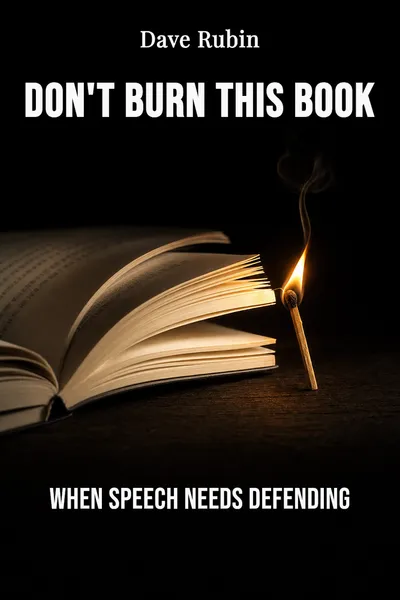
Don't Burn This Book
When speech needs defending
Description
Around 2015, Dave Rubin was a comedian-turned-host with a comfortable spot in progressive media. He had worked at The Young Turks, the loud online news network, and he held the positions you would expect: pro-choice, pro-gay-marriage, suspicious of the right, certain that his side had the better arguments. Then he started a long-form interview show, The Rubin Report, and began doing something that sounds harmless and turned out not to be — he let guests he disagreed with finish their sentences. He talked to libertarians, conservatives, the occasional provocateur. He listened. And somewhere in those conversations he noticed that he could no longer reliably defend half of what he believed, because he had never actually examined it.
What followed was a public unraveling and a public reassembly. Rubin describes drifting away from the progressive left, getting labeled a sellout and worse, losing friends, and finding himself adopted by people who had been his opponents the week before. "Don't Burn This Book," published in 2020, is his account of that journey written as a kind of survival manual for anyone feeling the same quiet panic — the sense that you are no longer allowed to ask certain questions out loud, and that asking them anyway will cost you something.
The book is part memoir, part argument, part instruction kit. Its bet is that the antidote to a culture of outrage isn't more outrage from the other direction; it's the slower, less satisfying work of thinking a position through and being willing to say what you actually conclude. The title is a dare and a warning at once. We come to it not for the politics but for the method underneath them.
The question we’re asking : What does it take to keep thinking for yourself once disagreeing out loud has a social price?What we’ll see : How one host's drift across the political map became an argument for engagement over outrage — and what his break reveals about the tribes he left and joined.
Table of contents
01Chapter 1 — The host who stopped knowing his own positions
Rubin's starting point is almost embarrassingly ordinary. He was a progressive because the people around him were progressive, because it was the default of the rooms he worked in, and because it felt good — morally settled, socially rewarded. He could recite the talking points. What he could not do, once he started interviewing people who held opposite views, was reconstruct the reasoning behind his own. He had inherited conclusions without the arguments that produced them, and the interviews kept exposing the gap.
The show itself did the damage, in his telling. Long-form conversation is unforgiving to slogans. When a guest spoke for an hour without being cut off or shouted down, their position stopped being a caricature and became a set of claims you either could or could not answer. Rubin found he often could not. Worse, he found that the format he had absorbed in cable-style media — the gotcha, the dunk, the clip engineered to humiliate — was useless once the goal shifted from winning the segment to actually understanding what the other person believed.

02Chapter 2 — Think for yourself, even when it costs you the room
The core instruction of the book is stated plainly and repeated often: think for yourself. Rubin treats this less as a slogan than as a discipline, because the hard part isn't forming an independent view — it's holding it when the room turns. He is candid about the cost. As he drifted, he was called a grifter, a sellout, a useful idiot for the right. Old allies stopped speaking to him. The accusation that stung most, he says, was that he had abandoned his principles, when his experience was the opposite: he had finally started examining them.
He insists the goal is not to flip from one tribe to another. The trap, as he describes it, is that someone who breaks with the left gets immediately conscripted by the right, handed a new set of conclusions to recite, and never actually does the thinking that the break was supposed to be about. Rubin's claim is that he tried to resist this — to land on positions issue by issue rather than buy a package. He stayed liberal on some things and moved on others, and found that this à la carte stance annoyed everyone, which he takes as a sign he was doing it right.
03Chapter 3 — The toolkit: facts, principles, and a thicker skin
Having argued the why, the book turns into something closer to a handbook for the how. Rubin lays out a set of habits for anyone trying to navigate political conversation without either capitulating or losing their nerve. The first is a near-obsessive return to facts over feelings. He urges readers to separate what is verifiably true from what merely feels true given their priors, and to be especially suspicious when a claim flatters their own side. The most uncomfortable facts, he notes, are usually the ones worth checking.
The second tool is principle over party. He recommends deciding what you believe about a given matter — free expression, due process, the limits of state power — and then applying it consistently, even when consistency lands you on the unpopular side of a specific case. The point of a principle, in his framing, is precisely that it binds you when it's inconvenient; a principle you abandon the moment it costs you something was never a principle, just a preference in disguise.
04Chapter 4 — What a defection says about the tribes themselves
Step back from Rubin the individual and his story becomes a small case study in how political tribes manage their members. The intensity of the reaction to his drift — the speed of the labels, the severing of friendships — says less about him than about the groups he left and joined. A community that treats a member's honest questions as betrayal is revealing something about its own confidence. You don't excommunicate someone over a position you're sure you can defend; you do it over one you'd rather not have to.
Rubin's experience illustrates a feature of tribes that long predates the internet: the deviant gets punished more harshly than the outsider. An opponent who never belonged is merely wrong. A member who starts asking the forbidden questions is dangerous, because their doubt is contagious from the inside. This is why his break felt to former allies less like a disagreement and more like apostasy — and why the language used against him borrowed so heavily from the vocabulary of heresy.
05Conclusion
The host who once couldn't reconstruct his own positions ended up writing a book whose entire premise is that you should be able to. Rubin's path took him from a settled corner of progressive media out into a no-man's-land where he answered to no party and was claimed, uncomfortably, by several. "Don't Burn This Book" is his attempt to turn that disorientation into something usable for other people feeling the first tug of the same doubt — the suspicion that they're holding views they've never actually inspected.
Related books