Does God Play Dice?
Chaos theory rewrites reality
Description
When Einstein wrote to Max Born in December 1926 that God "does not play dice," he was quarrelling with quantum mechanics — the new physics that made the universe run on probabilities rather than certainties. He wanted a world where, if we knew enough, everything would follow. Ian Stewart, the British mathematician who has spent a career making hard maths speak plainly, borrows that line for the title of his book and then quietly turns it against Einstein. The dice, it turns out, were already on the table long before the quantum. They were hiding inside classical physics, in the equations Newton himself wrote down.
Stewart's subject is chaos: the discovery that perfectly deterministic systems — systems with no randomness anywhere in their rules — can produce behaviour so tangled that it looks, for all practical purposes, like chance. A dripping tap, a swinging pendulum, the weather, the wobble of a planet. None of these break Newton's laws. They obey them exactly. And yet they cannot be predicted. That paradox is the crack that ran through twentieth-century science, and Stewart's book traces it from a French mathematician's failed prize essay to the electrode in a modern heart.
First published in 1989 and revised a decade later, the book arrived while chaos was still a fashionable word, freighted with butterflies and hype. Stewart's project is to strip the mysticism away and keep the mathematics — to show that chaos is neither doom nor magic but a genuine third thing, sitting between the orderly and the random, and that once we see it we stop reading the world quite the same way.
The question we’re asking : If the laws of physics are exact and deterministic, why is so much of the world impossible to predict?What we’ll see : How a two-word rebuke to quantum theory ended up describing tap water, planetary orbits and the rhythm of a failing heart.
Table of contents
01 Chapter 1 — The clockwork universe that never was
For roughly two centuries after Newton published his laws of motion in 1687, physics ran on a single confident assumption: the universe is a machine. Give it a set of starting conditions — where every particle is, how fast it moves — and the equations grind out the future, forever, with no ambiguity. The French mathematician Pierre-Simon Laplace put it most boldly around 1814, imagining an intellect vast enough to know the present state of everything. For such a mind, he wrote, nothing would be uncertain; the future, like the past, would lie open before its eyes. Prediction was just a matter of computing power.
Stewart lingers on this picture because it is so seductive and so wrong. The clockwork universe worked beautifully for the cases that made it famous — the return of a comet, the eclipse timed to the minute, the tide tables. These are the tidy problems, the ones where small causes produce small, proportionate effects. Nudge the input a little and the output shifts a little. The whole edifice of engineering and astronomy was built on that reassuring proportionality, and it held so well that its limits went almost unnoticed.

02 Chapter 2 — Three bodies, and the end of certainty
The man who first glimpsed the crack was Henri Poincaré, and he did it while trying to win a prize. In 1889 King Oscar II of Sweden offered a reward for a solution to a version of the many-body problem: would the solar system remain stable forever, or might a planet one day fly off? Poincaré submitted an essay, was awarded the prize, and then, while the work was being prepared for publication, found an error in his own reasoning. Correcting it, he discovered something far stranger than the stability he had hoped to prove.
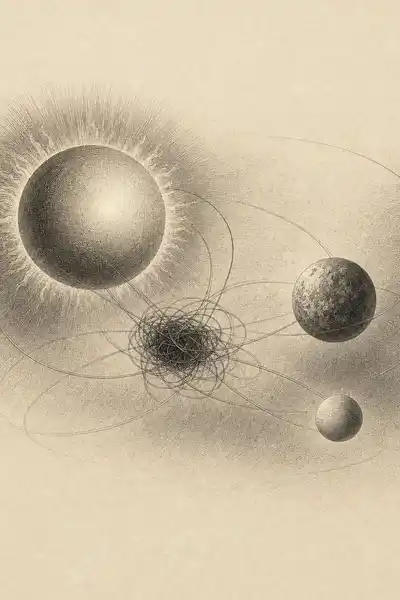
In the corrected work, Poincaré found that the orbits in even a simplified three-body system could tangle into a mesh of infinite complexity — trajectories that crossed and recrossed in a pattern he admitted he could not even draw. He wrote, with visible unease, that the figure was so complicated he would not attempt to sketch it. What he had stumbled onto was sensitive dependence: the property that two starting points, however close, can end up following wildly divergent paths. Stewart presents Poincaré not as a prophet but as an honest mathematician who followed his equations into territory he found genuinely disturbing.
03 Chapter 3 — When simple rules go wild
The heart of Stewart's book is a claim that still surprises people: chaos does not require complicated equations. It can spring from rules a schoolchild could follow. His favourite example is a single line of arithmetic used to model animal populations — take a number between zero and one, multiply it by itself subtracted from one, scale it up, and feed the answer back in. Repeat. For gentle settings of the scaling knob the population settles to a steady value. Turn the knob and it starts to oscillate between two values, then four, then eight, and then, past a certain point, it stops settling into any pattern at all.
This cascade — the period-doubling road into chaos — was mapped in the 1970s by the physicist Mitchell Feigenbaum, who noticed that the successive doublings arrive at a fixed ratio, roughly 4.669, the same number for a whole family of different systems. Stewart makes much of this, and rightly: it means chaos has universal structure. The onset of unpredictability is not itself unpredictable. There are laws of the lawless. A system that has become impossible to forecast in detail can still be described precisely at the level of its overall pattern.
04 Chapter 4 — The shape of the unpredictable
Step back from the tap and the weather and the wandering moon, and the deeper thing Stewart is doing becomes clear: he is quietly dismantling the old opposition between order and randomness. For centuries those were the only two boxes. A thing either obeyed a law you could compute, or it was chance, dice, luck. Chaos is the discovery that there is a third box, and that most of the interesting world lives in it — deterministic to its core, yet as unforecastable as any coin toss. Determinism, Stewart insists, never promised predictability. We simply assumed it did, because the examples we grew up on were the well-behaved ones.
This reframing changes what science can honestly ask for. Long-range weather prediction is not a technology waiting to be perfected; it is mathematically foreclosed, because the atmosphere amplifies the tiniest uncertainty until it fills the whole forecast. That sounds like defeat, but Stewart flips it. If you cannot control a chaotic system by overpowering it, you can sometimes steer it with almost nothing — because it is so sensitive, a whisper of a nudge at the right moment sends it where you want. Chaos is a handle as much as a barrier.
05 Conclusion
The book that began with a two-word rebuke to quantum theory ends by turning the rebuke inside out. Einstein wanted certainty underneath appearances, a world where randomness was only ignorance in disguise. Chaos grants him the deterministic laws he longed for and then denies him the predictability he thought came with them. Poincaré's tangled orbits, Lorenz's runaway forecast, Feigenbaum's universal number, the arithmetic of a population that will not settle — all of them describe a cosmos that follows its rules exactly and still cannot be read ahead.
Related books