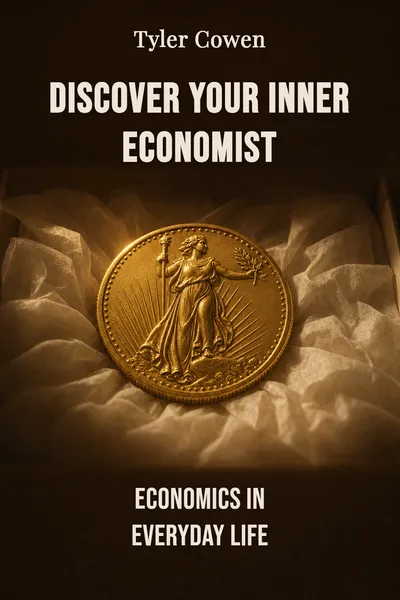
Discover Your Inner Economist
Economics in everyday life
Description
Tyler Cowen has a problem most economists would envy. He is one of the most respected members of his field — a professor at George Mason University, the mind behind the blog Marginal Revolution — and yet the questions that fascinate him are almost embarrassingly small. Why do children refuse to clean their rooms? Why does a paid dishwasher work harder than a guilty spouse? Why do the best meals so often come from the shabbiest restaurants? In his 2007 book Discover Your Inner Economist, Cowen decided these were not distractions from serious economics. They were the whole point of it.
The book arrived in a moment when economics was busy leaving the trading floor. Freakonomics had shown, two years earlier, that the tools of the discipline could be aimed at cheating teachers and drug gangs. Cowen took the move one step further and turned the lens inward — onto the reader's own kitchen, marriage, bookshelf, and travel plans. His claim is deceptively cheerful: everyone already has an inner economist, a faculty for weighing costs, incentives, and scarce attention. Most of us just deploy it clumsily, or at the worst possible moments.
What makes the book more than a bag of tricks is where Cowen keeps landing. Again and again, the everyday puzzle turns out to hinge not on money but on motivation — on what happens to our desire when someone pays us, praises us, or hands us a rule to follow. The inner economist, it turns out, is less an accountant than a student of human wanting.
The question we’re asking : Can the cold logic of incentives really tell us how to live an ordinary day — and does it hold up once money enters the room?What we’ll see : How Cowen turns economic reasoning loose on chores, restaurants, museums, and gifts, until the discipline starts to look like something other than a science of money.
Table of contents
01Chapter 1 — The price of a favor is never zero
Cowen opens with a scene every household knows: getting someone to do something they would rather not do. His example is disarmingly domestic — persuading a child to keep a bedroom tidy, or coaxing more effort out of a spouse. The instinctive move is to offer money, or to nag. Both, Cowen argues, tend to backfire, and the reason is one of the book's central threads. Incentives do not simply add motivation on top of what is already there. They can crowd it out.
The idea draws on a body of research Cowen weaves in as story rather than citation. When you pay someone for a task they were doing out of pride, duty, or affection, you quietly reclassify it. It stops being a gift and becomes a job. And a job priced at a few dollars is worth, precisely, a few dollars — no more. The child who once tidied to please a parent now calculates whether the allowance is worth the trouble. The favor that cost nothing to ask was, in a sense, the most valuable version of it.

02Chapter 2 — When paying more buys less
If the first lesson is that paying can backfire, the second complicates it further: sometimes paying more delivers less than paying nothing at all. Cowen is fascinated by the ways money changes the meaning of an exchange, not just its size. He returns often to the difference between what he calls the world of markets and the world of gifts — two systems that run on incompatible logic and that we constantly, clumsily, mix up.
Consider generosity. A friend cooks you dinner; you feel warmly indebted. Now imagine the friend hands you an itemized bill for ingredients and labor, priced fairly at what a restaurant would charge. The transaction is objectively better value, and yet something has curdled. Cowen uses cases like this to show that the gift economy is not inefficient sentimentality to be corrected by pricing. It runs on trust, reciprocity, and the deliberate refusal to keep exact score — and those are precisely the things a price tag erases.
03Chapter 3 — The museum, the meal, and the art of wanting
Halfway through, the book turns from other people to ourselves, and to what may be Cowen's favorite subject: how to enjoy things. He is a famous devotee of ethnic restaurants, cheap street food, and the overlooked corners of culture, and he treats pleasure as a problem of scarce attention rather than abundant supply. We are drowning in available experiences. The binding constraint is not access but focus.
His restaurant heuristics have become the book's most quoted section. Seek out places where the rent is low and the clientele is discerning, because that combination lets ambition survive on thin margins. Beautiful, comfortable dining rooms in prime locations are, perversely, a warning sign — you are paying for the ambience, and the kitchen knows it can coast. The best food often hides behind ugly signage in strip malls, where the only thing the owner can compete on is the food itself. It is pure incentive analysis, applied to lunch.
04Chapter 4 — Incentives are everywhere, and mostly invisible
Step back from the chores and the restaurants, and a single idea holds the book together. For Cowen, economics is not really the study of money. It is the study of incentives — the mostly invisible pushes and pulls that shape what people do — and money is only its loudest and least interesting instrument. The reason the discipline can wander into kitchens and museums is that incentives are already there, quietly at work, long before any cash changes hands.
This is why Discover Your Inner Economist keeps dissolving the boundary between the economic and the personal. Praise is an incentive. Guilt is an incentive. The desire to see ourselves as generous, disciplined, or cultured is an incentive powerful enough to move us where no bonus could. Cowen's contribution is to insist these are not soft substitutes for real economics but its proper subject matter — the actual levers behind most of human behavior, hiding in plain sight because they carry no price tag.
05Conclusion
By the end, the promise of the title has quietly reversed itself. We came expecting to discover an inner accountant, someone better at getting value for money, and we leave with something stranger: a heightened awareness of everything money cannot touch. Cowen's inner economist spends most of his energy on motivation, meaning, and attention — the scarce goods that no price can create and that a careless price can destroy. The chores, the meals, the museum galleries were never really about efficiency. They were rehearsals for noticing.
Related books