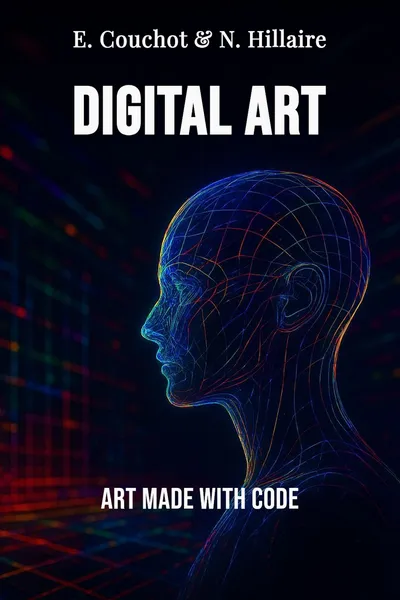
Digital Art
Art made with code
Description
In the late 1950s, in an American ballistics laboratory, a mathematician named Ben Laposky was pointing a camera at an oscilloscope. The device was built to measure electrical signals; Laposky fed it waveforms and photographed the glowing curves that danced across the screen. He called the images Oscillons. They were among the first pictures anyone had made by asking a machine to draw. A few years later, engineers in Germany and the United States — people like Georg Nees, Frieder Nake, A. Michael Noll — started feeding instructions to plotters and computers, and hanging the results on gallery walls. Almost nobody in the art world knew what to make of them.
Edmond Couchot and Norbert Hillaire, two French thinkers who spent decades watching this field grow, tell that story in their book Digital Art — but they refuse to treat it as a gadget show. Their subject is not the hardware. It is what happens to the very idea of a work of art when the brush is replaced by an algorithm, when the artist writes a rule instead of making a mark, and when the finished piece can be copied endlessly with no loss. That shift, they argue, is not a footnote to art history. It reorganizes it.
We tend to imagine digital art as a recent arrival, something that showed up with screens and social feeds. Couchot and Hillaire push the clock back and widen the frame. What they trace is a slow negotiation between the human hand and the calculating machine — a negotiation that unsettles the categories we inherited from painting, photography, and cinema, and that quietly dismantles one of art's oldest certainties: that somewhere there is an original.
The question we’re asking : What actually changes about art when the artist writes code instead of holding a brush?What we’ll see : How images made by machines moved from a laboratory curiosity to a form that redefines authorship, viewing, and the very notion of an original work.
Table of contents
01Chapter 1 — The machine learns to draw
The first computer images did not come from artists. They came from engineers and scientists who happened to have access to expensive machines and a curiosity about what they could produce. Couchot and Hillaire situate the true beginning in the mid-1960s, when Georg Nees and Frieder Nake in Germany, and A. Michael Noll at Bell Labs in the United States, independently exhibited plotter drawings generated by programs. These were geometric, austere, often built from random number generators told to stay inside strict limits. Nake exhibited in 1965; the same year, Noll showed work in New York. The pictures looked like nothing painting had prepared us for.
What made them art, or refused to, was a live question from the start. A machine following instructions seemed the opposite of inspiration. Yet the authors point out that the programmer chose the rules, the constraints, the range within which chance could wander. The randomness was authored. This is the paradox that runs through the whole book: the more the artist hands over to computation, the more the real creative act migrates upstream, into the design of the process rather than the execution of the image.

02Chapter 2 — Programs, systems, and the artist who steps back
If the first chapter of digital art was the plotter drawing, the deeper story is the rise of the artist as designer of systems rather than maker of objects. Couchot and Hillaire lean on a distinction that predates computing: between the work as a finished thing and the work as a program that generates things. Once you write a rule capable of producing thousands of variations, which one is the artwork? The output on the wall, or the generative engine behind it? The authors argue the center of gravity shifts to the engine.
This is where the book's key concept enters: what Couchot calls the move from representation to simulation. A painting represents — it stands in for something absent. A digital simulation, by contrast, models a behavior and lets it run. It does not depict a wave; it computes one, and the wave can respond, change, evolve. The artist becomes closer to a legislator than a painter, setting the laws of a small world and watching what emerges. Emergence — outcomes the author did not explicitly plan but made possible — becomes a signature of the form.
03Chapter 3 — When the viewer completes the work
The most consequential thing digital art added, in Couchot and Hillaire's account, is interactivity. A traditional artwork is finished before we meet it; we look, it does not look back. An interactive installation is different. It waits. It responds to our movement, our voice, our touch, and it is not fully itself until someone acts on it. The authors treat this as a genuine mutation, not a gimmick — a shift in the ontology of the work, in what kind of thing it even is.
They trace precedents in kinetic and participatory art of the 1960s, but computation changed the scale and depth of the exchange. A digital system can sense, calculate, and answer in real time, so the loop between spectator and work tightens into something like a conversation. Myron Krueger, an American pioneer, built responsive environments in the 1970s where a projected silhouette of the visitor interacted with graphic elements — he called the field artificial reality years before virtual reality became a slogan. The visitor was no longer in front of the image. The visitor was inside the loop.
04Chapter 4 — What a work becomes when it has no original
Nearly a century ago, Walter Benjamin worried about what mechanical reproduction would do to art — how photography and film, by making endless copies, would strip away the 'aura' of the unique object rooted in a single place and moment. Couchot and Hillaire pick up exactly there, and note that digital art pushes his question past its breaking point. Benjamin still had a negative, a master print, an original from which copies descended. In a purely digital work there is often no original at all. There is code, data, a state that can be recomputed identically anywhere, forever, with no first instance that the others are copies of.
This is the quiet radicalism the authors keep circling back to. A file is not a copy in Benjamin's sense; it is the thing itself, indistinguishable from every other instance. The distinction between original and reproduction, which underwrote the entire economy and mystique of art — auction houses, provenance, the aura of the one true canvas — simply dissolves. The digital work is not devalued by reproduction; it is constituted by it. Reproducibility is not what happens to the work afterward. It is what the work is made of.
05Conclusion
Ben Laposky's Oscillons hang in museum collections now, curiosities from a moment before anyone had a name for what was being born. What began as light traced on an oscilloscope in a ballistics lab became, over sixty years, a form that quietly undid some of art's oldest assumptions: that the artist makes the mark, that the work is finished before we arrive, that somewhere there is an original the rest of us only copy. Couchot and Hillaire follow that undoing from the first plotter drawings through generative systems and interactive environments, insisting throughout that the interesting part was never the technology but the shift underneath it.
Related books