
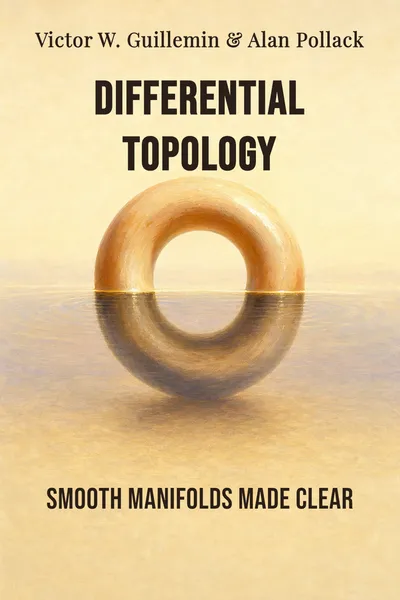
Differential Topology
Smooth manifolds made clear
Description
Picture a sphere — the surface of an orange, say. If we shrink ourselves down and stand on it, it looks flat. We can draw axes, measure distances, do ordinary calculus, and nothing seems to warn us that the ground curves away in every direction and eventually loops back on itself. That gap — between what a surface looks like up close and what it does globally — is where a whole branch of mathematics lives. Guillemin and Pollack's Differential Topology, first published in 1974 and still in print half a century later, is the book that made that gap feel navigable to generations of students who arrived knowing only undergraduate calculus and linear algebra.
The objects in question are called smooth manifolds: spaces that look, at any small scale, like ordinary flat space, but which can be twisted, curved, or knotted at large scale. A circle, a sphere, a doughnut, the space of all possible rotations of a rigid body — all of them are manifolds. The subject asks what we can say about such shapes when we allow ourselves to bend them freely but never tear or crease them. It sounds abstract, and in the wrong hands it becomes a wall of heavy machinery. What made this particular book a standard text is that it refuses the machinery and bets everything on a single, almost visual idea.
That idea is transversality — roughly, the study of how shapes cross one another when they meet. It seems like a small thing to build a course on. And yet from it the authors draw some of the deepest results in the field, the kind that connect the counting of solutions to equations, the fixed points of maps, and the flow of a fluid across a boundary. The book is short, self-contained, and unusually generous with the reader. It is worth asking why so slim a volume earned its place.
The question we’re asking : How does a single, almost geometric idea — how shapes cross when they meet — replace the heavy apparatus most textbooks lean on?What we’ll see : How Guillemin and Pollack build the world of smooth manifolds from intuition, and let one recurring idea carry the weight of the field's hardest theorems.
Table of contents
01Chapter 1 — The surface you can walk without falling off the edge
The book opens where the reader already lives: in ordinary Euclidean space, with the calculus of several variables that any analysis course has covered. Rather than defining a manifold abstractly, as some texts do, Guillemin and Pollack keep it concrete. A manifold is a subset of some larger flat space that looks locally like a piece of lower-dimensional flat space. A circle sitting in the plane looks, near any of its points, like a little stretch of line. A sphere sitting in three dimensions looks, near any point, like a patch of plane. The dimension of the manifold is the dimension of those local patches, not of the space it happens to sit inside.
This choice matters. By embedding everything in familiar space from the start, the authors get to use ordinary derivatives and ordinary linear algebra without apology. The central technical object is the derivative of a smooth map, which at each point becomes a linear map between tangent spaces — the flat approximations to the manifold at that point. If we zoom in far enough on any smooth surface, the curvature washes out and what remains is a plane; that plane is the tangent space, and the derivative tells us how a map stretches and rotates it.

02Chapter 2 — When two things have to cross
Two curves drawn on a page can meet in different ways. They can cross cleanly, cutting through each other at a point, or they can merely graze — touch and pull apart without really crossing. The difference feels obvious to the eye, and transversality is the precise version of that intuition. Two submanifolds meet transversally when, at every point where they intersect, their tangent spaces together fill up all the available directions. A clean crossing is transversal; a tangency is not.
Guillemin and Pollack elevate this from a curiosity to the spine of the whole book. The reason is that transversal intersections are stable and generic. Stable means a small wobble of either shape does not change the qualitative picture — two lines crossing at a point still cross at a point after you nudge one of them, whereas two lines that merely touch will, after a nudge, either separate entirely or cross properly. Generic means that if an intersection is bad, an arbitrarily small perturbation will fix it. Tangencies are exceptional accidents; transversality is the rule you fall into almost automatically.
03Chapter 3 — Counting what stays fixed
The payoff of building this foundation is a run of theorems that feel, at first, unrelated, and turn out to be siblings. The first is the notion of intersection number. When two manifolds of complementary dimension meet transversally inside a third, they meet in isolated points, and each point can be given a sign according to how the crossing is oriented. Add the signs and you get an integer — and remarkably, that integer does not change when you deform the shapes. It is a topological invariant, insensitive to the local wiggling, sensitive only to the global situation.
From intersection numbers the book reaches the Poincaré–Hopf theorem, one of the results it is most admired for handling cleanly. Imagine combing the hair on a sphere: somewhere it must stand up or swirl, because you cannot comb it flat everywhere. Poincaré–Hopf makes this exact. It says that if you draw a smooth vector field on a compact manifold — an arrow at every point — the arrows must vanish somewhere, and the signed count of those vanishing points always equals a single number determined by the shape itself, the Euler characteristic. For the sphere that number is two, which is why the cowlick is unavoidable.
04Chapter 4 — One idea instead of ten machines
Step back from the individual theorems and the real achievement of Differential Topology comes into focus. Most routes into this material pass through heavy scaffolding — homology theory, cohomology, algebraic constructions that take chapters to erect before they earn a single geometric consequence. Guillemin and Pollack decline the scaffolding. They bet that one honest idea, pursued patiently, can do the work of a whole apparatus, and the bet holds. Transversality is not a trick that dispatches one problem; it is a lens that makes a family of problems look like one problem seen from different angles.
This says something about how mathematics is best learned, and it explains the book's staying power as a teaching text. A student who memorizes ten specialized techniques has ten things that can be forgotten. A student who internalizes transversality has an instinct: when two things meet, make them meet cleanly, then count. That instinct transfers. It is why readers report that the book changes how they see problems even outside the subject — the reflex of perturbing away degeneracy and reading off what survives is a habit of thought, not a lookup table.
05Conclusion
Return to the orange we were standing on. Locally, it was flat and forgiving; globally, it curved back on itself and refused to be combed smooth. Between those two facts lies the whole distance the book travels — from the calculus of the local patch to the invariants that only the global shape can carry. Guillemin and Pollack cross that distance without heavy freight, letting the single notion of how shapes cross when they meet ferry the reader from definitions to the Poincaré–Hopf and Lefschetz theorems and, at the close, to a clean statement of Stokes' theorem, which ties the behaviour of a quantity on a region to its behaviour on the boundary.
Related books