

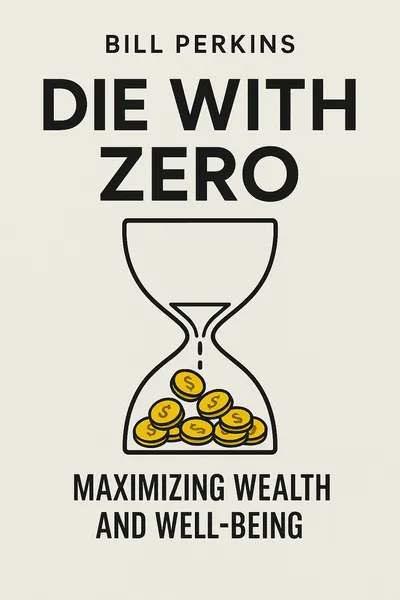
Die with zero
Maximizing wealth and well-being
Description
The "Die With Zero" philosophy, as proposed by Bill Perkins, advocates for a shift in focus from excessive wealth accumulation to generating memorable life experiences once you've saved enough for retirement and charitable giving. The philosophy is grounded in the belief that money unspent equates to life experiences missed, and thus, time wasted. For instance, if you pass away with $1 million unspent, that's $1 million worth of experiences you didn't have.
The goal is to optimize the use of our finite time on earth, not to amass wealth that remains unutilized. The philosophy is encapsulated in nine rules, which include maximizing positive life experiences, investing in experiences early, aiming to die with zero, and knowing when to stop working for maximum lifetime fulfillment. The idea is not to reach zero before you die, leaving you high and dry, but to have as little as possible left unused for all the time and energy you spent working to earn that money.
Table of contents
01Principle #1 – prioritize joyful life experiences.
Bill Perkins, with his engineering background and analytical prowess, emphasizes the importance of optimizing life's experiences and not deferring them until retirement. He critiques the common practice of working in unfulfilling jobs for years to secure a financially stable retirement, considering it a waste of life's potential. Perkins advocates for a systematic approach to personal financial planning that prioritizes fulfillment and minimizes waste, highlighting the significance of timing in life's pursuits. He points out that accumulating wealth without health to enjoy it is futile, and that life is not about hoarding money like points in a game.

02Principle #2 – begin experiencing early.
Bill Perkins highlights the significance of investing in life experiences from an early age, as they add depth and value to one's life journey. He uses the analogy of a well to describe life, where the water symbolizes experiences. He observes that many people continuously add experiences to their lives, akin to filling a cup with water, but often fail to 'drink' enough of these experiences, leaving them with regrets later in life. He references a quote from Carson in Downton Abbey, "The business of life is the acquisition of memories. In the end that’s all there is," to underscore his point that experiences provide not only immediate pleasure but also create lasting memories that can be revisited, much like the returns from a long-term investment.
03Principle #3 – strive to leave nothing behind.
Bill Perkins' philosophy of dying with zero assets encourages individuals to spend their earnings on valuable experiences, family, and legacy, rather than accumulating wealth. This perspective suggests that those who enjoy their work should not quit but should find a balance between work and spending on enriching experiences. Perkins advocates for gifting to children earlier in their lives when they are building their careers and families, instead of waiting until one's death. While concerns about outliving savings or facing unforeseen expenses in old age are legitimate, Perkins argues that these can be addressed by spending more while young and healthy and by investing in insurance for peace of mind. The goal is to use retirement funds for family, philanthropy, and memorable experiences, not to die wealthy.
04Principle #4 – utilize all planning resources.
Life expectancy calculators found on websites such as www.longevityillustrator.org, www.livingto100.com, and the Society of Actuaries offer insights into potential lifespan based on various factors, including lifestyle choices. By using multiple calculators, individuals can gain a broader understanding of how their habits may impact their longevity, which can motivate them to make healthier lifestyle choices and assist in retirement planning. Additionally, insurance companies provide income annuities as a financial product designed to address the concern of outliving retirement savings. By investing a lump sum, individuals receive a guaranteed monthly payment for life, which can be a crucial part of a balanced financial plan, depending on one's risk tolerance.
05Principle #5 – distribute wealth to children/charity early.
The "die with zero" concept advocates for individuals to allocate their wealth to their children before their demise, allowing the funds to have a significant impact on their lives. This approach prompts the question, "What about the kids?" The money you leave for your children is not your money, but theirs. The idea is not to spend your children's money, but to spend yours and give your children what you have allocated for them before you pass away. This strategy separates their money, which becomes untouchable by you, from your money, which you should spend down to zero. The issue with most inheritances is that by the time the money is received, it's often too late to make a significant difference. If you wait until your death to give money to your children, the timing of the gift becomes random and unpredictable. The "die with zero" approach encourages deciding in advance how much money you will give your children and when, ideally when they are between the ages of 26 and 35, a time when they can extract the maximum enjoyment from it.
06Principle #6 – avoid living life on autopilot.
The idea that saving a fixed percentage of income is universally the best strategy is being challenged by some economists who advocate for a more dynamic approach, especially for young people who anticipate higher earnings in the future. This alternative strategy, often referred to as the "Die with Zero" approach, suggests that it may be economically sensible to borrow and spend more than you earn early in your career if you're confident about your income growth prospects. According to this concept, the balance between enjoying the present and saving for the future should shift throughout one's life.
07Principle #7 – plan according to life's seasons.
The inevitability of death highlights the importance of living life to its fullest, a principle that can be effectively implemented by categorizing life into different stages or seasons. Recognizing that each life season is distinct and certain experiences are exclusive to specific periods is crucial for planning life experiences accordingly.
The awareness of our finite lifespan acts as a strong motivator to maximize life's experiences, similar to how a teenager, aware of an impending move, would make the most of their time by visiting places they've always wanted to see. In the same vein, knowing our time is limited should encourage us to actively seek enriching experiences instead of passively experiencing life.
08Principle #8 – recognize when to cease working.
In life, there's a zenith of net worth, a "peak," which signifies the best time to consider retiring for maximum lifetime fulfillment. It's essential to recognize this peak before it's passed, as regrets often don't include wishing for more office hours. The goal isn't to exhaust funds but to judiciously use savings for enriching experiences while still able to enjoy them. A common worry is outliving one's wealth; to mitigate this, estimate your lifespan with a doctor's help, use online calculators for retirement duration, and add extra years as a buffer. Then, calculate your annual retirement expenses comprehensively to determine your survival threshold, setting a baseline for retirement needs.
09Principle #9 – embrace greater risks early, not later.
Youth is often seen as a time for boldness and risk-taking, given that the potential for success often outweighs the possible downsides of failure. For example, losing an entry-level job may not have long-term consequences, as finding a similar or better position is usually feasible.
However, as individuals age, the risk-reward ratio changes significantly. The consequences of failure, such as losing a high-level job, become more severe. Pursuing a risky career, like acting, may be advisable in one's twenties but becomes less appealing in later decades.
Bill Perkins highlights the importance of not waiting until retirement to take bold steps, pointing out that the "go-go years" are fleeting. He encourages people to make the most of their time, even if they've delayed taking risks, and suggests not hesitating to relocate for intriguing career opportunities. Connecting with like-minded individuals in different locations can be transformative, especially when venturing into a new career field.