

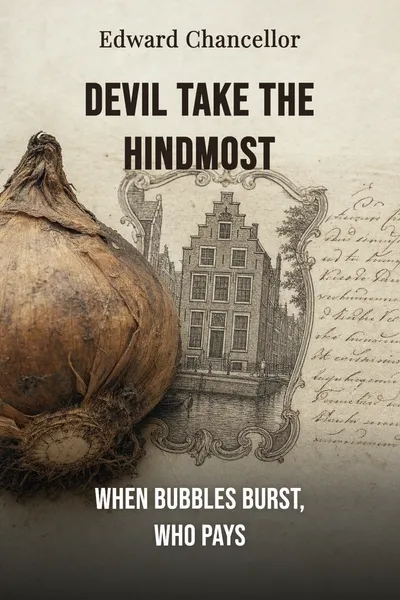
Devil Take the Hindmost
When bubbles burst, who pays
Description
In Amsterdam in the winter of 1636, a single tulip bulb of the Semper Augustus variety was reportedly changing hands for the price of a fine canal house. Weavers, bakers and chimney sweeps were trading contracts on flowers that would not bloom until spring, on markets held in the back rooms of taverns. Then, in February 1637, a routine bulb auction in Haarlem found no buyers. Within days the price of everything collapsed. Fortunes built on paper promises evaporated, and men who had felt rich at breakfast were ruined by supper.
Edward Chancellor opens his history of financial speculation with scenes like this one, and the striking thing is how modern they feel. Swap the tulips for internet stocks, the Haarlem tavern for a Nasdaq ticker, and the story barely changes. In Devil Take the Hindmost, published in 1999 as the dotcom mania was cresting, Chancellor traces the same drama across four centuries — the South Sea Bubble, the railway frenzy, the 1929 crash, the Japanese asset bubble — and finds not a series of accidents but a single recurring performance, restaged in every generation with a fresh cast.
The title comes from an old proverb about a race where each runner looks after himself and the slowest is left to the devil. That is speculation in a phrase: a scramble in which everyone believes they will get out before the fall, and someone always does not. Chancellor's real interest is less in the euphoria than in the reckoning — the moment the music stops and the losses have to land somewhere.
The question we’re asking : Why do financial bubbles keep repeating across centuries, and when they burst, who actually ends up paying?What we’ll see : How the same speculative drama replays through history, what drives it, and where the wreckage finally settles.
Table of contents
01Chapter 1 — The oldest game with new costumes
Chancellor's central move is to strip speculation of its era-specific disguises and show the machinery underneath. The tulip mania of the 1630s, the South Sea Bubble of 1720, the emerging-market and railway crazes of the nineteenth century, the roaring 1920s, Japan in the 1980s, the dotcom boom of the 1990s — each looks unique in its details and identical in its bones. There is a new technology or a new opportunity, a story about why this time the old rules no longer apply, an influx of amateur money, and a final phase where prices detach entirely from any plausible value.
He is careful to distinguish speculation from investment, a line he draws early and holds throughout. The investor buys an asset for the income it produces and the value it holds; the speculator buys it only because he expects to sell it to someone else at a higher price. Speculation is a bet on the crowd, not on the thing itself. That is why it thrives on novelty — a canal, a railway, a South American mine, a website — anything unfamiliar enough that nobody can say with confidence what it is worth, which means anybody can claim it is worth anything.

02Chapter 2 — Manias run on feelings, not spreadsheets
If the pattern is so predictable, why does nobody stop it? Chancellor's answer is that bubbles are engines of emotion, and emotion overrides arithmetic every time. Greed pulls people in, fear of missing out keeps them there, and a peculiar collective reasoning convinces otherwise sensible people that the usual limits have been suspended. The numbers are available the whole way up. They are simply not what anyone is looking at.
He is drawn to the human texture of these episodes — the promoters, the plungers, the ruined clergymen. During the 1690s stock boom in London, and again in the Paris of John Law's Mississippi scheme around 1720, coffee houses and streets filled with people trading paper they did not understand for gains they could not resist. Law, a Scottish gambler and financial visionary, briefly made the word millionaire necessary before his system imploded and took much of the French economy with it. The mania rewarded confidence and punished caution, right up until it reversed and did the opposite.
03Chapter 3 — The bill always comes due
The euphoria is the part everyone remembers; Chancellor insists on the part they forget. Every bubble ends, and the ending is never symmetrical with the rise. Prices that took years to inflate can collapse in days, because confidence, once broken, does not rebuild on the same schedule it decayed. And the losses do not vanish. They redistribute, usually downward and outward, onto people who joined late and understood least.
The Great Crash of 1929 is his set piece for consequence. The speculative boom of the 1920s had been fed by margin buying — investors putting down a fraction of a stock's price and borrowing the rest — so that when prices fell, lenders called their loans and forced selling that drove prices lower still. The collapse did not stay contained in the market. It rolled into the banking system, into employment, into the wider economy, helping to deepen a depression that reshaped a generation and, in Chancellor's telling, the century's politics along with it.
04Chapter 4 — The state as the reluctant player of last resort
Step back from the individual manias and a larger relationship comes into focus, the one Chancellor treats as the deepest lesson of the whole history: speculation and the state are locked together, and the state keeps ending up as the buyer of losses nobody else will take. This is not a modern development bolted on after 1929. It runs right through his account, from the South Sea scheme, which was created to manage government debt, to John Law's Mississippi venture, which was effectively an arm of the French crown.
The pattern he traces is uncomfortable. Governments benefit from booms — they raise tax revenue, they finance debt, they bask in the appearance of prosperity — and so they rarely have much appetite for stopping a mania while it is still profitable to their treasuries. But when the collapse comes and threatens the banking system or social order, the same governments feel compelled to intervene. The upside is privately captured on the way up; the downside is socially absorbed on the way down. Chancellor sees this asymmetry as one of the most durable features of financial history.
05Conclusion
Chancellor closes his tour of four centuries roughly where he began: with the conviction that speculation is not an aberration we might one day cure but a permanent companion to markets, resurfacing whenever memory fades and a fresh story of easy riches takes hold. The tulip trader in a Haarlem tavern and the day trader chasing internet stocks are, in his account, the same figure — persuaded that the ordinary laws of value have been suspended for their particular moment. They almost never have.