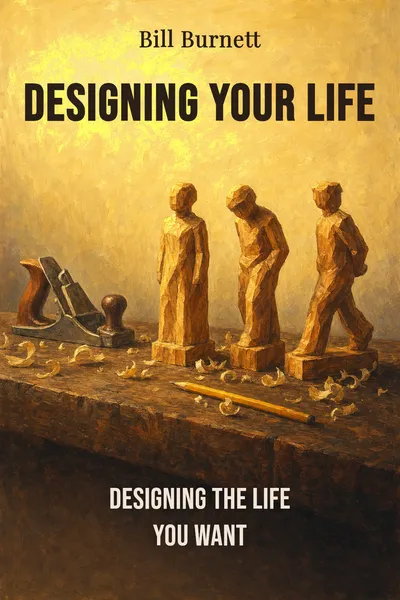
Designing Your Life
Designing the life you want
Description
Somewhere around the age of six, most of us get asked what we want to be when we grow up. The strange thing is that the question never really goes away. It comes back at twenty, when the degree is nearly finished and nobody feels ready. It comes back at forty, in the middle of a career that pays the bills but leaves a low hum of dissatisfaction. It comes back at sixty, when retirement is supposed to be an answer and instead opens a new blank page. Bill Burnett, who ran the design program at Stanford, and his co-author Dave Evans, a Silicon Valley veteran who worked on early Apple products, noticed that the people sitting across from them were all stuck on the same question — and stuck for the same reason.
Their diagnosis was blunt. We treat our lives as a problem to be solved, when they are really a thing to be designed. A problem has a single correct answer waiting to be found, which is why so many of us feel we have failed when we cannot locate it. A design has no single right answer. It has prototypes, iterations, dead ends that teach you something, and a next version that is better than the last. Burnett and Evans took the working methods designers use to build products people love and turned them on the messiest object of all: a human life, including their own.
The book that came out of their popular Stanford course landed in 2016 and stayed on bestseller lists well beyond the campus. Its promise was not a passion to discover or a five-year plan to execute. It was a set of tools — the same ones used to design a phone or a chair — applied to the question of how to spend the years we have. What follows is how those tools work, and why designers turn out to be surprisingly good guides to a life.
The question we’re asking : If a well-designed life can't be found the way we've been taught to look for it, how do we actually build one?What we’ll see : How two Stanford designers took the everyday methods of the workshop and turned them on the oldest question we never stop asking.
Table of contents
01 Chapter 1 — The wrong question, asked for decades
Burnett and Evans start by picking apart the question itself. "What do you want to be when you grow up?" assumes there is one answer, that it exists somewhere inside us already formed, and that the job is to uncover it. This is the passion myth — the belief that each of us has a single true calling and that a happy life is a matter of finding it and following it. The authors point out how much damage this idea quietly does. Most people, when surveyed, cannot name one dominant passion. And plenty of those who can still have no idea how to turn it into a working life. The myth sets a test that most of us fail, then leaves us feeling the failure is personal.
The problem, in their language, is that we are working from what they call dysfunctional beliefs. These are ideas we hold so firmly that we never think to question them, and which keep us stuck. "I studied this, so I have to do this." "It's too late to change now." "If I were smart enough, I'd already know what I want." Each one sounds like a fact. Each one is really a belief dressed up as a fact, and each one closes doors before we've even tried them.

02 Chapter 2 — Start where you are, not where you wish you were
Every design project begins with an honest assessment of the current situation, and Burnett and Evans insist a life is no different. Before we can build anything, we have to know where we actually stand. Their tool for this is a simple dashboard covering four areas: health, work, play, and love. We rate how full each gauge feels right now — not how full it should be, not how it looks to others, just how it feels. The point is to notice, without judgment, which parts of life are running low.
This is where a lot of well-meaning self-improvement goes wrong. We try to fix things that aren't actually broken, or chase what the authors call a gravity problem. A gravity problem is one you can't act on — like gravity itself. "I wish I'd started this career at twenty-five" is a gravity problem; the past won't move. "Poets don't earn much and I want to be a poet" is another. The only sane response is to accept the parts of reality that won't budge and redirect energy toward what will. Acceptance here isn't defeat. It's the first honest step, the way a designer accepts the material they're actually working with.
03 Chapter 3 — Build your way forward, three lives at a time
Here is the move that gives the book its shape. Rather than committing to one plan, Burnett and Evans ask us to sketch three. They call these Odyssey Plans, and each one covers roughly the next five years. The first is the life we're already living or clearly heading toward — the obvious extension of what we do now. The second is the life we'd build if the first one suddenly vanished, if the industry disappeared or the job became impossible. The third is the wild card: the life we'd design if money and other people's opinions were no object.
Sketching three at once matters more than the content of any single one. It breaks the trap of the single right answer by forcing us to admit that several good lives are possible. Most people, doing this exercise, are surprised to find they had quietly assumed there was only one acceptable future — and relieved to discover there wasn't. Each plan gets a rough timeline, a question it's trying to answer, and a quick gut-check on resources, likeability, confidence, and coherence with our workview and lifeview.
04 Chapter 4 — A method borrowed from the workshop
Step back from the exercises and what Burnett and Evans are really proposing is a change of category. For most of history we've filed "what to do with my life" under the same heading as a math problem: a question with a hidden but findable solution. Design filed it somewhere else entirely — under the kind of problem where the answer doesn't exist until you build it, and where you build it by making, testing, and revising. That reclassification is the quiet radical move at the heart of the book, and everything else follows from it.
It matters because the two categories carry different emotions. If life is a problem with one right answer, then being unsure means you've failed, and every wrong turn is proof of it. If life is a design, then being unsure is simply the normal early state of any project, and wrong turns are iterations. The authors aren't offering false comfort; they're pointing out that a lot of the suffering around these questions comes from using the wrong mental model. Change the model and the same facts stop feeling like a verdict.
05 Conclusion
The child's question — what do you want to be when you grow up? — turns out to have been badly phrased all along. It asks for a destination when what we needed was a method. Burnett and Evans don't hand back a tidier answer; they hand back a way of working. Know where you actually stand. Reframe the beliefs that have been quietly holding the door shut. Sketch several lives instead of agonizing over one. Then build small, cheap versions of the ones that intrigue you and let reality do the teaching. None of it promises a single perfect outcome, because a well-designed life doesn't have one.
Related books