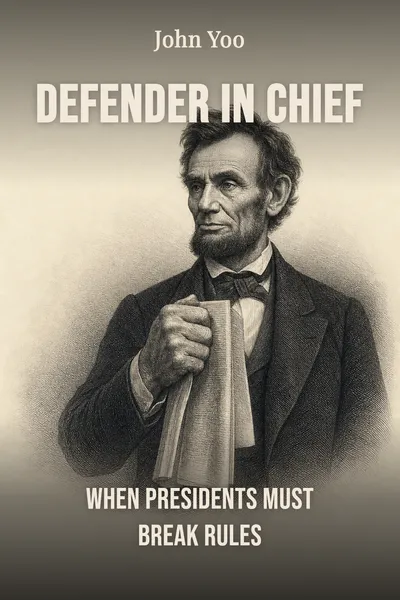
Defender in Chief
When presidents must break rules
Description
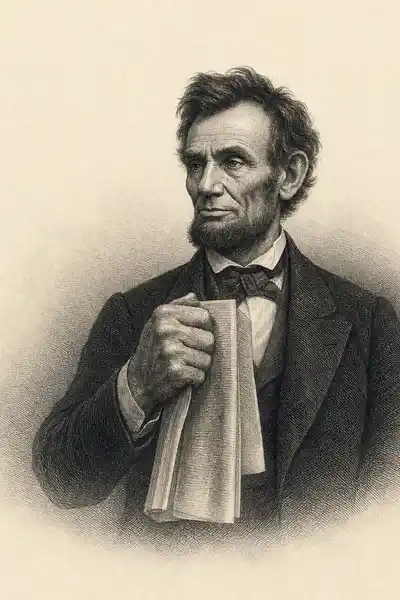
Picture the winter of 1861. Abraham Lincoln, weeks into the job, suspends habeas corpus along the rail line between Philadelphia and Washington — the constitutional right that stops the government from jailing you without charge. Chief Justice Roger Taney rules that only Congress can do this, that the president has broken the law. Lincoln does not comply. He keeps the suspension in place, later telling Congress that he could not let the whole body of the law go unexecuted, and the government itself collapse, to keep one clause perfectly intact. The Union held. The precedent unsettled people then, and it unsettles people now.
That tension sits at the center of Defender in Chief, the book by legal scholar and former Justice Department official John Yoo. His claim is deliberately provocative: the moments when a president seems to strain against the Constitution are often the moments when the president is doing exactly what the Constitution was built for. Yoo reads the founding document not as a straitjacket on executive power but as a design that deliberately created a strong, fast-moving presidency — one meant to act first and be judged later, especially when the nation's security is on the line.
It is not a comfortable argument, and Yoo knows it. He built part of his own reputation drafting legal opinions on executive power after September 11, work that critics have never forgiven. But whatever we make of the messenger, the underlying question refuses to go away: how much room does a president get to bend a rule in a crisis, and who — if anyone — gets to say when the bending has gone too far?
The question we’re asking : When a president strains against the rules, is that a betrayal of the Constitution or the thing it was designed to allow?What we’ll see : How Yoo reads the founding design, the crises that tested it, and why he thinks the courts are the wrong referee.
Table of contents
01Chapter 1 — The framers wanted a strong executive
Yoo starts where every argument about presidential power should start: in the room in Philadelphia in 1787, where the men writing the Constitution had just lived through the opposite problem. The Articles of Confederation had given the young country no real executive at all — no single person who could act, decide, or move quickly. The result had been drift, unpaid soldiers, and a government that could barely function. When the framers sat down to fix it, they were not trying to cage a king. They were trying to build something the confederation had lacked: energy.
That word, energy, does a lot of work in Yoo's telling, and it comes straight from Alexander Hamilton. In the Federalist Papers, Hamilton argued that energy in the executive was a leading character in the definition of good government — that decision, activity, secrecy, and dispatch were exactly the qualities a single president could supply and a committee never could. Congress deliberates. Courts decide slowly, case by case. Only the executive can act now, with one voice, and answer for it afterward.

02Chapter 2 — War, secrecy, and the powers nobody voted for
The clearest test of Yoo's thesis is war, and the record here is remarkably one-directional. On paper, Congress declares war; the Constitution says so plainly. In practice, presidents have committed American forces hundreds of times, and Congress has formally declared war only five times in the country's history — the last in 1942. Everything since Korea has happened under some other authority, or none at all. Yoo does not treat this as a scandal to be corrected. He treats it as the accumulated judgment of two centuries about who actually has to decide when the shooting starts.
His examples run across the whole span. Thomas Jefferson, who distrusted executive power in theory, sent the Navy against the Barbary pirates without waiting for a declaration, and later made the Louisiana Purchase on authority he privately admitted the Constitution did not clearly grant. Franklin Roosevelt traded destroyers to Britain and ran convoys in the Atlantic before the country was formally at war. Truman went into Korea calling it a police action. Each president reached past the strict letter because the situation demanded speed, and in each case the country largely accepted the reach.
03Chapter 3 — The courts are not the last word
Here Yoo turns to the branch most Americans now instinctively trust to settle these fights: the Supreme Court. His argument is that we have quietly come to believe the judiciary is the final referee on presidential power — that whatever the president does, the courts will either bless it or strike it down, and that ruling ends the matter. Yoo thinks this is both historically false and dangerous, and he spends much of the book pulling the assumption apart.
Historically, he points out, the Court has usually declined to play referee in the hardest cases. It waited until 1952, deep into the Korean War, to tell Truman he could not seize the nation's steel mills — and even that famous ruling, Youngstown, produced no single majority rationale, just a scatter of opinions that lawyers have argued over ever since. In wartime the Court has more often deferred, upheld, or simply stayed out of the way, from the Civil War through the Japanese internment cases to the terrorism litigation of the 2000s. The judges know they command no army and control no budget; they pick their fights.
04Chapter 4 — The guardian, not the usurper
Step back from the individual cases and the shape of Yoo's whole argument comes into view. The title, Defender in Chief, is doing real work. Yoo's president is not a would-be autocrat straining against the Constitution but its designated guardian — the one office built to move fast enough to protect the constitutional order when it is genuinely threatened. On this reading, the choice is never simply between rules and their violation. It is between a president who defends the whole structure and a rigid literalism that would let the structure fall in the name of keeping one clause pristine.
That reframing is what makes the book more than a catalog of strong presidents. Yoo is asking us to notice that our instinct — the reflex that says a bent rule is always a broken one — is itself a fairly recent development, tied to our modern faith that law is whatever a court finally says it is. The framers, he argues, thought differently. They wrote a document meant to be defended by action as much as by adjudication, and they trusted the executive with the part of that defense that could not wait for a verdict.
05Conclusion
Return to Lincoln and the suspended right in the winter of 1861. He never claimed the clause did not exist or that the chief justice was wrong about the ordinary rule. He claimed something harder: that a president sworn to preserve the Constitution cannot let the entire system dissolve in order to honor one part of it perfectly. That is the paradox Yoo builds his whole case around — the guardian who must sometimes strain a rule to keep the thing the rules exist to protect. Every president in the book, in his telling, has faced some version of the same bind.
Related books