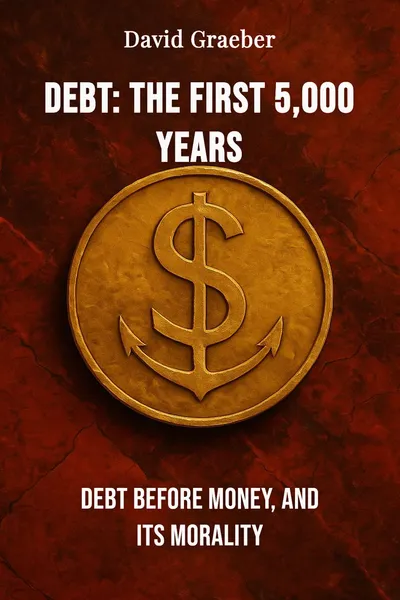
Debt: The First 5,000 Years
Debt before money, and its morality
Description
Open any introductory economics textbook and you'll meet the same tidy fable. Once upon a time, people bartered — a chicken for a pair of sandals, a sack of grain for a knife. But barter was clumsy, the story goes, because you needed a farmer who wanted exactly what the sandal-maker had to offer. So humanity invented money to grease the wheels, and later, credit and debt grew out of money. It's a neat sequence: barter, then coins, then debt. Adam Smith told a version of it in 1776, and we've been repeating it ever since.
The trouble, as the anthropologist David Graeber lays out in Debt: The First 5,000 Years, published in 2011, is that no one has ever found this barter economy. Not in the historical record, not among the societies anthropologists have actually studied. The pure barter village of the textbooks is a thought experiment that got mistaken for a memory. And when Graeber goes looking for what people actually did before money, he finds something the standard story got backwards. Debt didn't come after money. It came long before it — thousands of years before the first coin was struck.
That reversal is the engine of the book. Graeber spent years reading across Mesopotamian temple records, medieval theology, and the ethnography of societies economists rarely consult, and what emerges is less a history of finance than a history of a feeling. Because underneath every loan, every mortgage, every casual "I owe you one," there's a moral charge — the sense that a debt is something you are obligated to pay, and that failing to is not just costly but wrong. Where does that conviction come from?
The question we’re asking : If barter never really happened, where did money come from — and why does owing someone feel like a matter of right and wrong?What we’ll see : How an anthropologist unwinds the tidy tale economists tell and finds a much older, stranger, more moral thing underneath.
Table of contents
01Chapter 1 — The barter story that never happened
The founding myth is older than economics itself, but Adam Smith gave it its canonical shape. In a world without money, he imagined, a butcher and a baker would have to haggle directly, and trade would stall whenever their wants didn't line up — the famous problem of the "double coincidence of wants." Money solved it. From Smith onward, nearly every economist has repeated the sequence as though it were settled history.
Graeber's objection is blunt: there is no evidence any society ever ran this way. When anthropologists in the nineteenth and twentieth centuries went looking for the barter economy, they came back empty-handed. Communities without money didn't line up goods for haggling. They kept track of who had given what to whom, and settled up over time, or not at all. Caroline Humphrey, a Cambridge anthropologist, put it flatly: no example of a barter economy has ever been described, let alone the emergence of money from one.

02Chapter 2 — Before coins, the ledger
The earliest writing we have isn't poetry or law. It's accounting. The clay tablets of Mesopotamia, from around 3500 BCE, are largely records of debts and credits — so many measures of barley owed to the temple, so much silver on account. This is roughly two and a half thousand years before the first coins appear in Lydia, in what is now Turkey, around the seventh century BCE. For most of recorded history, in other words, there was elaborate credit and no cash.
The system ran on units of account. Sumerian temple administrators reckoned everything in silver by weight, or in barley, but the metal itself mostly stayed in the vaults. What circulated were obligations. A merchant might owe the palace; a farmer might owe the merchant; and these debts were recorded, transferred, and cancelled on the books without a coin changing hands. Money, in this world, was information — a way of measuring what one person owed another — long before it was a thing you could hold.
03Chapter 3 — When violence becomes a number
If debt began as a way of tracking mutual obligation, how did it acquire its harder edge — the sense that a debt is a debt, non-negotiable, to be paid at any cost? Graeber's answer runs through the darker side of the record. Much of what we now think of as debt, he argues, grows out of relations of violence that were later dressed up in the language of money.
Consider the practice of blood money. In many early societies, when one person killed or injured another, the offender's family owed the victim's family a payment — so many cattle, so many measures of silver. The striking thing is what the payment was for. It wasn't the price of a life, as if a person could be bought. It was closer to an admission that the debt could never truly be paid, a placeholder for a wound that money can only acknowledge, not settle.
04Chapter 4 — The morality hidden in every IOU
Step back from the tablets and the blood money, and Graeber's real subject comes into focus. Debt is not, at bottom, an economic category. It's a moral one. The word itself carries the charge: we speak of paying our debt to society, of owing someone an apology, of being deeply indebted to a mentor. Long before it means a loan, debt means an obligation — and obligations sit squarely in the territory of right and wrong.
What Graeber wants us to notice is how thoroughly the moral language runs in one direction. "One has to pay one's debts" sounds less like an economic observation than a commandment. It feels self-evidently just — so much so that when a creditor is powerful and a debtor desperate, our instinct is still to side with repayment. Yet the same history shows the opposite intuition surfacing again and again: the jubilees of the ancient Near East, the debt forgiveness woven into scripture, the recurring sense that debts pursued past all reason become a form of theft in themselves.
05Conclusion
Graeber began by dismantling a bedtime story — barter, then coins, then debt — and ended somewhere no economics textbook ventures. The clay tablets don't show us clever traders inventing money to smooth their exchanges. They show us temples and kings keeping account of obligations, forgiving them when the arithmetic grew cruel, and a long human argument about when a debt is sacred and when it's simply a wound with a number attached.
Related books