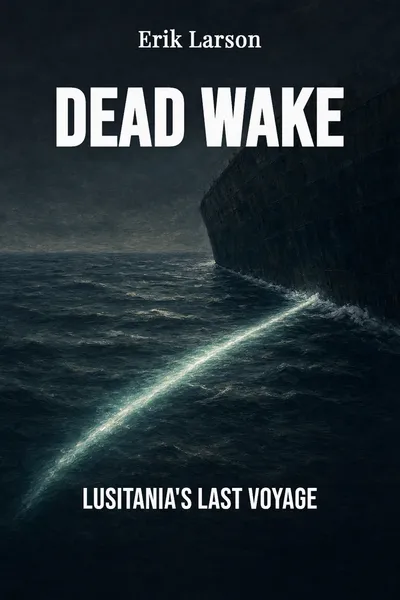
Dead Wake
Lusitania's last voyage
Description
On May 1, 1915, the RMS Lusitania pulled away from Pier 54 in New York, bound for Liverpool with 1,959 people aboard. She was the fastest civilian ship afloat, a floating hotel of mahogany and gilt, and her passengers had reason to feel safe. That morning the German embassy had placed a notice in American newspapers warning that travelers entered the war zone around Britain at their own risk. Most read it, shrugged, and boarded anyway. The Lusitania could outrun anything in the water. Everyone knew that.
Erik Larson's Dead Wake follows that crossing minute by minute, but it refuses to treat the ending as inevitable. Instead it braids together the people who, without knowing it, were converging on the same patch of sea off the Irish coast: Captain William Thomas Turner on the bridge, the U-boat commander Walther Schwieger beneath the surface, and a British naval intelligence unit in London that knew more than it ever shared. President Woodrow Wilson appears too, distracted by grief and a new infatuation while a war he wanted no part of drifted toward him.
What Larson does, with the patience of a man who has read every logbook and telegram, is restore the suspense to an event whose outcome we already know. He lets us sit with the contingencies — the fog that lifted, the orders that never came, the four-minute window in which two ships found each other. The result is less a disaster story than a study of how many separate decisions had to align for 1,198 people to die in eighteen minutes.
The question we’re asking : How did a ship everyone believed was too fast to catch end up at the bottom of the sea in eighteen minutes?What we’ll see : The crossing as Larson reconstructs it — the people, the secrets, the near-misses, and what the wreck forced the world to stop denying.
Table of contents
01 Chapter 1 — A ship that believed itself untouchable
The Lusitania was a creature of an earlier confidence. Launched in 1906, she had once held the Blue Riband for the fastest Atlantic crossing, and she carried that reputation like armor. At nearly 800 feet, with four funnels and a top speed above twenty-five knots, she belonged to a world in which ocean liners were symbols of progress rather than targets. By 1915 that world was already gone, but the ship and many of her passengers had not caught up to the fact.
Larson is careful with the texture of the voyage. He gives us the booksellers and the wine merchants, the suffragist Theodate Pope, the bon vivant Charles Frohman, the young mothers traveling with infants. He lets us into the first-class dining saloon and the engine rooms alike. This is one of his signatures as a writer: the human detail is not decoration, it is the argument. The people aboard were not statistics waiting to become a casualty list. They were planning dinners and worrying about seasickness.

02 Chapter 2 — The man under the sea
Walther Schwieger commanded U-20, and Larson treats him neither as a monster nor as a hero, which is harder and more honest. He was a competent, well-liked officer who kept a dachshund collection aboard cramped submarines and who, by the standards of his service, was simply doing his job. That refusal to flatten him into a villain is part of what gives the book its moral weight. The torpedo that struck the Lusitania was fired by a person, not a force of nature.
The book reconstructs life inside a 1915 U-boat with claustrophobic precision: the foul air, the diesel fumes, the unreliable torpedoes that ran too deep or failed to explode, the cramped berths shared by men and dogs. Submarines of that era spent most of their time on the surface, diving only to attack or hide. They were fragile, blind for much of the day, and dependent on luck as much as skill. Schwieger had already had a frustrating patrol, running low on fuel and torpedoes, when he turned for home along the southern coast of Ireland.
03 Chapter 3 — The seven days nobody saw coming
The most disturbing thread Larson pulls runs through a basement in London known as Room 40, the Admiralty's secret intelligence unit. By 1915 the British were reading intercepted German naval signals with extraordinary success. They knew U-20 was at sea. They tracked her movements down the Irish coast. They knew, in broad terms, that a submarine was operating directly in the Lusitania's path. And the warnings that reached Captain Turner were vague, generic, and stripped of the specificity that might have changed his choices.
Larson does not allege a tidy conspiracy, and he is too careful a historian to claim one. What he documents is a pattern of decisions whose combined effect was to leave the ship exposed: protective escorts not provided, intelligence not passed on, a captain navigating on incomplete information while London held more. Whether through bureaucratic inertia, the obsession with protecting the Room 40 secret, or something colder, the gap between what was known and what was shared is the book's quiet accusation.
04 Chapter 4 — What the wreck made impossible to ignore
Step back from the individual lives and the Lusitania marks a hinge in how war was waged. Of the 1,198 who died, 128 were American, and the sinking detonated a wave of outrage in a United States that had until then watched the European war from a comfortable distance. Wilson did not declare war in 1915 — that would come nearly two years later, in April 1917 — but the event lodged in the American imagination and made eventual entry feel, in hindsight, like the closing of a trap. Larson resists the schoolbook shorthand that the Lusitania caused America to join the war, while showing exactly how it reset the emotional terms.
The deeper shift the book traces is about the nature of the battlefield itself. The submarine had collapsed the old distinction between combatant and civilian, between a warship and a liner full of families. A torpedo fired from beneath the sea could not stop to check who was aboard, and the doctrine of unrestricted submarine warfare made that indifference a policy rather than an accident. The fragility Larson keeps returning to is not only the fragility of bodies in cold water; it is the fragility of the rules that had once, however imperfectly, hemmed war in.
05 Conclusion
Turner survived, clinging to wreckage, and spent years living down an exoneration that never fully arrived. Schwieger died in 1917 when U-88, the boat he then commanded, struck a mine; he did not live to see the doctrine he served help draw America into the war. Wilson married Edith Galt that December and, in 1917, asked Congress for the declaration he had spent so long avoiding. The ship itself settled eleven miles off the Old Head of Kinsale, where she remains, slowly dissolving into the seabed she reached in eighteen minutes.
Related books