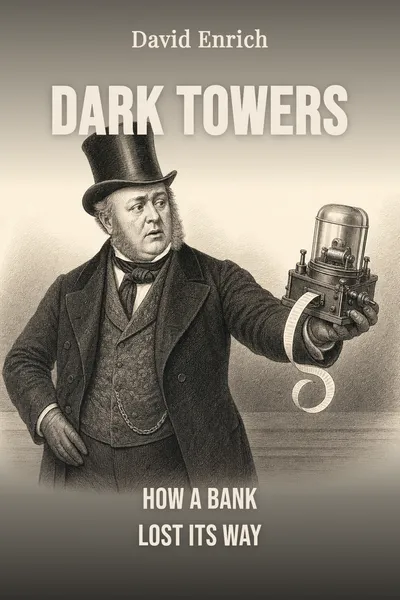
Dark Towers
How a bank lost its way
Description
On a cold night in January 2014, a Deutsche Bank executive named William Broeksmit was found dead in his London home. He had left notes apologizing to colleagues, worried about investigations that were closing in. Broeksmit had spent years as one of the bank's most trusted risk experts — the man who understood, better than almost anyone, how much danger the institution was carrying on its books. His death became the opening thread of David Enrich's investigation, because the people around him kept asking the same thing: what had he seen that frightened him so badly? Enrich, a financial journalist at the New York Times, spent years pulling on that thread.
What he found was the story of how a respectable German lender, founded in 1870 to finance trade abroad, transformed itself into one of the most aggressive and least controllable players on Wall Street — and then nearly destroyed itself doing it. Deutsche Bank chased American investment banking with a hunger that eventually pulled it into money laundering scandals, Russian mirror trades, and a relationship with a single American developer that no other major bank would touch: Donald Trump. By the time regulators caught up, the fines ran into the billions and the reputation was in ruins.
Enrich's book reads like a thriller, but it is built on interviews with former employees and confidential documents. It is less about one villain than about a culture — one where ambition ran ahead of judgment, and where the systems meant to say no had quietly stopped working. The result is a portrait of modern finance that is hard to unsee.
The question we’re asking : How does a cautious 150-year-old bank turn into a machine for taking on risk nobody could measure or stop?What we’ll see : We follow Deutsche Bank from its Frankfurt beginnings into its Wall Street reinvention, the people it broke along the way, its strange loyalty to a client everyone else refused, and what one bank's unraveling says about the whole system.
Table of contents
01 Chapter 1 — From Frankfurt to the world
Deutsche Bank began in 1870 with a modest mission: to help German companies finance trade beyond their borders, at a time when British banks dominated global commerce. For most of the next century it was exactly what its name suggested — a pillar of the German economy, conservative, deeply woven into the country's industrial fabric, closer to the world of steelmakers and carmakers than to the trading floors of London or New York. It survived two world wars, the collapse of the Reichsmark, and a postwar reckoning with its role under the Nazi regime. Through all of it, the bank kept a reputation for solidity.
The turn came in the late twentieth century, when Deutsche Bank decided that being Germany's bank was no longer enough. It wanted to be a global investment bank, a peer of Goldman Sachs and Morgan Stanley, playing in the fastest and most lucrative corners of finance. The decisive move was the 1989 purchase of the British merchant bank Morgan Grenfell, followed a decade later by the 1998 acquisition of the American firm Bankers Trust for roughly $10 billion — at the time the largest foreign takeover of a US bank ever.

02 Chapter 2 — The men who paid the price
The human cost sits at the emotional core of Enrich's book, and it begins with William Broeksmit. A quiet, gifted risk manager who had followed his mentor from Bankers Trust into Deutsche Bank, Broeksmit understood the machinery of leverage from the inside. He knew how much the bank had borrowed against how little, and he grew increasingly uneasy as investigations mounted and colleagues came under scrutiny. When he took his own life in early 2014, he left behind apologies and anxieties that pointed at something larger than any one man's despair.
His death did not close the story; it opened it. His son, Val Broeksmit, obtained a trove of his father's documents and emails, and over the following years became an erratic but persistent source — feeding material to journalists and investigators, trying to make sense of what his father had been part of. Through those documents, Enrich reconstructs a bank where the people who best understood the danger were often the most powerless to change course, drowned out by the ones bringing in revenue.
03 Chapter 3 — The banker of last resort
By the 1990s, Donald Trump was radioactive to most of Wall Street. A string of casino bankruptcies and defaults had left the major banks unwilling to lend to him; he had burned too many of them. Deutsche Bank, hungry to build its American business and less burdened by that history, became the exception. Over roughly two decades, its various divisions extended Trump well over a billion dollars in loans, financing towers, resorts, and golf courses when nobody else would.
Enrich traces how bizarre this relationship became. At one point Trump defaulted on a loan and then sued Deutsche Bank over it, blaming the financial crisis for his inability to pay — and yet another arm of the very same bank kept lending to him afterward. The right hand did not know, or did not care, what the left hand had suffered. The loans were often channeled through the private-banking division, which catered to wealthy individuals and operated with different rules than the commercial side that had already been stung.
04 Chapter 4 — When one bank is the whole system
Step back from the scandals and the personalities, and Deutsche Bank becomes a case study in a structural problem, not a German one. The book's deeper subject is what happens when a single institution grows so large and so entangled with the rest of finance that the ordinary mechanisms of control — regulators, auditors, the bank's own risk managers — simply cannot keep up with it. Deutsche was, for years, at or near the top of the list of banks that global watchdogs considered systemically important, meaning its failure could threaten the wider economy. That designation was supposed to bring extra scrutiny. In practice it also created leverage: an institution too dangerous to let collapse is an institution with room to misbehave.
Enrich's account suggests that the fines, however large, functioned less as deterrents than as a cost of doing business. Billions in penalties are painful, but they are survivable when the underlying model keeps generating revenue, and they arrive years after the conduct they punish. Regulators across several countries pursued Deutsche Bank for money laundering, sanctions violations, and manipulation of benchmark interest rates, yet the pattern of behavior kept recurring. The book's implicit argument is that after-the-fact punishment is a poor substitute for controls that actually work before the damage is done.
05 Conclusion
The investigation that began with a man found dead in London ends without the tidy resolution a thriller would promise. William Broeksmit's fears were never fully explained, his son's documents never produced a single decisive revelation, and Deutsche Bank, battered and shrunken, kept operating. What Enrich delivers instead is something more durable than a scandal: a demonstration of how an institution built over 150 years can lose its judgment in a matter of decades, not through a single crime but through a thousand small surrenders to the pressure of growth.
Related books