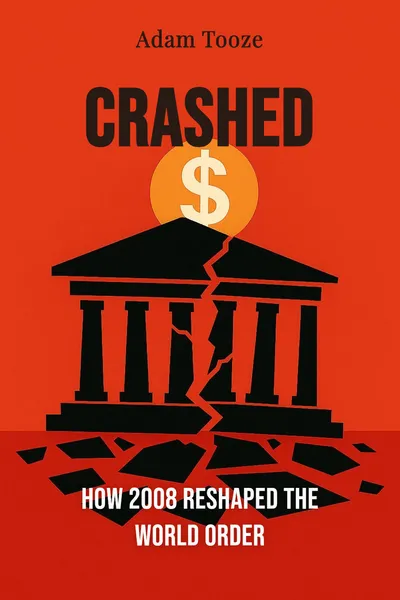
Crashed
How 2008 reshaped the world order
Description
In September 2008, the American investment bank Lehman Brothers filed for bankruptcy, and within days the plumbing of global finance seized up. The story most of us carry from that autumn is a national one: American banks made reckless bets on American mortgages, American regulators looked away, and an American economy paid the price. It is a tidy story, and Adam Tooze, a historian at Columbia, spends the six hundred pages of Crashed dismantling it. The crisis, in his telling, was never contained by the borders of the country that hatched it.
What made 2008 different from earlier panics was the machinery underneath. By the mid-2000s European banks had built enormous dollar-denominated balance sheets, borrowing short-term in a currency their own central banks could not print, to buy the very American assets that were about to implode. When the money markets froze, the shortage was not of euros or pounds but of dollars — everywhere at once. The panic was global because the banking system had quietly become global, in a way almost nobody had bothered to map.
Tooze's larger argument is that we misremember 2008 as a moment when it was really the opening of a decade. What began as a liquidity scramble became, over ten years, a chain of political ruptures — bailouts, austerity fights, sovereign-debt crises, and the slow erosion of the postwar consensus. To read the crash as a single autumn is to miss the thing it actually was: a rolling event that redrew who holds power, and how.
The question we’re asking : What if the financial crisis of 2008 was never a financial crisis at all, but a decade-long political event that quietly rearranged the world order?What we’ll see : How a dollar shortage went global, how the rescue was engineered outside democratic view, and how the wreckage kept moving for years afterward.
Table of contents
01Chapter 1 — The dollar was everyone's problem
The conventional account of the crisis stops at the water's edge: subprime mortgages, Wall Street, a housing bubble in Nevada and Florida. Tooze's first move is to widen the frame until the picture no longer fits inside the United States. The engine of the crisis, he argues, was not simply bad American loans but the vast, invisible web of transatlantic bank funding that had grown up around them. European banks were not innocent bystanders who caught an American cold. They were principal players, and in some respects the most exposed of all.
The mechanics matter here, so it is worth slowing down. Through the 2000s, banks in Germany, France, Britain, Switzerland and the Netherlands borrowed dollars in wholesale money markets — huge sums, rolled over every few days — and used them to buy American mortgage-backed securities and other dollar assets. On paper it looked like clever arbitrage: borrow cheap, hold higher-yielding paper, pocket the spread. In practice these banks had taken on a currency mismatch of staggering size: liabilities in dollars, backed by a central bank that could not issue dollars. The European Central Bank could flood the system with euros all day and it would not help a Bavarian lender that owed dollars it could no longer roll over.

02Chapter 2 — The rescue nobody voted for
If the crisis was global and dollar-shaped, only one body could actually fix it: the Federal Reserve, the sole issuer of the currency the whole system was choking on. Tooze's most striking chapters trace how the Fed, quietly and at enormous scale, became the lender of last resort not just to American banks but to the world. It did this largely through swap lines — arrangements under which the Fed handed dollars to foreign central banks, which then lent them on to their own struggling institutions. A Swiss or Korean bank could stay solvent on liquidity that originated in Washington.
The numbers involved dwarf the headline bailout figures the public argued over. The Troubled Asset Relief Program in the United States was capped at $700 billion and became a lightning rod for political fury, congressional hearings, and years of resentment. The Fed's swap lines and emergency lending, by contrast, ran into the trillions, flowing to European and Asian central banks with little public debate and almost no democratic scrutiny. A German or Korean bank could be kept alive by dollars from the Fed, and the citizens of neither country would ever be asked, or told in any detail. The most consequential financial operation in modern history unfolded largely off the public ledger.
03Chapter 3 — Austerity crosses the Atlantic
By 2010 the acute banking panic had subsided, and Tooze charts how the crisis mutated rather than ended. In the United States, the response settled into aggressive monetary support and, for a while, fiscal stimulus. In Europe, the story turned darker. The private banking losses that governments had absorbed reappeared as swollen public debts, and the political mood congealed around a single prescription: austerity. Cut spending, restore confidence, discipline the profligate. A crisis born in private balance sheets was rewritten as a crisis of public overspending.
The eurozone was uniquely ill-equipped for what followed. Greece, Ireland, Portugal, Spain and eventually Italy found themselves with debts denominated in a currency they could not devalue and could not print, governed by a central bank in Frankfurt that spent the early crisis years reluctant to act as a true backstop. What might have been manageable national problems became an existential threat to the single currency. The Greek debt crisis that erupted in 2010 was less a Greek failing than a structural fault line in the euro itself, one designed in from the start — a monetary union without a fiscal one, a shared currency with no shared treasury behind it.
04Chapter 4 — A crisis that never really closed
Step back from the mechanics and Crashed makes a claim about time itself: 2008 was not an event with an end date. It was the opening of a decade-long unraveling whose aftershocks Tooze traces straight through to the political convulsions of the mid-2010s. The failure to resolve the crisis cleanly — to distribute its losses in a way that felt legitimate — left a residue of grievance that mainstream politics could not absorb, and that would eventually find its own channels.
Nowhere is this clearer than in the eurozone, which is where Tooze's argument comes to rest. The euro was rescued, but the manner of its rescue hollowed out the democratic promise beneath it. Elected governments in Greece and Italy were pressured from office in 2011, replaced by technocratic administrations more agreeable to creditors; budgets were written under the supervision of central bankers and finance ministries in other capitals; the message to voters across the periphery was that the fundamentals of economic life were no longer theirs to decide. A currency union meant to bind Europe together instead exposed a hierarchy of creditors and debtors, and the resentment ran both ways.
05Conclusion
The autumn of 2008 looked, at the time, like a financial emergency that clever people would stabilize and the world would move past. Tooze's achievement in Crashed is to show that the stabilizing never really finished. The dollar shortage was patched by the Federal Reserve; the banks were saved; the euro held together by a hair. But the deeper question the crisis posed — who decides, and in whose name — was answered in a way that satisfied the balance sheets and unsettled the politics.
Related books