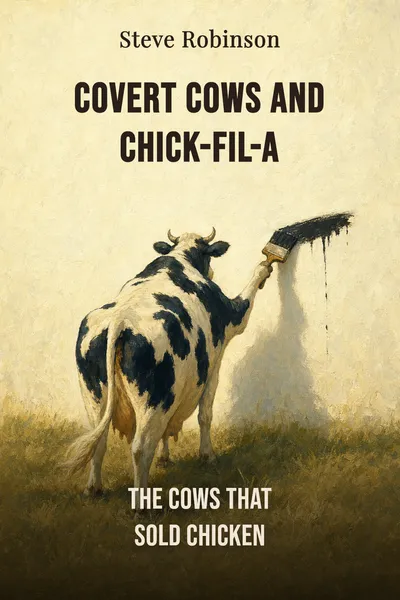
Covert Cows and Chick-fil-A
The cows that sold chicken
Description
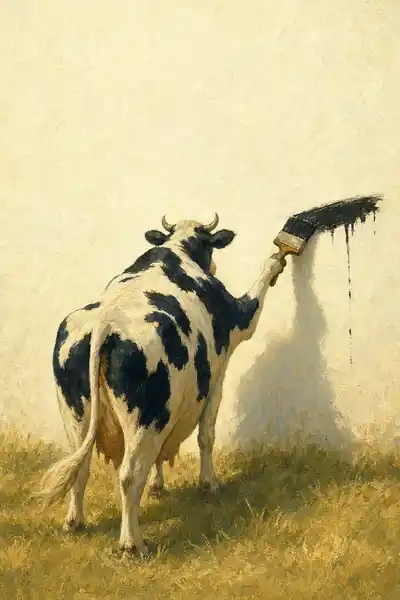
In 1995, a single billboard went up in Atlanta showing two black-and-white Holstein cows, one perched on the other's shoulders, painting four misspelled words in dripping letters: "EAT MOR CHIKIN." There was no chicken sandwich pictured, no price, no restaurant in the frame. The brand name sat small in the corner. By the standards of fast-food advertising at the time — where rivals spent fortunes filming glistening burgers under studio lights — it looked almost like a mistake. It wasn't. The cows had a clear, slightly absurd motive: if Americans ate more chicken, fewer of them would be eaten.
Behind that billboard was a chain that did almost everything the industry said you shouldn't. Chick-fil-A closed every Sunday, which meant surrendering one of the busiest sales days of the week. It refused, for years, to spend the way McDonald's or Burger King spent. And it handed the heart of its advertising to a herd of self-interested cattle who couldn't spell. Steve Robinson, the company's chief marketing officer for nearly thirty years, was in the room for most of those decisions, and his account of them is the spine of "Covert Cows and Chick-fil-A."
The cows became one of the most recognized advertising campaigns in America, running for more than two decades. But the more interesting story is what was underneath the joke — why a family-owned chicken company in the South kept betting against the conventional wisdom of its own industry, and kept winning. Robinson tells it from the inside, as the person whose job was to translate the founder's convictions into things people would actually find funny, and remember.
The question we’re asking : How did a chicken chain build one of the most beloved brands in America by ignoring nearly every rule of fast-food marketing?What we’ll see : How a self-interested herd of cattle, a closed Sunday, and a stubborn idea about purpose added up to a brand people defended like a friend.
Table of contents
01 Chapter 1 — A typo on a billboard that nobody fixed
The cows arrived almost by accident. Chick-fil-A's agency, The Richards Group in Dallas, had been asked to dress up a three-dimensional billboard — the kind with figures climbing out of the frame. Someone sketched a cow with a paintbrush, scrawling a plea to spare its own life by redirecting appetites toward poultry. The misspelling was deliberate: cows, the logic went, would not be strong spellers. Robinson and his team looked at the rough idea and recognized something the polished food photography never gave them. It was funny, it was strange, and it made you do a small double take to get the joke.
That double take was the whole point. Robinson describes the realization that the cows worked precisely because they didn't behave like advertising. They never claimed the food was delicious. They never showed a sandwich. They simply lobbied, in their crooked handwriting, for their own survival, and let the audience connect the dots. A brand that talked about itself less ended up being talked about more. The campaign launched on outdoor boards first, where the cows could be rationed out across a city like a running gag the public slowly let into the joke.

02 Chapter 2 — The cow logic of a brand that refused to sound corporate
The deeper bet behind the cows was a theory about how a small advertiser should fight much larger ones. Chick-fil-A could not outspend the burger chains, and Robinson knew it. McDonald's and Burger King poured money into national television, blanketing the country with reach Chick-fil-A simply could not afford. So the company chose a different weapon entirely: a brand character so distinct and so consistent that a fraction of the spending could buy a disproportionate share of attention. Memorability, not volume, became the lever.
That meant discipline. The cows always sounded like cows — gleeful, scheming, grammatically hopeless. They never broke character to deliver a corporate message about quality or value. Robinson describes resisting the constant temptation to make the cows "say something useful," because the moment they stopped being a joke and started being a salesman, they would lose the audience's affection. The restraint was the strategy. The brand was willing to be liked first and persuasive second, trusting that affection would do the selling on its own.
03 Chapter 3 — Sunday closed, drive-through full
No decision tested the theory harder than the closed Sunday. Truett Cathy had shut his first restaurant on Sundays from the beginning, partly out of religious conviction and partly because he believed people, including himself, needed a day to rest. As Chick-fil-A grew into shopping malls and then freestanding stores, that policy became a standing argument with landlords, analysts, and anyone who looked at the math. Closing one day in seven meant forfeiting roughly a seventh of possible sales in a brutally thin-margin business.
By the usual logic it should have been a liability. Robinson's account is that it quietly became an asset. The closed sign on Sunday told customers something a campaign never could: that this company would leave money on the table for a principle, which made every other claim it made more believable. Employees got a guaranteed day off in an industry notorious for grinding people down, which fed back into the service culture that the cows were implicitly advertising. The constraint and the brand reinforced each other.
04 Chapter 4 — The thing the cows were actually selling
Step back from the herd and a larger idea comes into focus, the one Robinson keeps circling. A brand, in his telling, is not what a company says about itself. It is the accumulated impression left by everything a company actually does, and advertising can only ever be a small, honest sample of that. The cows worked because they sampled something real. A chain that genuinely chose principle over a day's revenue could credibly run an ad that chose charm over a hard sell. The two moves came from the same place.
This reframes the marketer's job in a way that runs against the industry's instinct. Robinson's chief task was less to invent persuasion than to protect alignment — to make sure the public face of Chick-fil-A never wrote a check its operations couldn't cash. The temptation in any growing company is to let marketing outrun the substance, to promise warmth the drive-through doesn't deliver, to claim values the spreadsheet quietly overrides. The cows survived for two decades because the company behind them kept being the company the cows implied.
05 Conclusion
The cows kept painting their misspelled plea for more than two decades, climbing billboards and water towers, surviving long enough to become a piece of American advertising folklore. They never showed a sandwich, never quoted a price, never abandoned the conceit that they were lobbying for their own lives. And the chicken company they fronted grew, restaurant by restaurant and closed Sunday by closed Sunday, into one of the most successful and most genuinely liked brands in the country — without doing most of what its industry insisted was required.
Related books